Is your young patient's smile on track?
4
minute read
•
August 14, 2026
Key Takeaways
- Every child has a dental age: A child’s teeth might develop faster or slower than expected for their actual age.
- Dental age adds an objective benchmark: Dental age benchmarking in Second Opinion gives dentists another data point to evaluate tooth development and support treatment planning.
- Timing can influence treatment decisions: Understanding where a child is developmentally can help clinicians determine whether to treat a primary tooth now or allow it to exfoliate naturally.
- Objective benchmarks can strengthen patient conversations: Showing families where a child’s dental development falls can make recommendations easier to understand and explain.
- Back-to-school visits are an opportunity to check development: As families prepare for a new school year, dental appointments can be a natural moment to look beyond cavities and assess whether a child’s dental development is progressing as expected.
Everyone has heard some version of the pediatrician's growth chart talk: height percentile, weight percentile, developmental milestones — all meant to answer the same question from parents, “Is my child on track?” Teeth have their own parameter to answer that question, but most people — dentists included — have yet to hear it framed that way.
Kids visit the dentist more consistently than almost any other age group; 87% of children see a dentist at least annually, compared to about two-thirds of adults. And much of those visits are spent tracking how a child's mouth is developing, which teeth have erupted, which are still forming, and whether everything is progressing as expected.
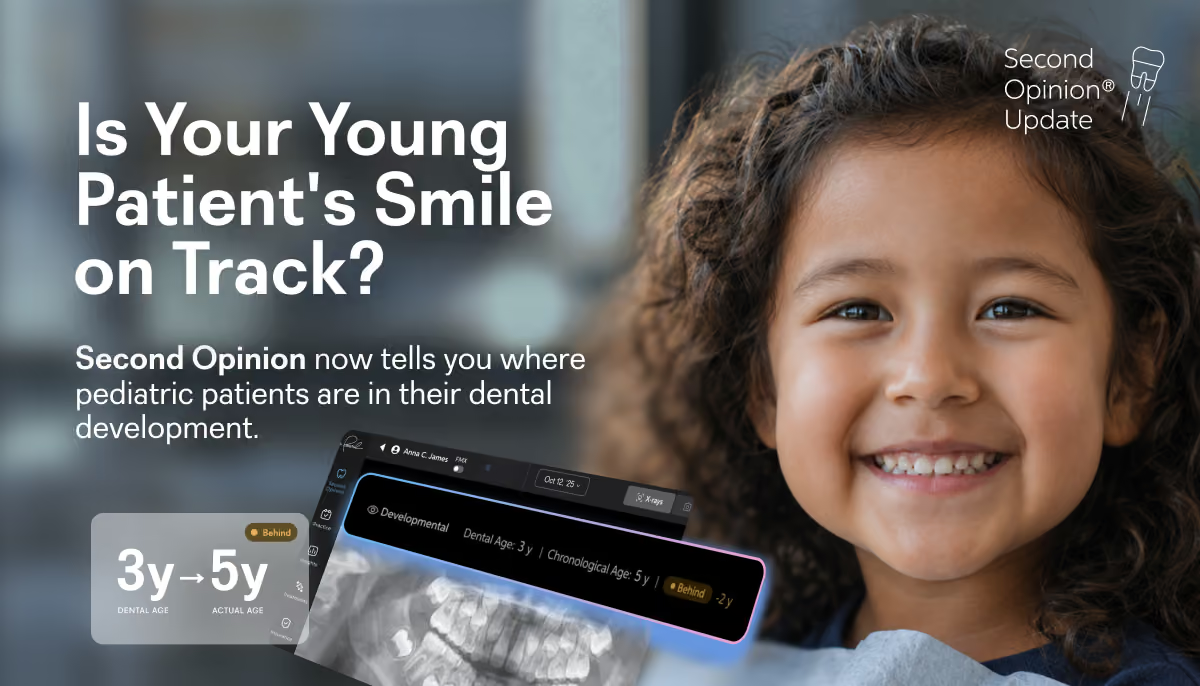
Those questions are what Pearl's new dental age benchmarking feature is built to address. Every child has two ages. There's their chronological age (how many years it's been since they were born) and their dental age, which reflects how far their teeth have actually developed. Often, those ages closely align. But some children develop months or even years earlier or later than their peers, and that difference can influence treatment decisions.
Built into Second Opinion, dental age benchmarking analyzes a child's x-ray and instantly evaluates a child's tooth development against expected norms for their age. Instead of relying solely on visual estimation, dentists have an objective benchmark to support treatment planning and conversations with families. It’s yet another data point available right in the operatory, giving clinicians another way to craft their care with patients always at the center.
We spoke with Dr. Gregory Wu, a general dentist, and Dr. Jerry Swee, a pediatric dentist, both of the multi-specialty practice Emerson Dental, about what such a tool means in practice, and why back-to-school season is the perfect time to put it into use.
Why Dental Age Isn’t Always Easy to Judge
A pediatric dentist looks at tooth development all day. Ask Dr. Swee to glance at a panoramic x-ray and say whether a child is ahead of or behind schedule, and he'll usually know right away. Ask a general dentist the same question, and it's probably a different story.
"If you showed me an x-ray of a kid and said she's 13 years old, I wouldn't necessarily know if they're developmentally on track or not," Dr. Wu said. "I think I speak for most general dentists that they don't necessarily look at that, but a pediatric dentist does."
This isn't a gap in expertise so much as a difference in specialization. Pediatric dentists evaluate tooth development every day, while general dentists divide their attention across patients of all ages. That's where dental age benchmarking fits in. Rather than replacing clinical judgment, it gives every dentist another objective data point to support treatment planning and deepen patient conversations.
Dr. Wu put it simply: "It's another tool to make us better clinicians."
A Small Different Can Change Treatment
For pediatric dentists, knowing a child's dental age can directly affect treatment decisions. Dr. Swee described a common scenario: a baby tooth that's right at the decision point between letting it fall out naturally and treating it now. "There's a time where it's borderline, do we treat it or do we just let it naturally fall out?" Dr. Swee said.
If the tooth is close to exfoliating on its own, a simpler option like silver diamine fluoride (SDF) may be enough to stabilize it. But if the child's dental development is running behind schedule and that same tooth still has years left to serve, a more durable treatment, such as a stainless steel crown, may be the better choice.
Dental age benchmarking gives dentists an objective reference point to support those decisions, helping them explain not just what they're recommending, but why it's the right choice for that child.
Just as importantly, it changes how dentists communicate with parents. But Dr. Swee is careful to frame "behind schedule" as normal variation, not a problem. "It's just a bell curve, and most people land here," he said. "It doesn't mean there's no outliers...It doesn't mean you're abnormal."
However, with an objective benchmark in hand, that conversation becomes much easier. "This tooth normally comes up at six, it's gonna come up probably closer to seven, and so we do need to treat this tooth," Dr. Swee said, describing how he'd explain it to a parent. "If this tooth was up higher, we would be okay, but it's not."
Instead of relying on broad explanations, dentists can show parents where their child's development falls and explain how that timing influences the treatment recommendation. The result is a more informed conversation, and one that's often easier for families to understand and trust.
Dental age benchmarking also reflects a broader shift in what AI can offer dentistry. Until recently, most dental AI has focused on detecting disease. But when AI is trained on millions of radiographs, it can also establish population benchmarks that help clinicians understand how an individual patient compares to peers.
That's the distinction between chronological age and dental age. Two children may both be 10 years old, but their teeth may be developing on very different timelines. By comparing a patient's tooth development against large-scale normative data, dental age benchmarking provides an objective measure of dental maturity that can support orthodontic planning, guide treatment timing, and help identify developmental differences earlier. Rather than replacing clinical judgment, it gives dentists another evidence-based reference for making more personalized decisions.
The same objective benchmark gained from this feature is also valuable beyond the operatory. Dr. Wu pointed to insurance appeals as one example. Some dental plans only cover preventive treatments like sealants until a certain age. If a child's teeth are developing later than average, dental age benchmarking gives practices objective evidence to help explain why additional coverage may be appropriate. "It could be used as a tool to fight a rejection," Dr. Wu said. "This is her age, they're like a whole year behind, you should give me a whole extra year."
Why This Matters For Back-to-School
Back-to-school season is one of the busiest times of year for pediatric dental visits. Families are checking off physicals, vaccinations, and dental appointments before classes begin, making it a natural moment to look beyond cavities and ask broader questions, such as “Is my child's development on track?”
The stakes start early. By ages 6 to 9, roughly half of children have already experienced a cavity, filling, or missing tooth, according to the CDC. Additionally, untreated dental disease is linked to an estimated 34 million lost school hours each year.
While Dr. Swee points out that decay doesn't follow the school calendar ("I think decay shows up whenever it shows up," he said), back-to-school visits often become one of the more reliable moments to check in on a child’s overall development. Dr. Wu sees back-to-school appointments as a natural opportunity to evaluate more than just cavities. Along with checking oral health, dentists can also assess whether a child's dental development is progressing as expected and help families better understand what comes next.
Like all of Pearl’s tools, dental age benchmarking doesn't replace a dentist's judgment, but it gives a clinician’s answer more precision. For general dentists, it offers an objective reference for evaluating development. For pediatric dentists, it provides another data point to guide treatment planning and easily explain recommendations to patients. And for parents, it turns questions about their kid’s development into clear answers.

About the author
Sheela Roth is a veteran dental practice management expert, thought leader and public speaker. As Head of Clinical Education for the dental AI company Pearl, Ms. Roth is responsible for developing and delivering strategic training programs that educate dental offices, staff and partners on AI and its successful application in dentistry. Previously, Ms. Roth founded and led the practice management consultancy Absolute Dental Business Solutions. She earned her BS and RDH from Loma Linda University..