What AI and x-rays just told us about American teeth
5
minute read
•
July 7, 2026
Key Takeaways
- The Pearl Oral Health Index reveals what traditional measures have missed: National estimates based primarily on visual exams have not included the disease that dental x-rays can reveal. By analyzing millions of x-rays with AI, Pearl's Oral Health Index reveals a significantly larger burden of untreated decay and provides a new view of oral health at population scale.
- The findings validate the importance of combining radiographs with AI to uncover hidden disease: By detecting early and otherwise invisible decay, AI helps quantify the conditions that traditional surveys were not designed to capture.
- Where patients live and receive care shapes oral health outcomes: The data shows differences in tooth loss based on dental access and meaningful variation in untreated disease rates between practices within the same communities.
- Better measurement creates better opportunities for action: A clearer understanding of oral health patterns can help clinicians, researchers, and policymakers develop more targeted approaches to improving care.
For the past several decades, the best available estimate of how many American adults have untreated tooth decay has hovered around one in five. That number, from the National Health and Nutrition Examination Survey (NHANES), is cited by dentists, educators and policymakers. The Healthy People 2030 initiative built its national targets on it.
That number is incomplete, because it has always left out a fundamental part of dental exams: x-rays.
The CDC’s flagship population health survey relies only on visual exams of about 25,000 people per cycle. Radiographs aren’t included, because radiographing tens of thousands of research volunteers raises ethics and consent questions a population survey isn't designed to answer. But radiographs illuminate pathologies that are undetectable to the human eye, like interproximal decay, early lesions, or disease beginning under existing restorations. That’s why we use both in clinical practice, because each one sees things the other cannot.
As a radiologic AI company, Pearl has collected and anonymized the x-rays of not thousands, but millions of patients, and we wondered: How does the picture of oral health in America change when you include radiographs as analyzed by AI?
Testing the method
The Pearl Oral Health Index, the first-ever radiologic census of the American mouth, finds that the share of American adults with untreated decay is not roughly one in five, as officially reported. By our measurement, it is closer to nine in ten.
Before considering that dramatic difference, it's worth looking at how Pearl performs on a measure where we already know the answer. One way to evaluate Pearl's methodology is to compare it against an outcome that can be independently verified: missing teeth.
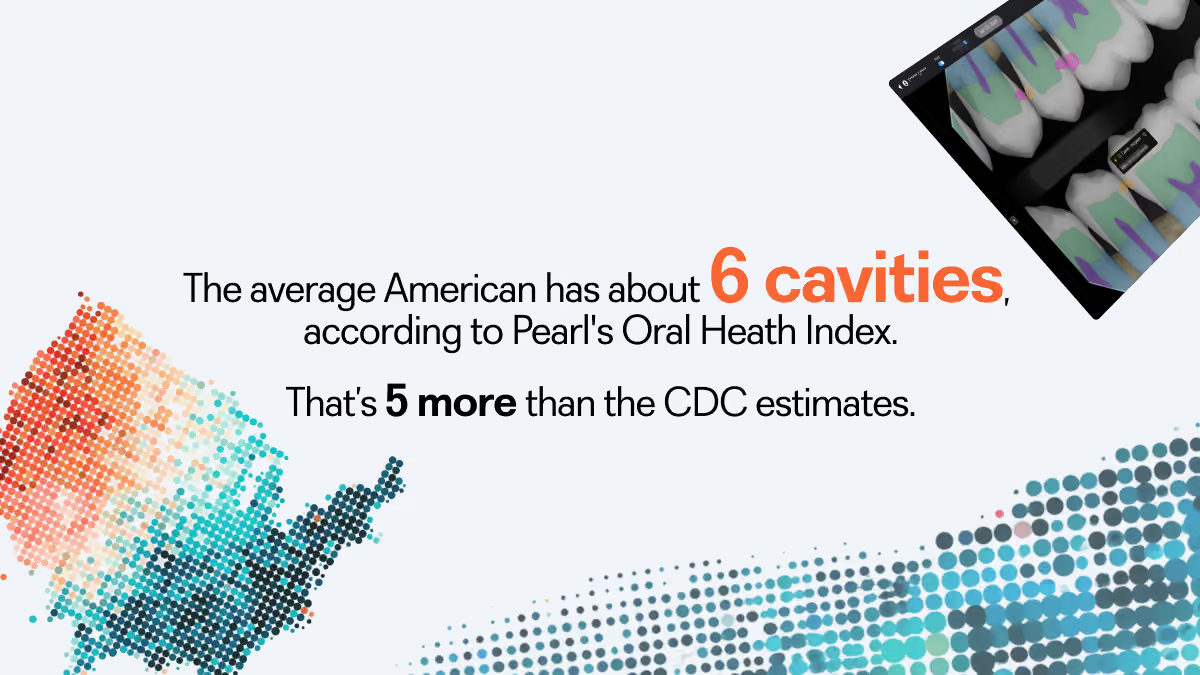
Here, Pearl’s findings align closely with the federal data. Where NHANES finds 2.0 missing teeth on average, Pearl finds 2.16. That close agreement is important to establish as it supports the validity of Pearl’s methodology before we turn to the much larger difference in decay. Here, Pearl finds 6.07 per patient. NHANES manual review finds 0.7.
By including AI-driven radiography analysis, Pearl detects not just obvious, cavitated lesions, but also incipient decay that may not be visible to the naked eye. That’s what makes the Oral Health Index so powerful. It uncovers the early, reversible disease that is impractical to count through visual exams alone, and therefore has remained invisible in national estimates.
It is important to note that this is a best-case scenario that includes only patients who have visited the dentist and gotten x-rays. People without dental care could not be included in the study, meaning the true number is almost certainly worse.
This is the first thing the data reveals: a disease burden substantially larger than what public health infrastructure has been able to see.
What the data reveals
The data also shows two other things that may matter just as much for practicing clinicians.
The first is geography, and the way it shapes outcomes in ways that have nothing to do with how sick a community is. In the 25 U.S. zip codes with no resident dentists, about 21 percent of teeth are extracted. In zip codes with more than 50 dentists, that figure is just under 15 percent. The disease burden in those underserved zip codes is similar to everywhere else, but when a dentist isn't nearby, the tooth comes out.
The second involves practice-level variation. Across 937 zip codes where Pearl could compare two or more dental offices, each seeing at least 100 adult patients, the typical difference in untreated decay rates between offices in the same community was 9.2 percentage points. In the top 10 percent of zip codes, that spread was nearly 18 points. The same AI model read every x-ray. What varied was how practices responded to what it found.
This is not evidence that some dentists are better than others. Clinical judgment is complex, patient circumstances differ, and treatment decisions involve conversations and context that no dataset captures. What it does suggest is that the way we have historically measured oral health — nationally, periodically, by visual exam — has made this kind of variation essentially invisible. We have not had the resolution to see it. Now, in some sense, we do.
What better measurement makes possible
Healthy People 2030 declared its goal of reducing untreated adult decay to 22 percent essentially achieved. That target was met, on the numbers. If the actual prevalence is closer to 95 percent among patients in dental chairs, then the target was calibrated to a denominator we had never fully measured. We weren't failing to make progress. We were making progress on a fraction of the problem while not knowing the rest of it existed.
What changes when the measurement changes? At minimum, the conversation does. A practicing dentist who knows that 52 percent of dental disease in patients aged 18 to 24 is currently untreated may think differently about how aggressively to pursue that population. A policymaker who knows that a patient's zip code affects whether their tooth gets restored or extracted may ask a different set of questions about where to direct resources. A researcher who knows that practice-level variation in untreated decay rates can span 45 percentage points within a single community has a different hypothesis about where care quality improvement should start.
None of that is an answer. The data Pearl has published is a picture of the care-engaged population at a particular moment, with the limitations that come with that. It cannot tell us what would improve outcomes. It cannot speak to the patients who never come in. It is the beginning of a kind of population-scale oral health intelligence that has not existed before, not the end of one.
Dentistry has always known that what it could measure and what was actually there were two different things. Every clinician who has taken a radiograph after a clean visual exam and found decay knows this. What changes now is scale. For the first time, that gap isn't anecdotal — it's quantified, mapped, and reproducible. That is not a problem to solve so much as a foundation to build on.
About the author
Dr. Mike Barniv brings a wealth of dental experience from over two decades in full-time private practice to his role as Vice President of Clinical Affairs at Pearl, a company leading global dental AI innovation. Before joining Pearl, Dr. Barniv served as VP at Delta Dental of Idaho, where he oversaw claims, utilization management and the strategic implementation of AI technologies. In academia, Dr. Barniv served as an assistant professor at the University of the Pacific School of Dentistry in San Francisco, CA, where he was also the director of their AEGD residency clinic. In his current position, Dr. Barniv leverages his comprehensive dental knowledge and experience in both clinical and administrative realms to enhance Pearl's commercial, clinical, and institutional endeavors. His unique perspective, combining hands-on dental practice with expertise in dental education and insurance sector innovations, positions him perfectly to advance progress toward comprehensive integration of AI across the dental category.