Dentistry’s trust problem

4
minute read
•
July 21, 2026
Key Takeaways
- Patient skepticism often stems from communication gaps: When recommendations come as a surprise, patients naturally question why treatment is needed and whether it's truly necessary.
- Clinical judgment is nuanced: Two dentists can reach different, evidence-based conclusions from the same x-ray because treatment decisions depend on the whole patient—not just a single image.
- Insurance coverage is not the same as clinical necessity: Coverage decisions reflect payer policies, while treatment recommendations should be based on what's best for the patient's health.
- AI doesn't diagnose or prescribe treatment: Tools like Pearl help surface clinical findings and improve patient understanding, but diagnosis and treatment decisions remain the responsibility of the dentist.
- Clear visual communication builds trust: When patients can see and understand what their dentist sees, they're better equipped to participate confidently in decisions about their oral health.
One of the most common things I’ve heard from patients as a public health dentist is, "Nobody has ever told me I needed that before."
Sometimes they're talking about a condition they’ve never heard of or a recommendation for a filling they didn't expect. Whatever the issue, the conversation follows a familiar pattern: the patient is surprised, and I’m surprised (and sad) that the patient is surprised.
Their surprise is often followed by a variety of questions: Why am I being told I need this now? Why hasn’t anyone mentioned this before? How do I know this recommendation is actually necessary? They’re all fair. And they point to something we’ve struggled with long before AI entered the chat: the gap between what clinicians see and patients experience.
Most patients base their oral health on feeling. If nothing hurts and they can eat comfortably, and if they're brushing and flossing regularly, they should have every reason to believe their mouth is healthy. As dentists, we’re trained to look beyond those parameters. We evaluate radiographs, periodontal measurements, signs of inflammation, and changes that develop over time. We look for disease before it becomes painful, expensive, or difficult to treat.
This isn’t unique to dentistry. Medicine is filled with judgment calls. When diagnosing and treating cancer, oncologists disagree. Patients get second opinions. Tumor boards convene to debate on the best course of action. Healthcare is grounded in science, of course, but it is not an exact mathematical equation with a single answer. It’s an ever-evolving, evidence-based practice.
Despite our tendency to take oral health a little less seriously, dentistry is no different.
Two dentists may look at the same x-ray and recommend different approaches, each completely reasonable. I might decide to monitor rather than treat a small area of decay in a patient who routinely visits every six months, maintains good home care, and has a stable history. Another dentist might decide to treat that patient in hopes of preventing future issues. In a patient who hasn’t been seen in years and has extensive decay, both of us might recommend immediate treatment. The x-rays may be identical, but the patients aren’t — and their care plans shouldn’t be either.
This complexity is even harder to navigate when cost enters the conversation. Dental care can take time and money, and sometimes a lot of it. When a procedure isn't covered by insurance, it can feel to patients like a confirmation that their dentist is recommending something unnecessary. But insurance coverage doesn’t reflect clinical need. Insurance providers determine what they'll pay for based on their own incentives. Dentists decide what we believe is appropriate for a patient's health.
This is recently where AI, as a new technology, tends to absorb some of the blame. In Joanna Stern’s recent book, “I Am Not A Robot: My Year Using AI to Do (Almost) Everything,” she raises the concern that AI is driving dentists to upsell patients on needless—and costly—treatments. That may sometimes be true, but it’s critical to note that good dentistry practices are the responsibility of the dentist. The truth is that any tool can be used irresponsibly. That’s why it’s important to understand what value AI is meant to add.
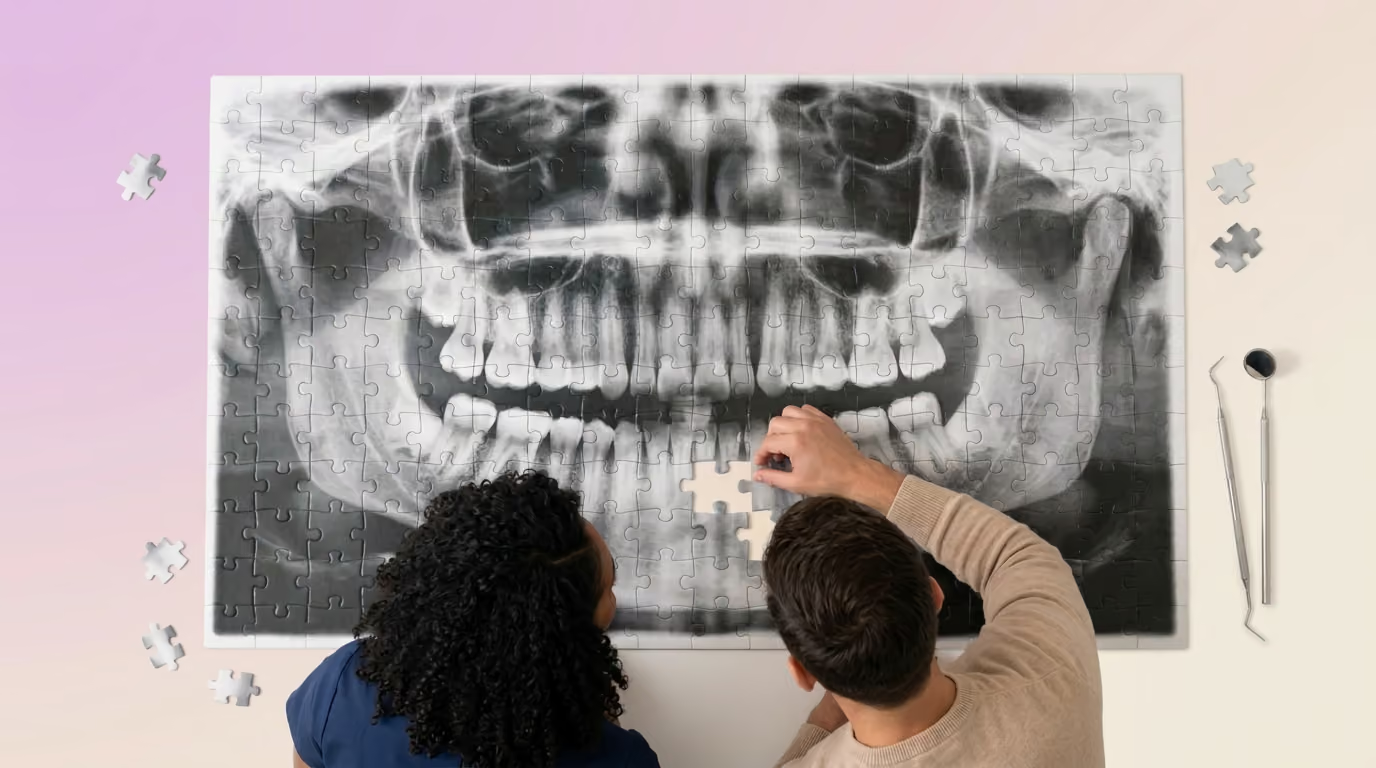
We rely on x-rays, periodontal probes, clinical examinations, sensitivity tests, and more to gather information. Pearl’s suite is yet another tool that requires the context of a patient’s overall health, history, and circumstance. What it doesn’t do is diagnose patients, recommend treatment, or replace clinical judgment. Those decisions belong to the dentist, as they always have. Excellent dentistry is about assembling each tool or source of information into the larger clinical puzzle, all in service of ensuring relevant information is visible and clearly communicated to improve patient care. It’s about looking at a single tooth in the context of not only the oral cavity, but also the person themselves. The more information at our disposal, the better decision we can make.
I cannot count the number of times a patient has moved from confusion to confidence after simply being shown what I was seeing and given the opportunity to ask questions. I didn’t try to persuade or sell them on treatment; they simply had all the resources they needed to make an informed decision. Educating our patients is the single most important part of our jobs as dentists if our goal is bettering the oral health of our community.
Using tools like Pearl responsibly, we make these conversations easier, scraping away the misunderstandings that have built up like plaque between clinicians and patients, and offering patients the clarity they deserve for real engagement in their oral health to take root.
About the author