
Patients over paperwork: how Voice AI returns focus to clinicians

4
minute read
•
April 23, 2026
Key Takeaways
- Documentation eats up to an hour of a dentist’s day: Dr. Sarah Schumacher, Pearl’s Director of Clinical AI, built Voice after experiencing the documentation burden firsthand as a practicing clinician.
- Template notes are a good start, but only capture what stays the same: Voice combines pre-built example notes with real-time transcript data so the details that change get recorded accurately without slowing providers down.
- Perio charting wastes the most valuable person in the room: Assistants are the backbone of the practice, Sarah says. Voice handles charting hands-free so they can focus on patient care rather than punching numbers into a computer.
- Nearly 15% of claims are initially denied: Thorough documentation is the best defense. Voice captures complete, accurate records in real time so nothing is missing when it counts.
- Not all dentists work the same way: Sarah and the Pearl team designed Voice to adapt to everyone — from 30+ customizable templates to flexible charting orders.
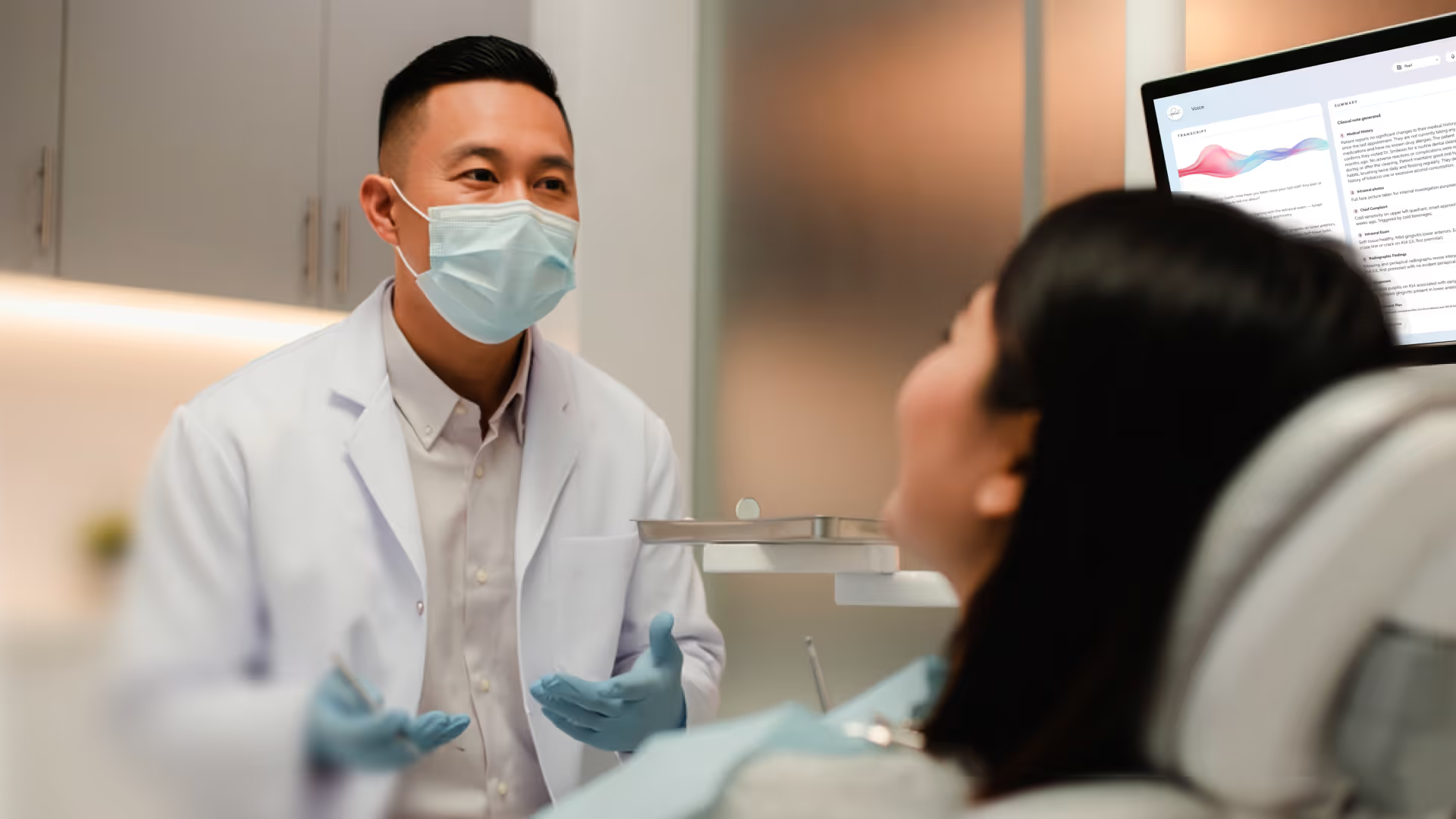
When you’re on your 20th patient of the day with three more still to go, it’s easy to lose track of all the moving parts. “You have to remember minute details, take notes and document thoroughly for each patient — there’s a lot of context switching,” says Dr. Sarah Schuhmacher, Pearl’s Director of Clinical AI.
Patients feel it too: 61% say their healthcare providers aren’t fully present during appointments. Oftentimes, the culprit is not so much the doctor as it is the paperwork.
.avif)
The tension between delivering great care and keeping up with the documentation it requires was what drove Sarah to lead the development of Pearl Voice: an AI assistant for hands-free clinical documentation and perio charting.
With years of experience across private practice, pediatric, and public health settings, Sarah brought concerns from the operatory directly into the product. We talked with her about dentistry’s documentation burden, how her time chairside shaped Voice, and what it means to build technology that puts patients, not paperwork, first.
Given everything a dentist juggles during the day, how much time would you spend after hours catching up on documentation?
Up to an hour, for sure. It's not acceptable to be lax on the quality of your documentation because you're tired or want to go home. If it's not in your note, it didn't happen.
Sometimes it goes smoothly, if it was a mild day…but sometimes you see a patient's name and you're like “I can't even remember what we talked about. That was four hours ago.”
With Voice, you just have a conversation with the patient and it's documented for you. You're not going to miss out on important things — patient's concerns, pros and cons, risks — that need to be documented. Patients want to be remembered and feel important, and they should because they are, and Voice helps balance the fact that it's impossible to do that 100% with every patient, every time.
Poor dental record-keeping persists industry-wide due to a lack of consistent guidelines, lax documentation and bad tech, according to recent research . Where did you see the biggest breakdown in documentation, and which Voice feature do you think will solve it?
Lots of providers use template notes right now. Often, a procedure is the same every time: the tooth, surface, and shade change, but most steps and techniques stay the same. That's why we put example notes into Voice, so that you could have that same pre-populated feel. But templates are only as good as the person filling them in, and when you're flying through your day, things get missed or left inaccurate.
Voice lets you pull from both the transcript and example note, so the variables that change get captured in real time. You then have more accuracy while also maintaining speed.
You can't sacrifice the quality of care you're giving a patient, so that time-sacrifice comes from other places. At the end of the day when you’re mentally drained, your notes might suffer. Voice, with its 30+ customizable templates, helps make up for that.
Perio charting is traditionally a manual, two-person process, with the clinician calling out measurements while an assistant records them. In your experience, what were the biggest pain points?
The waste of talent. The assistant sits there punching numbers into a computer when they’re far more qualified to do other things. Our assistants are the backbone of the practice. There are so many aspects of dentistry that will never be achievable by AI: especially the human aspect of taking care of people, of each other. But recording numbers? Let the computer do that so the assistant can do the more important, patient-centered care.
Nearly 15% of claims submitted to private payers are initially denied, in part because every payer has its own documentation requirements. What’s it like to navigate that inconsistency, and how do you see Voice shifting that experience for providers?
The best thing you can do is have the most complete documentation possible. You don't want to have an SRP denied because your perio chart was incomplete, or you didn't record GM when the GM was zero, and you could have just said, “Zero, zero, zero, repeat all” using Voice. If we can make it easier to maintain complete, thorough records, it helps everybody involved.
As a clinician, what was the most surprising or exciting part about developing this product?
The most exciting part was implementing the example notes. Being able to add crucial components to the note without the slog of dictating all of it feels like the unlock that takes Pearl Voice from promising to must-have.
It was surprising how many people asked me for different orders in perio charting. In my head, I'm thinking "everyone does it this way.." Other dentists say, "No, this is the right way,” or "I'm left-handed and I do it this way." We have to be able to serve people in their own practices because dentists aren't standardized. 9 out of 10 dentists agree that we never agree with each other. This tool was designed to be helpful for everyone.
What do you see Voice adding to the Pearl platform?
Dentistry's hard. You're doing really complicated procedures in a tiny wet cave on a moving human who experiences fear, pain, and exhaustion. I want to make sure that we're only helping the workflow, not disrupting it.
We're building a well-rounded experience for dentists and hygienists with the goal of improving patient care. Coming from public health, I feel very strongly about the ethics of dentistry and the importance of very compassionate patient care. With all the talk of how scary AI is, it’s cool that in our little section of it, we're trying really hard to always work for the good of human beings.
About the author
Nick Garrison is an experienced marketer, communications leader and multidisciplinary creative. He is the Vice President of Marketing at Pearl, an AI company specializing in diagnostic and business analytics solutions for the dental industry. Prior to joining Pearl, Mr. Garrison led communications for the Santa Monica-based adtech start-up GumGum. Earlier in his career, Mr. Garrison worked as a screenwriter and producer, before leaving Hollywood to found and lead a successful college and graduate school admissions consultancy. He received his bachelor’s degree from Harvard University.