AI in Dentistry: Unpacking the Upsell Question
4
minute read
•
May 22, 2026
It’s a story almost as old as dentistry itself. A patient goes in for a check-up, gets x-rays and leaves wondering if their dentist’s recommended treatment is really necessary.
That old story recently made tech headlines when author (and former WSJ tech reporter) Joanna Stern introduced a new character on the New York Times podcast Hard Fork. It was dental AI.
Joanna’s story is deeply relatable. Her AI-enhanced x-rays “showed I have a lot of plaque buildup,” but the recommended four-part periodontal treatment didn’t track. “I’ve never needed this before,” she told podcast host Casey Newton. “My teeth really aren’t bothering me.”
The conversation that followed, though ostensibly about AI, was really about something else: the mistrust stoked by clinical disagreement. Joanna integrated the experience into her new book, “I Am Not A Robot: My Year Using AI to Do (Almost) Everything,” and got a second, third, and fourth opinion from dentists who agreed a little home care would do the trick for her plaque. She ends her anecdote by concluding that practices “are using AI to try to upsell you on dental procedures.”
That conclusion is shining a light on two underlying problems that those of us in the dental industry have long understood:
- Dentists often disagree
- Preventive care is undervalued
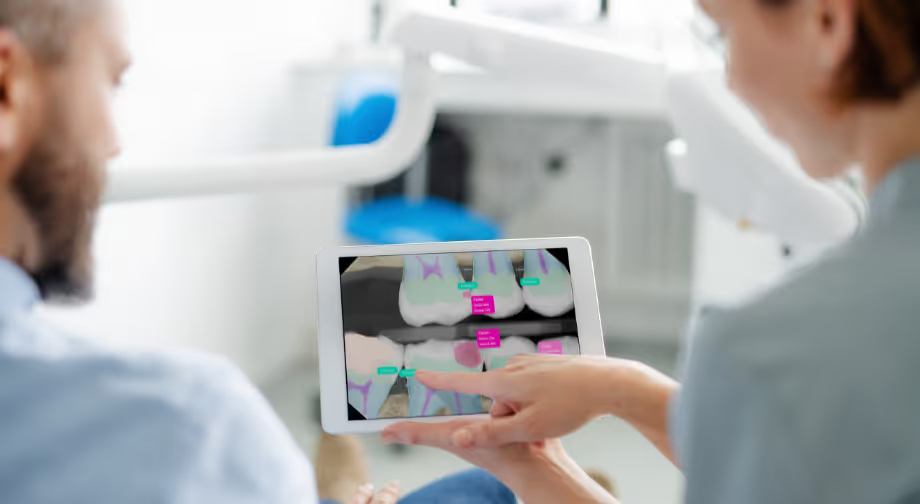
It’s noteworthy here that the clinicians didn’t disagree with Pearl’s x-ray analysis or the diagnosis. There is plaque. Pearl detected it, and thanks to our colored, labelled overlays, Joanna saw it too. The dentists simply disagreed on how to treat it.
That disagreement points to a broader challenge in dentistry that has nothing to do with AI as a diagnostic aid: Clinicians are often treating conditions patients cannot yet feel themselves. Oral disease often develops gradually and asymptomatically, creating a gap between what dentists see and what patients perceive and therefore prioritize. In that gap, even preventive recommendations can feel subjective, unnecessary, or financially motivated.
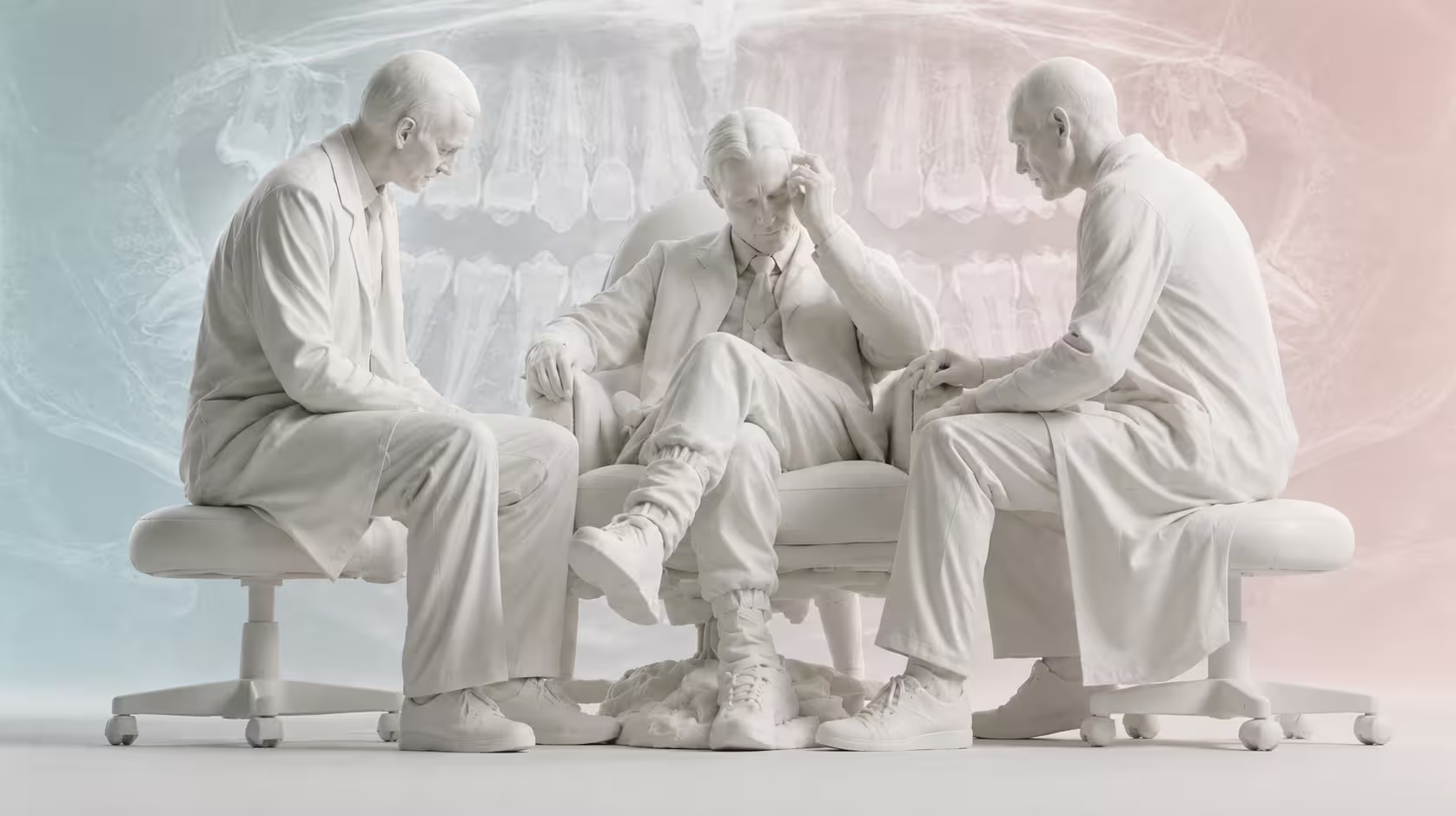
As the son of a dentist myself, I started Pearl to help solve the problems of diagnostic concurrence and treatment presentation. A few years ago, we asked 136 dentists to review 11 x-rays and measured how often they agreed. There was never unanimous agreement, and dentists agreed on any given pathology less than 50% of the time.
With data like that, and her own experience, Joanna’s reaction is understandable. Like our eyes, our liver, or our heart, we often don’t think about our teeth and gums until they start to fail us. But preventive options exist precisely because many oral health issues become more painful and invasive, not to mention more expensive, once symptoms appear.
Unfortunately, dentistry isn’t considered part of the core medical establishment. It has separate associations, schools, and insurance plans. But oral health is systemic health. Systemic disease can manifest itself first in our mouths. Diabetes, for example, worsens periodontal disease, and periodontal inflammation worsens glycemic control. Gingival bleeding and chin numbness can indicate certain kinds of cancers. Both can be painful, obvious, and caught early during routine dental exams.
But unlike other areas of healthcare, where earlier and earlier detection, now often powered by AI, is praised, dental prevention is often met with skepticism. Patients today are voluntarily paying extra for AI systems to analyze their x-rays for breast cancer and other diseases, and yet when a dentist invests in these solutions and offers them as part of a standard visit, patients’ first thought - like Joanna’s - is, This must be a mistake.
Our radiologic AI is FDA-cleared and, as proven by a third-party UCLA study, 94% accurate in detecting dental caries. However, the FDA and Pearl itself are very clear that our AI does not diagnose. That is the sole prerogative of the dentist. What Pearl’s AI does is flag areas of concern for review, and it does that exceedingly well.
AI like Pearl’s can detect early decay, and decay between teeth that can’t be seen by the naked eye, and can calculate bone decay to fractions of a millimeter. In the hands of a conscientious dentist, that kind of focus saves teeth and preserves a patient’s overall health. Our colorful illuminations make clearer to patients when and where treatment is needed. Joanna herself acknowledged, “It’s very easy to see the cavities.”.
Clinical disagreement will always exist in dentistry, just as it does throughout medicine. We literally named our product Second Opinion. But patients should never feel excluded from the diagnostic conversation, and that’s really one of the most positive outcomes of Joanna’s experience. She was empowered with information to go ask additional questions and make a determination alongside her dentist(s) as to the best course of treatment.
We built Pearl not to replace judgment, but to help make dental conditions easier to see, explain, and understand. In a field where so much disease progresses silently, better visibility leads to better conversations – and better conversations are where trust begins.
About the author
Ophir Tanz is an award-winning entrepreneur and technologist. He is the founder and CEO of Pearl, an AI company focused on solving fundamental problems in the dental industry. Previously, Ophir founded and led GumGum to several hundred million dollars in global revenue by applying computer vision machine learning to drive and measure value for the digital media and sports sponsorship industries. Ophir earned a bachelor’s and master’s degree at Carnegie Mellon University. An established member of the Los Angeles startup community, Ophir actively advises and invests in startups and, in 2017, was named one of Goldman Sachs’ 100 Most Intriguing Entrepreneurs.