Alveoloplasty dental code: What dentists need to know
5
minute read
•
October 13, 2026
Key Takeaways
- Alveoloplasty uses D7310, D7311, D7320, or D7321, all billed per quadrant.
- D7310 and D7311 are for alveoloplasty performed with extractions; D7320 and D7321 are for alveoloplasty without extractions.
- Within each pair, the higher-volume code covers four or more teeth or tooth spaces; the other covers one to three.
- Routine smoothing to close an extraction socket isn't separately billable; distinct ridge recontouring is.
- Coverage is most consistent when the procedure prepares the ridge for a prosthesis and is well documented.
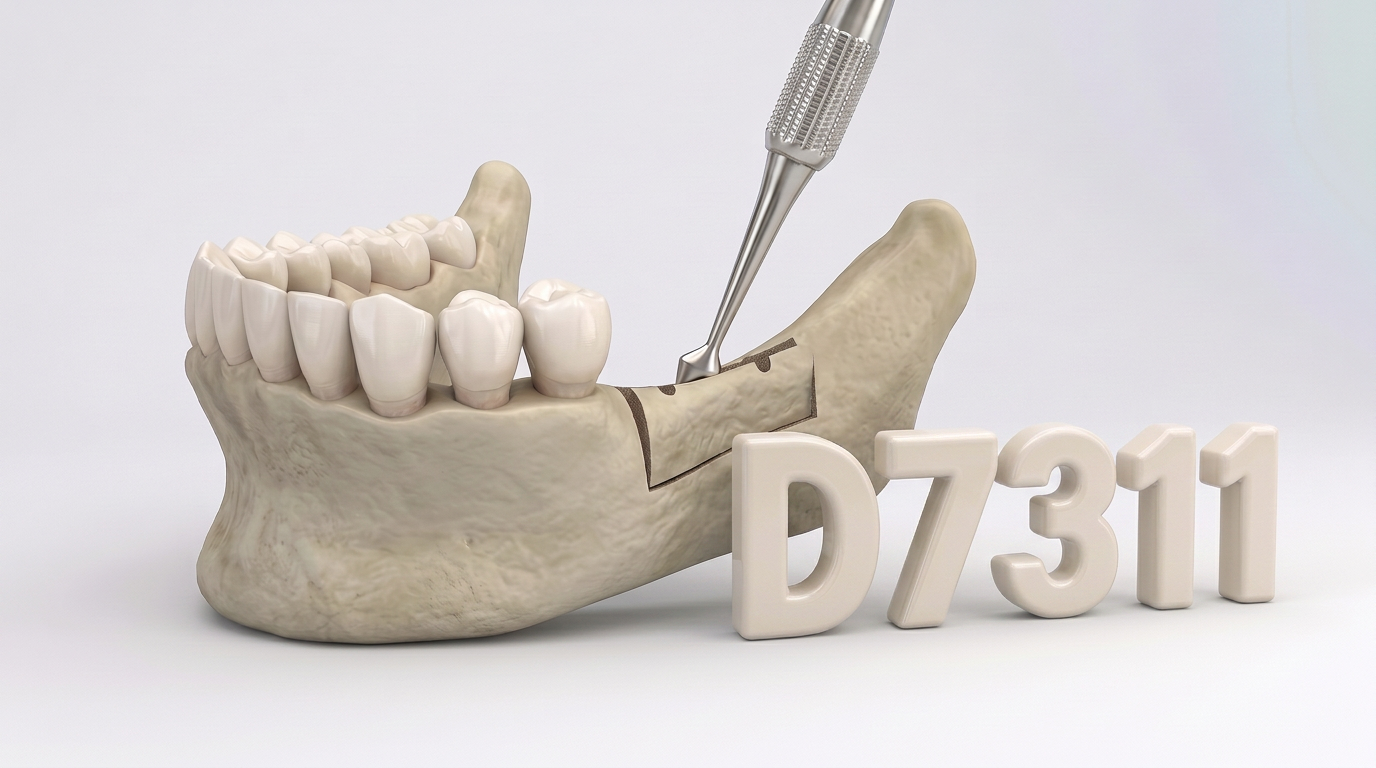
Alveoloplasty is the surgical reshaping, smoothing, or recontouring of the alveolar bone to prepare the ridge for a prosthesis, improve healing, or remove sharp bony projections that would otherwise complicate denture seating or cause discomfort. It's billed using CDT codes D7310, D7311, D7320, or D7321, depending on whether it's performed with extractions and how many teeth or tooth spaces are involved in the quadrant.
The distinction between these four codes is one of the most frequently misapplied decisions in oral and pre-prosthetic surgery billing. The correct code depends on the clinical circumstances under which the procedure is performed, not on how extensive the bone contouring itself was.
D7310, D7311, D7320, and D7321: Which alveoloplasty code applies?
The CDT library provides four alveoloplasty codes, and selecting correctly means understanding the clinical context.
D7310: In conjunction with extractions, four or more teeth or tooth spaces
D7310 applies to alveoloplasty performed with extractions involving four or more teeth or tooth spaces in a quadrant, a single surgical procedure combining extraction and ridge preparation. It's billed per quadrant, so recontouring across multiple quadrants at the same appointment needs a separate D7310 for each quadrant.
D7311: In conjunction with extractions, one to three teeth or tooth spaces
D7311 applies to alveoloplasty at the same appointment as extractions, involving one to three teeth or tooth spaces in a quadrant; the same logic as D7310 but for a smaller area. It's also billed per quadrant, with a separate code for each quadrant treated.
D7320: Not in conjunction with extractions, four or more teeth or tooth spaces
D7320 applies when alveoloplasty is a separate procedure, not at the same appointment as extractions, involving four or more teeth or tooth spaces in a quadrant.
D7321: Not in conjunction with extractions, one to three teeth or tooth spaces
D7321 applies when alveoloplasty is a separate procedure, not with extractions, involving one to three teeth or tooth spaces in a quadrant. For example, this code might be used at a healing appointment after earlier extractions or in an already-edentulous area.
The most common coding error
The most common error is confusing the "in conjunction with extractions" codes (D7310, D7311) with the "not in conjunction with extractions" codes (D7320, D7321). The second most common is ignoring the number of teeth or tooth spaces in the quadrant, which is what separates D7310 from D7311 and D7320 from D7321. Both are exactly the kind of mismatch that drives avoidable denials, so keeping the distinction clean is part of the same discipline behind any reduction in denials and better collections.
When is alveoloplasty separately billable from extractions?
One of the most practically important questions is whether bone recontouring done with extractions is a separately billable alveoloplasty or is considered incidental to the extraction.
The distinction is this: the minor smoothing of sharp bone edges that routinely accompanies an extraction, necessary to close the wound, is generally part of the extraction and not separately billable. Surgical recontouring that goes beyond closing the socket, specifically to prepare the ridge for a prosthesis, is a distinct and separately billable procedure.
To support separate billing of D7310 or D7311, the record has to describe the recontouring: the indication beyond routine wound management, the area treated, and the technique used. For D7320 and D7321, separate billability is easier to establish since there's no concurrent extraction fee, though the record still needs the indication. Getting that clinical documentation right is what keeps the claim from being bundled into the extraction fee.
Insurance coverage and pre-authorization for alveoloplasty
Alveoloplasty is typically classified as an oral surgery procedure, and coverage is most consistent when it's performed to prepare the ridge for a prosthesis and supported by documentation of clinical need.
Where it's part of a planned pre-prosthetic sequence, submitting a pre-authorization that identifies the code, the anticipated quadrant, and the indication lets you confirm coverage before treatment. The documentation that most commonly supports the claim includes clinical notes describing the ridge anatomy that indicated recontouring, pre-treatment radiographs showing the ridge condition, a surgical record describing the extent and technique, and a description of the planned prosthetic treatment the alveoloplasty is meant to facilitate.
Alveoloplasty in pre-prosthetic surgery sequences
Alveoloplasty most often occurs as part of a broader pre-prosthetic surgery sequence, whether at one appointment or across several, and coding it correctly means treating each procedure independently.
A few combinations come up repeatedly:
- Alveoloplasty with multiple extractions in preparation for an immediate complete denture, billed per quadrant alongside the extraction codes. Use D7310 where four or more teeth or tooth spaces are involved in that quadrant, and D7311 where only one to three are, which is common in a partially edentulous arch.
- Alveoloplasty at a dedicated pre-prosthetic appointment after the extraction sites have healed, where the extractions happened at an earlier visit. Because no extraction is performed at that appointment, this is D7320 or D7321 depending on the number of teeth or tooth spaces in the quadrant, not D7310 or D7311.
- Alveoloplasty on an already-edentulous ridge with no recent extraction history, which also falls under D7320 or D7321, depending on the number of teeth or tooth spaces involved.
- Alveoloplasty combined with other procedures like torus removal, where each is coded separately with its own CDT code.
Benefits of correct alveoloplasty code usage in your practice
Choosing D7310, D7311, D7320, or D7321 correctly, based on whether extractions were involved and the number of teeth or tooth spaces, keeps your clinical records accurate and clearly tied to any concurrent, prior, or unrelated extraction history. It distinguishes pre-prosthetic surgical preparation from routine extraction wound management, and it cuts the rejections caused by code-selection errors or inconsistencies between the record and the claim.
Coding per quadrant supports accurate tracking across the arch and lets you document procedures in multiple quadrants with a separate code for each. And correct selection captures appropriate compensation for the surgical time and skill involved in recontouring beyond routine wound management, distinguishing the separately billable alveoloplasty from extraction wound management included in the extraction fee.
Presenting that clearly to patients is easier with a well-built treatment plan, and tracking the pattern across a caseload is what Pearl's Practice Intelligence is built to surface. Pearl AI supports the timestamped surgical records that accurate coding depends on.
FAQs
What is the dental code for alveoloplasty?
Alveoloplasty uses D7310 or D7311 when performed with extractions, and D7320 or D7321 when performed without. All four are billed per quadrant, and the choice within each pair depends on whether four or more, or one to three, teeth or tooth spaces are involved.
What's the difference between D7310/D7311 and D7320/D7321?
Whether extractions happen at the same appointment. D7310 and D7311 are for alveoloplasty in conjunction with extractions; D7320 and D7321 are for alveoloplasty done separately. Within each pair, the first code covers four or more teeth or tooth spaces and the second covers one to three.
Is alveoloplasty separately billable when performed with extractions?
Only when the recontouring goes beyond the routine smoothing needed to close the extraction socket. Minor smoothing is part of the extraction. Distinct ridge recontouring performed to prepare for a prosthesis is separately billable as D7310 or D7311, provided the record documents its extent and indication.
Does dental insurance cover alveoloplasty?
Usually as an oral surgery procedure, most consistently when it's performed to prepare the ridge for a prosthesis and supported by documentation of clinical need. Pre-authorization is common, and some plans bundle minor recontouring into the extraction fee.