Is the five chair practice obsolete?
4
minute read
•
July 28, 2026
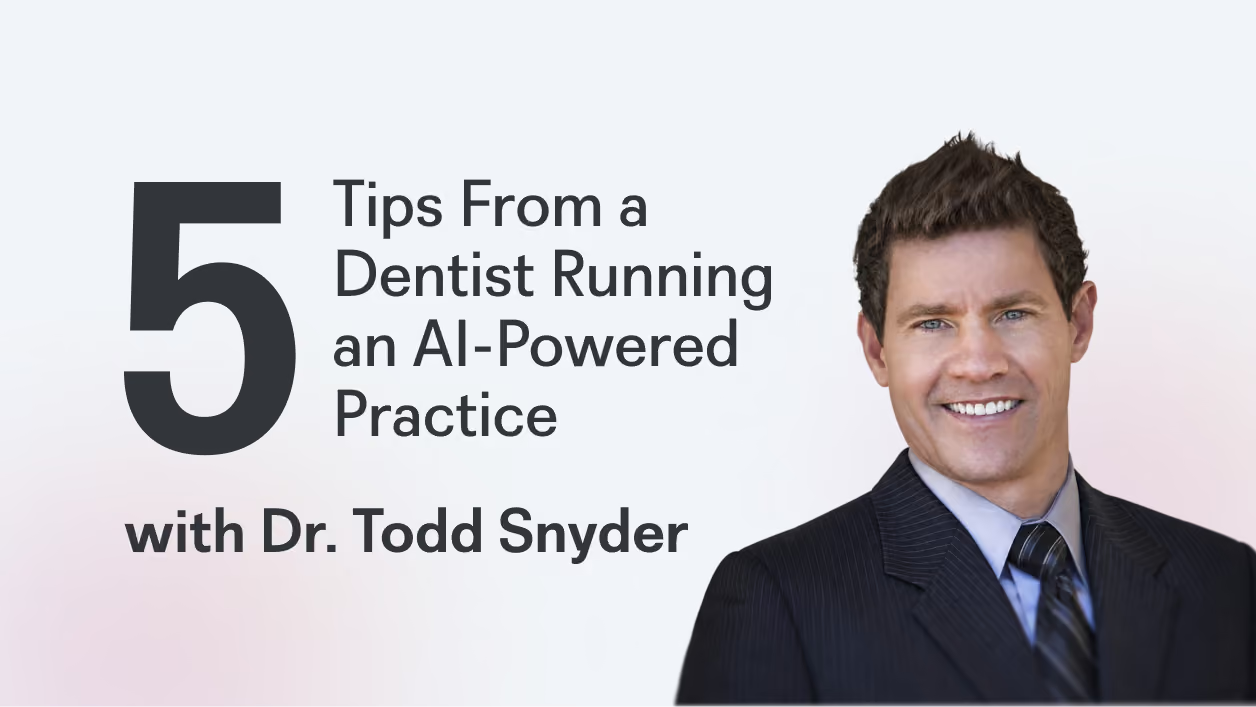
Dr. Todd Snyder doesn't have a front desk. He doesn't have a hygienist answering phones. Some days, he doesn't have any employees at all. And on a recent Pearl-hosted webinar, "The Broken Dental Practice Model: Why Working Harder Isn't Working Anymore," he made the case that the old formula — see more patients, take more insurance, hire more staff — isn't a growth strategy anymore. It's a slow leak.
Snyder, a former UCLA faculty member turned practice-model provocateur, spent an hour walking dentists through why the traditional fee-for-volume model is buckling under insurance reimbursement cuts, staffing shortages and rising overhead and why "doing more dentistry" isn't the fix everyone thinks it is. Here's what stuck.
1. The problem isn't clinical. It's structural and dentists keep treating the wrong disease.
Ask a struggling dentist what's wrong and they'll usually blame themselves: not enough case acceptance, not enough diagnosis, need to learn a new procedure. Snyder’s pushback: that's optimizing inside a broken system. "The whole business model needs to be revamped," he argued — bolting on a new laser or a 3D printer doesn't touch the underlying math of a practice built on shrinking insurance reimbursements and rising costs. More dentistry into a broken machine just makes a bigger, more chaotic machine.
2. Insurance isn't the safety net dentists think it is. It's the thing keeping them in place.
Snyder’s framing was blunt: reimbursements have barely moved since the 1970s while overhead has exploded, and the industry has quietly absorbed the difference by working harder for less. His read on why so few dentists leave insurance networks despite knowing this: fear, not economics. "You are in a prison, a self-imposed prison built by you," he told attendees — one where the exit was unlocked the entire time.
3. "Attract" and "convert" matter more than "deliver" and almost nobody spends time there.
Most practices pour all their energy into the treatment chair, what he calls the "deliver" piece. Snyder’s model splits patient acquisition into three legs of a triangle: attract, convert, deliver. Nail the first two with the right marketing, the right patient, the right communication before they ever sit down, and delivery gets dramatically easier. Skip them, and you're stuck trying to out-produce your way out of a leaky funnel.
4. Patients don't buy dentistry. They buy clarity, urgency, trust and belief — and that's an emotional transaction, not a logical one.
Snyder’s biggest departure from dental-school orthodoxy: education doesn't close cases, emotion does. Rattling off tooth numbers and radiograph jargon doesn't move patients to "yes" — it just confuses them. His pitch for where AI tools like Pearl fit in isn't as a diagnostic add-on, but as a communication device: something that lets a patient look at a color-coded scan and reach their own conclusion ("that must be bad") rather than being told what to think. Self-generated urgency, he argued, converts better than any pitch.
5. AI isn't the strategy. It's the weapon — and it's what let him cut his headcount to zero.
Snyder was explicit that technology without a system is just an expensive toy: "AI is not the strategy... it is the operating system." In his own practice, AI answers the phones, verifies insurance eligibility, handles perio charting by voice, and auto-generates clinical notes — work that used to require a front desk and a hygienist's downtime. His argument to a room full of dentists nervous about staffing shortages: the fix isn't finding more employees. It's needing fewer of them.
The takeaway: Snyder isn't telling every dentist to go drop insurance or run a solo office — he was careful to frame his own practice as a proof of concept, not a mandate. But his core argument lands regardless of practice size: the old playbook of see more, hire more, do more is running out of room, and the practices adapting fastest are the ones treating AI and communication strategy as core infrastructure, not add-ons.
See the full on-demand webinar here, or embedded below.