
See it, treat it, sorted
AI detection and timely treatment of caries
Transcript
Hello, and good evening. My name is Sam. I am from Pearl. I'm a dental hygienist and therapist in the UK. I'd like to give my colleague the opportunity to introduce himself as well.
Good evening, everyone. Thank you for joining us this evening. It's great to have you all here. I'm Mark. I'm a dentist working in the UK, and I work as a clinical trainer with vVardis. So we're excited to get going this evening. I'll pass back to Sam. We'll get straight into it.
Thank you. So welcome to "See It, Treat It, Sorted" — how Pearl and vVardis close the gap between early AI-powered lesion detection and timely repair with Curodont Repair. As an overview of tonight's session, here is what we're going to be covering. Closing the detection gap — we're going to be looking at how AI works in dental radiography and where Pearl sits within that framework. We're also going to be looking at how we bridge the treatment gap — Curodont Repair, how it works, what it's for, the evidence — and Mark will also take you through some real usage cases. And then we'll bring everything together and look at how a powerful partnership of Pearl and vVardis can give you deliverable outcomes within your practice.
So let's jump straight in. Early caries often gets watched, not treated, and AI is how we can reliably draw the line and bring those two together to be treating those lesions. Traditionally, we watch and wait. There's good data that early caries is a significant problem within dentistry, and technology here is where AI can really support and boost your patients' confidence. 82% of patients said that they want their dentist to be using the most advanced tech. Really good evidence base that patients are looking for a digital patient journey within practice. They really want to have the best possible experience when they're visiting the dentist.
55% of patients said that they would feel more confident if the dentist was verifying their X-ray read with AI, with artificial intelligence, and 63% of patients are unsure if their dentist is reading their X-rays accurately. That is not a confidence thing. It's not around the trust in the dentist — it's actually in the diagnosis itself, and where AI can really support you in terms of those conversations with patients. It's helping your patients to better understand their treatment plans and therefore getting them to go ahead. And that consistent AI second read on the radiograph is how you can really help your patients and support their understanding of the radiograph and therefore introduce more timely treatment.
So if you haven't had the opportunity to see Pearl's Second Opinion already, I'm just going to give you a little bit of a walkthrough and show you the environment and how you can utilize it in practice with your patients.
So I have a little video here, so I'm just going to press play and show this to you. So this is the environment, this is the interface. As you can see, you have your pathology types on the right-hand side of the screen. You can utilize those to be tailoring your patient conversation, supporting patient understanding. If I just press play there, you can see a little bit more around the interface. This is your really powerful patient communication device. It's two parts that are going to help support patient communication. You're taking away the conversation of this little shadow here and this little shadow here into quite literally a colored discussion, so you're really able to support your patient understanding here.
You can also see there on the screen — I'm just going to pause this for a second so you can have a little look at that — we also have the pediatric view, as you can see here. So transforming the colors on the screen, also with a little bit more behind it with the "sugar bugs." It's really supporting engaging pediatric patients and also their parents. So you're supporting both patient and parent understanding here.
So I'm just going to stop sharing here and pass over to my colleague Mark to walk you through Curodont Repair and the case selection. So I'm just going to stop sharing. Over to you, Mark.
Thank you. I'll just share my screen now. Hopefully — is that all good there, Sam?
All good there. Thank you.
Perfect. So thank you, Sam, for the run-through with Pearl. That was as interesting as ever — it's such a great technology. I'm going to now tie it in with how that early diagnosis of enamel caries can be treated these days. So firstly, we'll start with Curodont Repair and the case selection — where exactly we would use Curodont. Now there's quite a lot going on on this slide, so I'm going to break it down into different areas.
We have prevention, where we have a healthy tooth, and we would keep everything the same — fluoride, oral hygiene, and diet.
Sadly, many patients come to us with these early enamel lesions. Now these are lesions confined within the enamel, not cavitated on the surface. And I'll give you guys a moment to think about what you would tend to do with these lesions. I'm sure it's very unanimous, unless you're using Curodont Repair, it's the usual — chart it as a watch area. Watch and wait, will do something when it gets worse. And, of course, you may apply some fluoride varnish or tell the patient to fix their diet, etc. But we watch and wait, and in many cases, patients come back in, say, twelve, eighteen months, and in a lot of those areas it progresses and has gone into the dentine, etc., and the restorative cycle starts.
So Curodont Repair is to act in this reversible stage, where something can be done to stop the decay and, in many cases, rebuild the damage. So we're really trying to seize that window of opportunity.
The main area we see these lesions is interproximal, on bitewings, periapicals, etc. And this is where Pearl AI comes in so handy. When we're taking these X-rays, we have the Pearl diagnosis on the screen and the patient can see these small lesions so much easier. As you see here, they're highlighted in orange. If you show them a tiny gray spot, the patients often don't know what they're looking at. If you show them something in bright orange, the patient really understands there's something going on, and it can really help as well with the uptake of Curodont because they can see something's for sure up with this tooth. If we can do something now, the better.
As well as interproximal, we do see early lesions on the buccal surface as well. These tend to be on the gingival margins where patients aren't brushing too well. We scrape off a layer of plaque and we see these white chalky lesions. Although we say white spot lesions, we do not mean things like MIH or fluorosis — it's purely for early areas of demineralization.
And thirdly, around orthodontic brackets or Invisalign or aligner attachments — these are again a common area we see these lesions. Patients aren't brushing too well, the braces act like a plaque trap, and sometimes food and debris gets trapped beneath the aligners themselves. So these are high caries risk patients, and we often see demineralization. So you can apply Curodont while these Invisalign attachments and braces are on — you don't need to wait for them to be removed. The earlier, the better.
Moving on to the technology itself. Curodont Repair is a natural peptide made up of natural amino acids. Therefore, it's suitable for all ages, children and adults. One thing I really love about Pearl AI is the mode that Sam just spoke about, where you can change it to pediatric mode. It breaks it down really easily for parents and children, and I think we're in an age now where parents are more on top of their children's health than ever. So they want to know as much as they can, and using tools like Pearl AI to help with that is a bonus. So it's suitable for all ages, it's a natural peptide, it takes less than five minutes to apply, and its aim is to arrest and reverse these early-stage caries.
And this is how it works. On the left side of the screen, you have an early enamel lesion with the enamel surface intact. When we apply Curodont, thousands of tiny peptide molecules flow through the enamel pores to the depth of the lesion. The acid from the caries — caries has an acidic nature — triggers these peptides to come together and form a 3D matrix, like a fishing net. So think of this third slide as a fishing net that's now within the tooth. Over time, this matrix, or fishing net, attracts calcium and phosphate from the saliva to build hydroxyapatite, natural hydroxyapatite that forms. And as that crystallizes, that arrests the decay and, in many cases, rebuilds the damage that's been done.
And a question we often get asked is, what's the difference between Curodont and fluoride varnish? Because often as dentists, we would see these early lesions and paint on some fluoride varnish to try stopping it. Now fluoride varnish is still, you know, gold standard for healthy teeth. However, once something has formed, studies have shown that Curodont Repair works better at arresting and reversing the decay because it's able to penetrate into the tooth and form that matrix. And they do work well together — it's not one versus the other. So Curodont works from the inside out, and fluoride varnish can act as an extra layer of protection on the surface of the tooth.
Moving on to how we apply Curodont Repair in practice. So you have a patient in the chair, you've diagnosed them with an early lesion, and you want to start the treatment. You'll be glad to know it's so easy. Every case I do, or nearly every case, is at the end of a checkup appointment — patients don't have to come back for a separate appointment.
Firstly, you would clean the site using any preferred method. I usually go with prophy paste and a slow-speed brush, and a bit of floss if it's interproximal. You rinse and dry. You then etch the area for twenty seconds using regular phosphoric acid etch. If it's interproximal, you would do a thin band of etch around the interproximal space, and you would floss that etch to the contact point.
Once you've etched for twenty seconds, you would activate the applicator, which comes as a sponge and a liquid — I'll show you a video on the next slide to show that. So activate the applicator, and you simply squeeze that sponge onto the area for around a minute in total. Technically, maybe ten seconds is enough, as it says on the slide. I like to do it for a minute or so just to be extra safe. So I squeeze it from the buccal embrasure for thirty seconds, lingual embrasure for thirty seconds, and then the patient's good to go. You don't need to light-cure it, you don't need to air-dry it or anything like that. You simply squeeze the peptide out and let it do its job.
For a few minutes, you'll, of course, explain the importance of diet, oral hygiene, etc., but then the patient's good to go. You tell them no eating or drinking for thirty minutes, same as fluoride varnish.
So I'll just play a video now to help visualize how exactly you would apply it in practice.
And some main tips when it comes to applying the product — I would encourage you to maybe take a screenshot of this slide because these are quite important. The box of Curodont comes as ten applicators. These are single-use applicators, and one applicator covers one interproximal space or two buccal lesions. It's only one interproximal space because with interproximal, you squeeze from the buccal and lingual embrasures, so you want to make sure you have enough peptide. You would always use the sponge that comes in the packet — do not dip an instrument like a microbrush in the liquid, because the peptide is in the sponge itself; the liquid just activates the peptide.
Always use unwaxed floss if you're cleaning the tooth beforehand or when you're flossing the etch between the teeth, because waxed floss can block the enamel pores, so the peptide may not penetrate as well — some wax may come off the floss and block the enamel pores. And I would always encourage you to use a flat plastic, as shown in the video, or any instrument like a flat plastic, to help squeeze the sponge into the area, because the sponge is quite delicate — it can be a bit awkward to squeeze into the area when the tongue and the cheek are in the way, but an instrument like a flat plastic really helps to make it super easy.
Now moving on to clinical data. As clinicians, we need to make sure we can trust what we are using on our patients. And when I first started using this product around two years ago, when they brought it to the UK, this was one of the first questions I asked. Now this peptide was discovered twenty-five years ago at the University of Leeds in the UK — so maybe some of you on the call studied at Leeds. And since then, it has undergone over 230 scientific publications, most significantly a systematic review and meta-analysis published in the Journal of the American Dental Association, as shown on the right side of the screen. This review concluded there was a large increase in initial caries arrest, a large reduction in the occurrence of cavitation, and shrinkage of initial caries lesions.
Now I think that final part, the shrinkage, is really cool — it's essentially saying the enamel is healing itself. These lesions are shrinking by the formation of hydroxyapatite. And to be published in this journal is not something that companies can just pay to be involved in — it needs real scientific backing, so it was a big deal to be published there.
It's been used in patients for over ten years now, and over 3,000,000 teeth have now been treated with Curodont Repair, so it's not something we are experimenting on our patients. Since it came to the UK around a year and a half to two years ago, it's been growing quite rapidly month on month. It's being used in over 700 dental clinics, and very recently it was approved by Bupa Dental Insurance, where, again, there's so much due diligence into the products they approve for their insurance, so to be approved by them is a big deal for us, and we're very happy about that. So it's for sure something you can trust and reliably use in your patients.
So the key studies I mentioned on the previous slide concluded there was a 93% success rate when it came to either stopping the decay or making the decay smaller over time. So the main thing we want from this product is to stop the decay from getting worse and stop that restorative cycle from starting. In around 50% of these cases, you will see it getting smaller over time, and you'll see that on things like X-rays and other ways of monitoring the teeth, and I'll show you that in the next few slides.
This is another one of the key studies, which compared Curodont Repair plus fluoride varnish versus fluoride varnish alone, and it showed that when you were using both together, over time, the amount of active caries was much lower compared to fluoride varnish alone, because, as I said earlier, Curodont Repair is able to penetrate, so it's working from the inside, whereas fluoride varnish sits more on the surface.
And these are some of the case studies where we've seen the lesions get smaller over time, which is in around 40 to 50% of the cases where you'll apply Curodont. So as I said, in 93% of cases you'll see it stop, and stop the need for a filling — the caries will arrest. However, in around 40 to 50% of cases, you will see it getting smaller.
And this is where Pearl AI can really come in handy as well, because there are many cases where these lesions are being monitored, where Pearl AI has picked up a lesion, Curodont Repair has been applied, and, for example, one year later another X-ray is taken, and even the AI cannot detect that lesion anymore, because that hydroxyapatite has formed — it's become more dense in the area, and it's not as radiolucent. So this is where you can really use AI to help monitor these lesions as well, which is really cool.
Another case — this was the upper left five mesial, one of my own patients last year. And what was interesting about this patient was they had never had a filling before. They were quite young, so when I told them there was a hole starting to form in their tooth, they were rightfully not too happy — they were quite annoyed at themselves. But I told them, listen, we have something now that we can do without drilling, without local anesthetic, takes a couple of minutes to apply. So we applied Curodont Repair. I brought them back in September, so six months later, because they were high caries risk. We took another X-ray, following FGDP guidelines, and we saw it get smaller, and they and I were super happy about the results.
Another case, upper left six mesial — Curodont was applied, eighteen months later an X-ray was taken, and we saw a nice infill of the lesion. These cases are all on our website, vvardis.com, if you did want to have a look in your spare time as well. And you will see different review periods — twelve months, eighteen months. It's not to say it took that long to work, it's just that's when the next X-ray was done in these specific cases. Generally, we tend to see results between three to six months.
We also have many cases being monitored with transillumination, where it's an intraoral camera with a special setting, and it makes it much easier to review these lesions at the same angle compared to X-rays — we know it can be a bit difficult to do that with X-rays sometimes.
With buccal lesions, as I mentioned earlier, it can be used for these early buccal caries. However, do not sell it as a cosmetic product. We do have many cases where we've seen nice cosmetic improvements, but if I'm speaking to a patient, it's very much saying we're trying to stop a hole from forming in the tooth, rather than we're trying to get rid of this white spot visually for you. But saying that, we do have many cases where we've seen it improve the cosmetics very nicely. If you were to want further cosmetic improvement after Curodont, you can use any method — you can still whiten as normal, you can still bond composite as normal, and even if you'd like to, you can resin-infiltrate as normal afterwards. It doesn't impact any of those.
And we are nearly there with this part of the presentation on Curodont. But one thing I really want to highlight is how to communicate with patients, because we as dentists in the UK — a lot of us are not using this too much, and any dentist who comes to us says they're not too sure how to speak to patients when they spot an early lesion.
Now this is where Pearl AI can also come in very handy, because it makes it much easier for the patient to visualize what's going on. But we say, keep it simple. Show the patient the X-ray and highlight the lesions for them and say, these are early holes forming in the tooth. In the past, there wasn't much we could do for these — we would put on some fluoride varnish, monitor it, but in many cases it would get worse, and you would need a filling at that point. Now we have something we can apply to stop the decay and, in many cases, rebuild the damage that's been done. So it's a very basic initial conversation I have with my patients. I stop there, see if they have any questions, but most of the time, when they say, you know, we're trying to avoid drilling, filling, etc., they're more than happy to go ahead. And as I said, most of the time it's straight at the end of a checkup — they don't want to come back and forth for something that takes two minutes to do.
And again, there's a communication framework that I put together, if you guys would like to screenshot this. It just talks you through it in a very easy breakdown format. Number three, I don't tend to do unless the patient asks me — I don't tend to explain how it works, because we wouldn't really do that for a filling or other treatments, so why overcomplicate it with this? One thing I do always do, I emphasize the consequences — point number four, I tell them, if we don't do this, there is a much higher risk of it getting worse, needing a filling, injection, etc. And this is where parents really appreciate this product as well. When you're telling a parent that their child has damaged their tooth, they're starting to get a hole, but we can do something without drilling, without injections, they're more than happy to go ahead, and rightfully so.
And I will pass back to Sam now for the final part.
Thanks, Mark. So just to bring this all together — Second Opinion is there to support you in identifying early lesions consistently and early on. You can also utilize Pearl's Second Opinion to be extending your conversation beyond the surgery. So when your patient has come in, there is functionality within Second Opinion to then be able to share those radiographs directly with the patient, either as a printout or as a QR code, so that your patient can then refer to that later, particularly if they want to speak to any family members before they go ahead with treatment. You have that to be able to support extending that conversation. So that is closing your detection gap.
Curodont Repair is giving you something noninvasive as far as your treatment goes. Think from a patient perspective — being able to be offered a treatment where there's no drilling, no injections necessary — from a patient's point of view, that's absolute goals as far as a patient is concerned, being able to be offered a solution that is going to be supportive of that minimally invasive approach with dentistry. So together, there are already loads of UK practices doing this. Hundreds of UK dental clinics are already doing this rather than going for the watch-and-wait approach, going down the early treat and identification of the lesions, and being able to send the patient away with a noninvasive restorative solution. So — see it, treat it, sorted.
Perfect. And on this final slide, we have a couple of QR codes to scan. On the left side is for Pearl AI, to book a live demo for your practice. And on the right side is for the vVardis website, where there's an eLearning platform and further training — there are so many videos on there on how to apply it, and resources as well. So for sure, on our website, we have lots of information. Now, Sam, just in case the QR code may not be working on your side, do you want to let them know how they could maybe reach out to book a live demo if they want to?
Absolutely. So they can also contact us through the Pearl website — you can visit hellopearl.com and contact us through that website.
Perfect. So I'm going to leave this up for a minute or so, and I'll stop sharing the screen because we'll go into some Q&A. So, actually, while I'm sharing, Sam, if you wanted to start with any Pearl questions, if there are any.
Absolutely. Let's see what we have here. So, question: "A friend of mine told me it's easier to recommend Curodont when he's using Pearl. Can you explain why this could be the case?"
So I don't know if you want to pick up that one, Mark, or I can answer that one.
Yeah, I mean, I could pull up the slide that might make it more visual to explain this part, and then you could take it from here maybe. So on the left side of the screen —
Yeah. So you can see the early lesions are identified by Pearl in the yellow color, and there's a differentiation between the early lesions and the more progressed lesions. As you can see, the early lesions are yellow, and the progressed lesions are highlighted for you in pink. So there's a clear differentiation between the progressed and more early lesions that you can differentiate between the two. So it's a very different conversation between treating the progressed lesion versus treating the early lesions there. So it's easy for your patients to understand, and they can see, with the tooth pass tool, when the caries has progressed beyond the enamel junction. So you can then utilize that for supporting patient understanding, and for helping your patient to understand where Curodont can be utilized versus where Curodont may not necessarily be the most appropriate solution.
Question for you here, Mark — what age can you use the product?
Yep, great question. So you can use it for any age. It's a completely natural peptide, therefore it's suitable to use in children and adults. Now, one thing we have to say is we say to avoid during pregnancy or breastfeeding. Although it's theoretically safe, it's a natural peptide, there's been no long-term studies done on those groups, so just to be extra safe, do not use it during pregnancy or breastfeeding, but you can use it in any age. I would just say take care if they're very young, because you have to etch the tooth for twenty seconds — if you feel they're not going to be cooperative for that part, then wait till they're a bit older in those cases.
Thank you for that, Mark. And next question — is this a one-off treatment?
Yes, another great question. So generally, it's a one-off treatment — it just needs to be applied once, and over time that matrix will start to crystallize into hydroxyapatite. The only time I would consider reapplying is if a patient came back to me in, say, a year and a half or two years, I'm reviewing the area and they really were not looking after the area — there's lots of plaque buildup, they have a bad diet, eating lots of sugar — you take an X-ray, it may have even gotten a bit worse on the X-ray. I would offer to reapply, but I would also tell them, you know, for this to do a good job long term, you do need to improve your habits at home, as it is with any dental treatment. So if they'd had a filling, they would get recurrent caries around the filling as well.
Thank you for that question. Next question is again for you, Mark — can Curodont be used for microfractures in enamel?
Sadly not — not microfractures. It's purely for early caries. If you think back to how I was explaining how Curodont works, it's the acid from caries that triggers the reaction. When it comes to things like tooth wear or microfractures in the tooth, it doesn't have that same acidity, so there's nothing to trigger the peptide to do its job. That's why it's purely for these early caries lesions.
I think that's it for the questions.
Somebody has just popped a message in just to say they're finding that the Pearl QR code isn't working.
Please, please do visit us via the website — you can go to hellopearl.com. If you're in the UK, you will automatically be redirected to the UK website, and you can contact us via the "Contact Us" platform on the website. So please do visit the Pearl website for that. Another question's just come in for you, Mark — how much do you charge the patients for this?
Yep, so typically in the UK, clinics are charging between £120 to £150 per applicator, and that covers two areas, two lesions, up to two lesions. So generally, between £120 to £150 is what clinics are charging in the UK.
Thank you for that question. Another question for you, Mark — is it suitable for deciduous teeth?
Yes, it's suitable for deciduous teeth and adult teeth. I actually work in a pediatric clinic, although I see the older children and teenagers. My colleagues who are pediatric specialists see many younger children and are applying this a lot as well, so for sure, offer it if you do see it in deciduous teeth as well.
Lovely, thank you so much for that question. Next question, again this is for you, Mark — is Curodont a method that's used all over the world?
Yes, well, we're getting there. It's a bit of a story — it started in Switzerland, which is where the company was founded. Once they had done some more studies in Switzerland and had been using it in patients, they took it over to the US, which is the largest market, and wanted to see how it would do there. It did very well there. And over the last two years, they've been growing it across Europe — UK, Italy, moving into many, many more countries in Europe now. So it's growing, expanding very rapidly at this stage.
Excellent, thank you so much again for that question.
I think that concludes all the questions that we have. So just, if we want to just give it maybe another few seconds, just to see if we have any more.
That looks like everything, I think — no more questions.
Okay, well, thank you so much for joining, and thank you for taking the time to spend with Mark and I to go through this presentation. We hope you enjoyed it. If you have any questions, obviously you have the two QR codes on the screen there — please do feel free to get in contact with us.
Perfect. Thank you all, and thank you so much, Sam, for this evening. Take care, everybody.
Thank you.
Meet Your Host
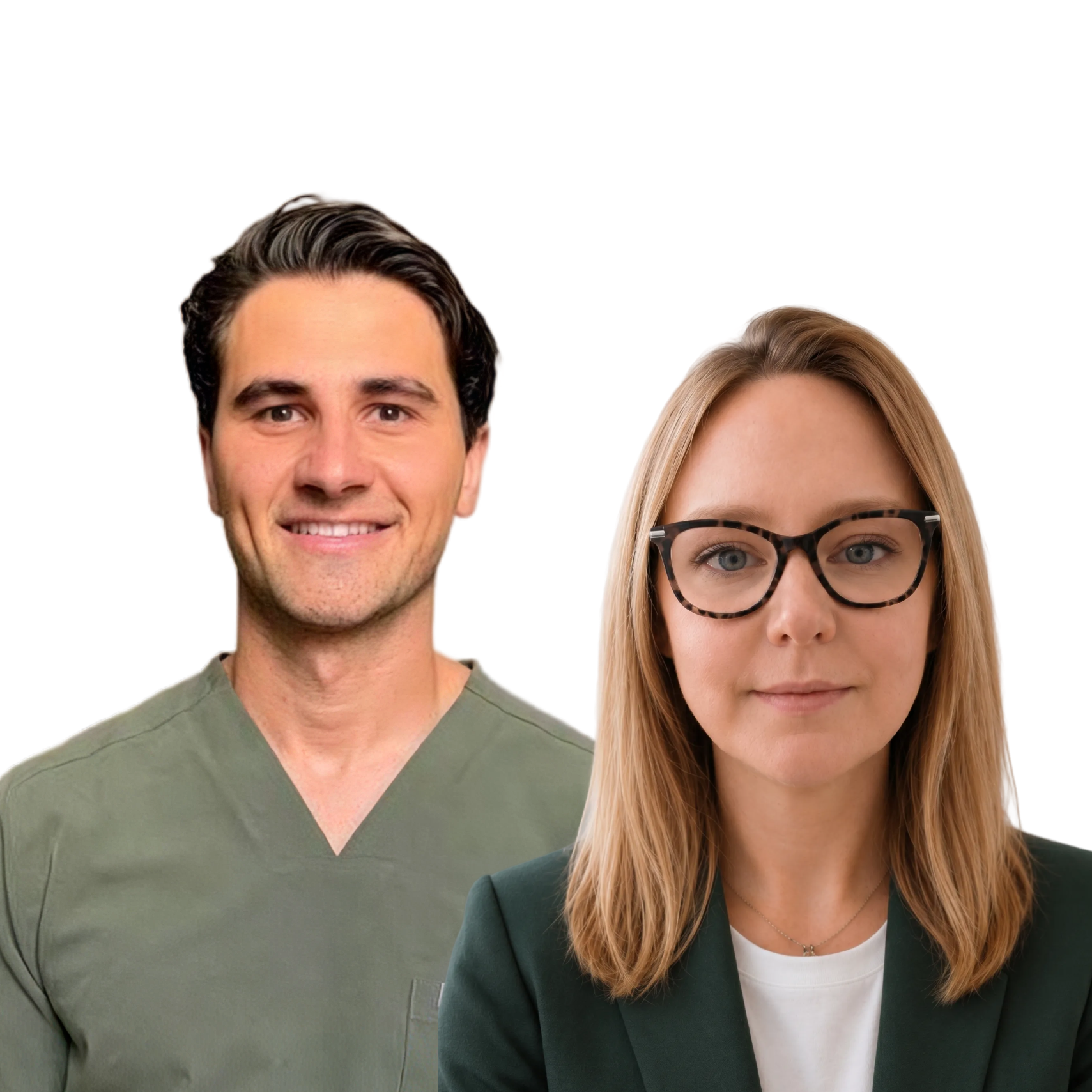
Mark Joseph is a UK-based dentist focused on prevention-led, minimally invasive dentistry and the management of early carious lesions. Through his clinical work, he has seen how peptide-based technologies are transforming early treatment with predictable, non-invasive outcomes. Sam Hogg is a qualified dental hygienist therapist with an MSc in Advanced Specialist Healthcare and over 15 years of clinical experience. Now serving as enterprise customer success manager at Pearl, she partners with enterprise organisations globally to drive AI adoption – bridging hands-on clinical expertise with real-world implementation.
Done learning and want to get started?
Book a demo