
Patient Communication
How generations differ and how you can respond
Transcript
Good evening, everybody. It's nice having you here.
So, this evening, we are going to talk about the integration of artificial intelligence and how this will help us face the changing the mentality of our patients. That's not a homogeneous group, but we will be facing a new generation of patients and we have to be prepared for that. So, Victoria, go ahead.
Okay.
So how are we actually meant to be providing the best care to every patient? I think that's what every single one of us wants to be doing every day. And the answer is that you need to get to know them.
I feel the way that I have grown as a dentist the most is being able to understand the types of patients that I treat. So the way I treat a twenty two year old might be very different to the way I treat an eighty two year old. Even the way I present myself, all of it. And that's because, all these different generations have been brought up in different ways and they expect different things from their health care practitioners.
And so you can see here even to this day AI now, this was this came out, what, a couple of last week?
And you can see that the different generations have different political beliefs.
They think differently. So you can see that the, people who were eighteen to twenty nine years old, they were a lot more for Kamala, and then the forty five to sixty four year olds were a lot more for Trump. So again, you can see that every generation is different, and it's we see it in everything, in health care, in politics, etcetera.
So what we're gonna do is we're gonna kind of go through, the different generations that you are going to be seeing at your clinic. And so your first is your AI Stanley, is what we call him.
And so he, is kind of in his seventies to his nineties.
The reason that they call him AI Stanley is because they don't complain, much. They work very hard. They stay silent.
And so as a result, their main concerns are that they don't like change. They don't like different things happening. They're worried obviously about their health.
They expect very good service. They want good health advice, and they want traditional health care. So they're very much doctor knows best. So in these types of scenarios, these types of patients, you give them a treatment plan and you say this is what you need done. They're most likely not gonna be asking any questions. They trust you, and they're gonna go ahead with it. As long as you provide them good service, you're not you're not changing things too much.
So to be quite honest with you, I think they're they're AI of the easiest generation to to treat. I don't know what you think, Dirk.
Yeah. Those are the pay the patients if they have, let's say, the willingness to to to follow a good treatment plan they're not that difficult to to convince so they trust you completely and that's the way things were done in the the old generations So we just had the patients that believed the the dentist completely, didn't question him, didn't, use, Google or whatever and just followed the opinion of the dentist. But things have changed.
So if we move on, we start going, to a slightly younger generation. So these are kind of your mid fifties to mid seventies, and we call them the baby boomers. So the baby boomers are the ones who actually, probably capitalized the most, from the recession.
They are very infrequent with their dental visits, actually.
They actually have a lot of work to do. However, their main concern is they want someone that they trust. They want very good quality of care. And the way that they will find a a dental professional or health care professional is very much word-of-mouth.
So for them, it's really important who their friends are seeing and the reviews that they're getting from their friends and family. Whereas the silent generation are a lot more, they're happy to go with their local dentist. Whoever is closer to them, they'll go. And as long as they seem clean and comfortable, they're happy.
So the baby boomers are asking a few more questions. They want trustworthy doctors, but they're still very much doctor knows best. So, again, I mean, obviously, you need to communicate and you need to get the consent from these patients, but they're not, very difficult or going to be asking lots and lots of questions.
And then we move on to our Karens. So these are your Gen x, and these are your mid forties to mid sixties.
They're very cynical.
They want extremely good quality of care.
They're very, they need very good convenience and time. So for them making appointments, they have to work with them.
They also AI be someone who will shop around a little bit and try and find the best service that works with them. And to be honest with you, the reason that your your Gen Xers or your Karens are like this is because many of them have young children. So that's why they need to be able to book appointments easily, and move around and have, convenience.
So they also, they're very cynical, but they're very loyal. If they find the right dentist or the right health care practitioner, they will go very regularly, and they'll come with their children and their, their family as well.
Yeah. But they they're under a lot of stress because they have their their young children, they have their mortgage to pay, they have a lot of career issues.
So, on one hand, they, they want the best treatments, But on the other hand, sometimes they are quite nervous and react a little bit irritated during the treatment. So those are the patients we have to give extra information and give tranquility while doing our treatment planning and and treatments.
Very true. And then we start moving on to the millennials.
And these are your mid twenties to your mid thirties.
And now we're gonna start seeing a big shift in how they see health care. So, prior, you know, the silent generation, even the baby boomers, it was still it was very much doctor knows best, and now it's Internet knows best. So the millennials have been raised with Google, and they love to research everything.
They will be the ones who come to you and they say, oh, what's, you know, I I learned about this treatment on YouTube, and I heard that this person on Instagram is doing x, y, zed. So they are a lot more knowledgeable, and they will question you a lot more. So for them, cost is a really big deal. So a lot of these, millennials are building their lives. They're trying to save up for their first house, etcetera. They're very into a very good experience.
So, because they're very much on the Internet, they will be looking, for example, for a dentist who looks good on Instagram, who has a nice waiting room. And it might sound really silly, but they they really like these things. They love the smell of a nice clinic, or the simple but small things. They want an emotional experience. And for them, because cost is so important, so is price transparency.
So these are the types of patients where you need to be communicating extremely effectively and particularly about costs. They might be the ones who need payment plans, and they would like digital digital options as well. So they're much more likely to be booking online, and researching as well.
And then we move on to our Gen z ers. So these are your Olivia's, and your Gen z ers are your kind of twenty five year olds and below.
And for them, patient knows best. So now we've shifted from Internet knows best to the patient knows best. So these people have gone on TikTok, Instagram, Google, and they've made their own decisions based on what they've seen AI. And they will come to you saying, I want a, root canal, or I want a ceramic implant, not AI, because AI learned that it's bad for me. Those types of things. So these people are actually probably the most difficult to treat in my opinion because they've been so influenced by the Internet, and the Internet often will give them the wrong information out there.
They also are very much into prevention and holistic health. So these types of patients, they wanna track things, they wanna understand what's going on in their mouths, but there's definitely no doctor knows best. These patients will be asking you questions about everything, and trying to compare before and afters.
For them, again, it's really important that they make the decision. They need it to be very convenient to them, and, that wellness aspect is really, really important for them as well.
Yeah, and just to be just to be clear, those will be our future patients because the the the older generations, as, normally they will be AI. So, more and more we will have a younger clientele, younger patients. So the reason why we give this webinar is that we will we wanted to help everybody, how to get prepared for the future. How do we, adapt as a as a dentist to a patient, to the patients that are getting younger and and younger with different mentality, different, circumstances.
Exactly. And so, therefore, what we're going to start seeing is what we call a self optimizing generation. So these are your to be honest with you, your mid so kind of like your your mid twenties to your mid forties.
And these are what we call self optimizing because it is now trendy to be healthy. These types of patients are gonna be wearing wearables. They want to track their data. They might have different diets. They might be fasting.
They're you know, it's cool to wear sportswear and do their Pilates and their yoga. And so we've seen a massive kick in health and prevention at the moment. And so for these types of patients, it's really, really important that they feel that you're trying to prevent their disease, number one, but also number two, that you are actually explaining and communicating their disease so that they can understand what's going on as well.
And so you can see here so a lot of research has been done on this. And this survey in twenty nineteen showed that actually less patients use a primary care practitioner. So these patients would actually rather take their own health in their hands and find a doctor via the Internet. So they are googling and etcetera to find their their dentist. And if they can try and avoid seeing the dentist, they will try as much as possible.
And all the data AI.
Sorry. All the data we are showing are done, upon research, done. And, those are studies done in the United States and in Europe. So this is how our patients' community is changing.
Exactly. And so this study as well, what you can see here is that so they looked at all of the different, generations, and they found that more patients think it's better to take care of their own health than go to a doctor. And they also found that more patients would prefer to avoid problems by leading a healthier lifestyle. And you can see where at the baby boomers so, the baby boomers is only eighteen percent, but that goes all the way up to thirty six percent for your millennials or your Gen Z. So again, there's a generational change and we're definitely having to change the way that we start to approach, dentistry and how we treat our patients.
Lastly, here's another study, and this shows that patients would prefer to monitor their own health indicators and communicate with their doctor virtually if they can. So what's really important about this study is it's showing that we need to be able to quantify disease better, communicate to our patients better so that they can actually track what's going on. So if we were able to have something where we could quantify the amount of decay, how deep it is into a lesion or how much bone loss there is and give them a number, then they can track that and keep on and remeasure every time they come back in.
Yeah. It's important because since, for example, here in in Belgium and Holland, we do not have enough dentists for our, complete population.
Like dental hygienists, their function will be much more important because they can take a lot of controls from us dentists.
So the second opinion is a tool that can take over a lot of functions because on one hand it gives a very objective idea how the situation is on decay on bone level and it's a it communicates very well. It's easy to to to communicate with.
Exactly.
And so that kind of shows us, you know, so I feel like the what we've really tried to push here is that, these this new generation of patients, they want better communication, and they want to understand their own oral health themselves.
So ways that we could look into this, it could be telemedicine.
It could be being a bit more wellness focused and trying to push prevention a bit more. It could be being more transparent with your costs and risks. So now, you know, we need to be signing consent forms. We need to explain to our patients what's going on. You can start to convert qualitative data. So for example, what you see on an X-ray, AI, just gray shadowing into quantitative data, for example, actually showing the depth of decay and measuring it.
And this is all to allow the patient to make their informed decision because the patient knows best at this point. So they need to to learn and understand it as lastly, you can start to use, saliva testing. You could also start using artificial intelligence to actually diagnose and communicate much, much better. And so today, we're really going to be zoning in on that artificial intelligence side of things and how it can be used to help you with communicating.
So, Derek, take it away.
Okay. So the the tool, we have now in order to defend ourselves more against that Gen Z population that is coming towards us and to to to explain them better giving them quantity dentistry is second opinion So it is an artificial intelligence that has been learning, thanks to thousands of x rays. Now basically, we as dentists, we have learned to, to make a diagnosis on, some gray scales we see on an x-ray, but sometimes for us it's quite difficult to, to have a, to give a good AI.
And the other thing afterwards is the communication towards our patients.
That is even more difficult because they just have to believe what we are saying. So, second opinion is will be our friends and will be our tool to, to communicate to the patients in an easy way on a very homogenic way because if we work in a group, clinic, then, sometimes depending on the personal criteria of the different dentists, we can have different results, of the x-ray diagnosis.
That is AI, second opinion will help us by creating a homogene diagnosis so we don't have the internal discussions.
Okay, you see there a decay, you see there bone loss, whatever.
So we're gonna have a small poll now, so that you can give your professional opinion.
And then we'll see afterwards how the results are.
So, please take your time to look at this X-ray.
And then, we're gonna wait a couple of seconds so that you can, have the time.
To decide if there is a cardiace decay or not.
And then you can fill in the poll and we can discuss it afterwards.
It's just the time to clear our throats a moment.
Okay.
And Victoria, I'm jealous about your eloquence. It's not English is not my maternal language, but, it's so nice hearing you speak.
So thank you.
No. You you speak amazingly.
So and AI least you can speak more than one language. So I can speak one pretty well, but that's about it, unfortunately.
Do my best. Important is communicating. So is second opinion because as a communication tool, it is great. Okay.
Speaking actually about language as well before I move on, I think that using something like second opinion, it translates a language that us dentists use into a language that your patients can understand because, this, for example, right now, even as a dentist, it's firstly, obviously, we're showing that it's pretty hard to diagnose decay. But secondly, if you are finding it difficult to diagnose decay, how are you going to communicate that effectively with your patient?
So let's check the chat if anyone is actually if anyone's doing the poll.
So if you guys wanna click on the chat to put in your vote, and then and submit it so that we'll just wait one more minute so that you guys can put your responses in.
K.
Yeah. So just look in your chat.
So now the the responses are getting in.
There we go. Very exciting. Alright. Give it a couple more seconds. Anyone for their last votes?
The the the question is if you see this X-ray on a Monday morning or you see it on a Friday afternoon when your family is waiting, you tend to look upon the x-ray in a different way and, second opinion helps us more, creating a more objective way approaching the the X-ray.
So I would say from the poll, the, three caries lesions has, gotten the most number of votes. So the majority of people think that there are three, AI or lesions of decay on here.
So let's see if everyone's right. And so you can see here, areas which have pink are areas where you're seeing, decay. So, actually, there are four.
Yeah.
Now what I actually I'm sorry. Go ahead.
No. Go go ahead, Victoria.
So what I actually find really interesting about these types of, what second opinion has been able to do is okay. Fine. Obviously, it's really useful to be able to see the decay, but, also, you can see, those all those tiny little measurements. So you can see the amount of bone loss from the, EDJ, so your analodentine junction and where your bony crest is. And I find that I do a lot of, perio, so gum treatments, and I find that actually really useful and important for being able to compare because, again, we're quantifying everything. So we're giving numbers to what we normally I I don't know about you guys, but usually, I used to kinda squint from far and be like, oh, like, ten percent bone loss. And now you can actually have numbers that you can measure.
Okay.
Good. So, if we go further, we can, we can try this to communicate with the patient.
And, this is what really helps.
We can segment all the tooth parts also so that they really today at one patient with a decay and it was about, let's say two millimeters from the nerve by segmentating the the different, tooth parts.
The patient was really anxious that she said no, let's let's clean that cavity, let's fill it up. So the motivation you have is enormous. If they see, for example, the two, enamel decays you see on the forty four and forty AI, it stimulates them a lot to start using the floss and extra fluoride toothpaste.
So you can have a remineralization of the zone and if you tell them, okay, if you start having a better dental hygiene, maybe we don't need to do the fillings.
So it it can, second opinion can be used enormously as a motivation tool.
Okay.
So if we look here, so moving from what you were just saying, Dirk, the next question is how does the use of AI help us to communicate better?
And you can see this is exactly what Dirk was mentioning where, each tooth part has been distinguished by a different color.
And I totally agree with Dirk that, you can actually start to see, you know, oh, it's in the enamel, or you can see on the, the, lower right thick that there's the decay is very, very close to the nerve. And, again, this means that if you're trying to allow your patient to make that decision, all you have to do is communicate and say, look. This is the decay. This is your nerve.
It's very close. I think we should do a phallic. And then they'll be like, okay. When can we book in?
Let's get going immediately.
Yeah. Exactly. Yes.
Okay. And so how does the use of AI help with case acceptance?
Now since we are, not explaining everything, but we have the AI that is showing the patients what the situation is, for example, if we use, an an, an OPG, then it gives a very clear view of how the situation of the teeth of the patients are. It can give information about, apical lesions, bone level, but on in one glance the patients AI see okay this is my mouth, what are the things that needs to be done? So, the good thing about second opinion is that it can create create also, I will show it a little bit further, a PDF that summarizes what the problems are. So this can be guarded as a screenshot and put into the patient AI.
So, in one glance we have an overview of an okay what needs to be done even if the patient comes back after his first checkup, in one glance, we see directly all the issues that that need to be done. Also, if we want to communicate it, in in a let in an accident or an AI you have to do, this could be very useful to use, to send to colleagues, to experts so that they don't have only have the opinion of the, the other dentists, but they have an objective, quantitative, information tool that tells them what the problems are so it can avoid a lot of discussion.
I totally agree, and I think that, I've used I've used, I would say, like, for the way that I use second opinion is mainly for, case acceptance. So, definitely, it helps with kind of being like a friend in the background where once in a while, I might be like, oh, I don't know if that's decay or not. And then I just kinda check my second opinion, and it gives me a second opinion. But, actually, what I have found has been the most important is for explaining and showing to a patient in an unbiased way.
I think that a lot of people don't trust the dentist already to start with. And so if we say, oh, yeah. Do you see that slightly gray thing there? That's decay.
You need a filling or you need a root canal or etcetera. A A lot of the AI, they don't actually trust us because they don't see it, and they don't understand what we're we're pointing at.
And so with this, just by being able to highlight the different tooth parts AI showing up areas where there's problems and being AI, this isn't me diagnosing it. This is the artificial intelligence suggesting that these are areas that have problems.
It means that the patient is actually probably more likely to go ahead with the treatment because you've recommended it, and the AI has kind of agreed with your treatment as well.
K.
So the next question is how does the use of AI improve your patient and dentist trust? So I think I kind of jumped the gun a little bit with that one. And I think that's my answer. I don't know about you, Dirk, but it really helps with building that trust because it's a third person in the conversation who is completely unbiased and and, you know, it's just saying what it sees.
AI.
And and, as as a marketing tool, the patient realizes that, his or her dentist is using the the the most, state of the art technology to help treating the dental health of that patient.
So it really creates a lot of confidence between patients and dentists because we do not have to rely one hundred percent on the AI, but we can use it to help us, communicate better with our patients and showing exactly what they have. So I'm using it now already two years. And for me, it has been something that can't be missed in in in my dental office.
So, Victoria, maybe you can explain. This is the PDF that that is generated by the, the program, let's say.
Yeah. So, basically, what it's showing is it's it's kind of decoding, what the, second opinion has found. So you can see here. So for example, it says that, the the green is, tartar, which has been found on the teeth, and it even says which teeth it's founded on.
You can see that the dark pink is, is deep decay.
You can see light pink is your your very early initial decay.
It shows you what your bone levels are. So it's kind of mapping out what the X-ray is showing and decoding it for your patient. And this is something you can print out, give it to the patient, and they can actually sit there and take a look and and learn and understand, what is going on in their mouth and what their x rays actually mean to them.
Yeah. Maybe, as you might know, Victoria and I, I am, we are participating in programs for the the European Space Agency on the the Dental Health for Astronauts and we are also, guiding a team from University of Louvert on a mass simulation project in the Utah desert. Now they all the crew members came to us for screening, so they came from different, dentists, let's say, and after the screening we just printed this out so they came home with a nice letter for their dentist, okay, please treat those problems.
So it gives a really objective way of analyzing, diagnosing the dental health of, of our patients.
Definitely.
So the next question, AI I think you kind of just answered it yourself now, Dirk, is how can AI help us gain time?
And exactly like what you said. So you've you've created this treatment plan.
That is a really nice and easy printout that you can print, and you can give it to the patient. It's kind of done part of the treatment plan for you.
So what I would do is I'd print this out, and then it also prints out, like, the the cost breakdown for all the treatment that needs to be done, and I give those two papers to them. And though that's kind of ninety five percent of patients, that's enough for them. And then there's that five percent who may be fine. You need to do a written plan. But this saves a lot of time, and makes it a lot AI more trustworthy as well.
Yeah. Exactly. Exactly. Good.
So moving on, how does the use of AI improve dentist satisfaction?
Yeah. For for me, it's completely because, I have a new partner in my, dental office, and it helps me diagnosing, communicating, and convincing the the patients in doing his dental treatments and, personally here in Florence, we have so much work. So the second opinion is just saving me time. So I don't have to be. I never had to be convinced as from the beginning when I saw them two years ago and for me it's a tool AI cannot miss anymore. So we are we are now applying it in the two dental clinics I'm working with, and everybody is very satisfied.
Also the oral hygienists, they feel much more secure because they have something in their hands they can use to already show to the patients without, the assistance of the of the dentist being there. So later on when she explains following the result of second opinion to the patients, Then the dentist comes in, confirms the treatment, so his visits, to the oral hygienist is also much shorter, so it's it's a benefit.
AI, I cannot, explain more than than it's, it it it was welcome and it's it's great.
Yeah. And I I would just kind of add on to that that, for me, it's there's a few different ways that it's helping. So number one, obviously, better communication with my patients. It does have the work for me, which makes my life easier, and therefore, more satisfaction.
The second is that, you know, even the best dentist in the world will sometimes make a mistake. And AI you said, it could be a Monday morning, it could be late at night on a Friday, it could be any of those things. And we are human.
And so once in a while, we make mistakes. Sometimes we need help.
And as a dentist, it's very difficult to just be AI, sorry. One second. I'm just gonna go next door and ask my colleague what they think about your X rays. It kind of makes you not sound like you know what you're doing. And so this for me is AI my little secret friend, and I can sometimes just check it. Just be like, actually, was that decay, or am I just seeing things funny because the light is shining on my screen funny? You know?
And so it's kind of given me more peace of mind, and also has sometimes picked up things that I haven't seen, which I think that we are in a more litigious world now where a lot more people are being sued, and it's something that most dentists are very scared of. And so just having that support, and also an unbiased third party in the room at that time being like, no. This is what the AI is saying, not me. Print it out. Show it to them. It means that there's no lapse in your communication at all. So I think for for both of us, it's kind of, it's made us limitless and and, really enjoy our jobs and make our jobs a lot easier as well.
Good. So, I hope we've, informed you well, get, shared our vision on, how we see this AI.
We have to be careful with AI. That's what the media tells us. But, I think in this case, the AI can help us. We always will have control. If we not agree, we will not agree. We are the first opinion.
The AI is the second opinion.
So, I hope you enjoyed our little talk and hope to see you next time.
Thank you so much. And I think before we jump off, we have a few questions.
So the first question is from someone about how about the group of millennials and Gen z patients or Gen z parents? Sorry. I work in pediatric dentistry, and I see that they are hard to motivate as well. They have very difficult questions sometimes and are not always open for explanation.
So I totally agree. I would say that, the majority of patient types of patients that I attract are your millennials and your gen z's, because we are very much prevention and health conscious and etcetera at our clinic.
I agree with you that they're difficult to motivate, but I think that the reason that they're difficult to motivate is because they don't understand what's going on in their mouth, and they don't trust us. So I do think that communicating that using something like second opinion helps with communicating, which then helps with motivation.
Another way that you can do it, which has helped with kids in particular, is by, like, disclosing plaque on their teeth.
It sounds silly, but just using a plaque disclosing tablet and showing all the bacteria and taking a photo of it, is also an extremely motivating tool. And the reason it's motivating is because you are you are showing them what's wrong with their mouth, and you are basically highlighting it, which is exactly what second opinion is doing but for X rays.
And in terms of the difficult questions, I think, yes, they all have definitely difficult questions.
But as long as you, hold yourself in in terms of being able to present the the the problems that they have in their mouth. And if they have, you know, strange questions and etcetera, then at least you know that you've done exactly the treatment plan that is meant to be for that patient.
Any more questions?
I think that's it, Dirk. Don't think we have any more questions. We blew them away.
Okay.
Good.
If you want to contact us afterwards, you see here our Instagram accounts.
Either you can contact us through AI Dental, So, you're welcome to, contacts to connect with us, and we will, see that we can help you with your queries.
Awesome. Good. Have a nice evening, everybody. Thanks for your attendance, and, see you next time.
Bye. See you. Have a nice evening.
Bye bye.
Meet Your Host
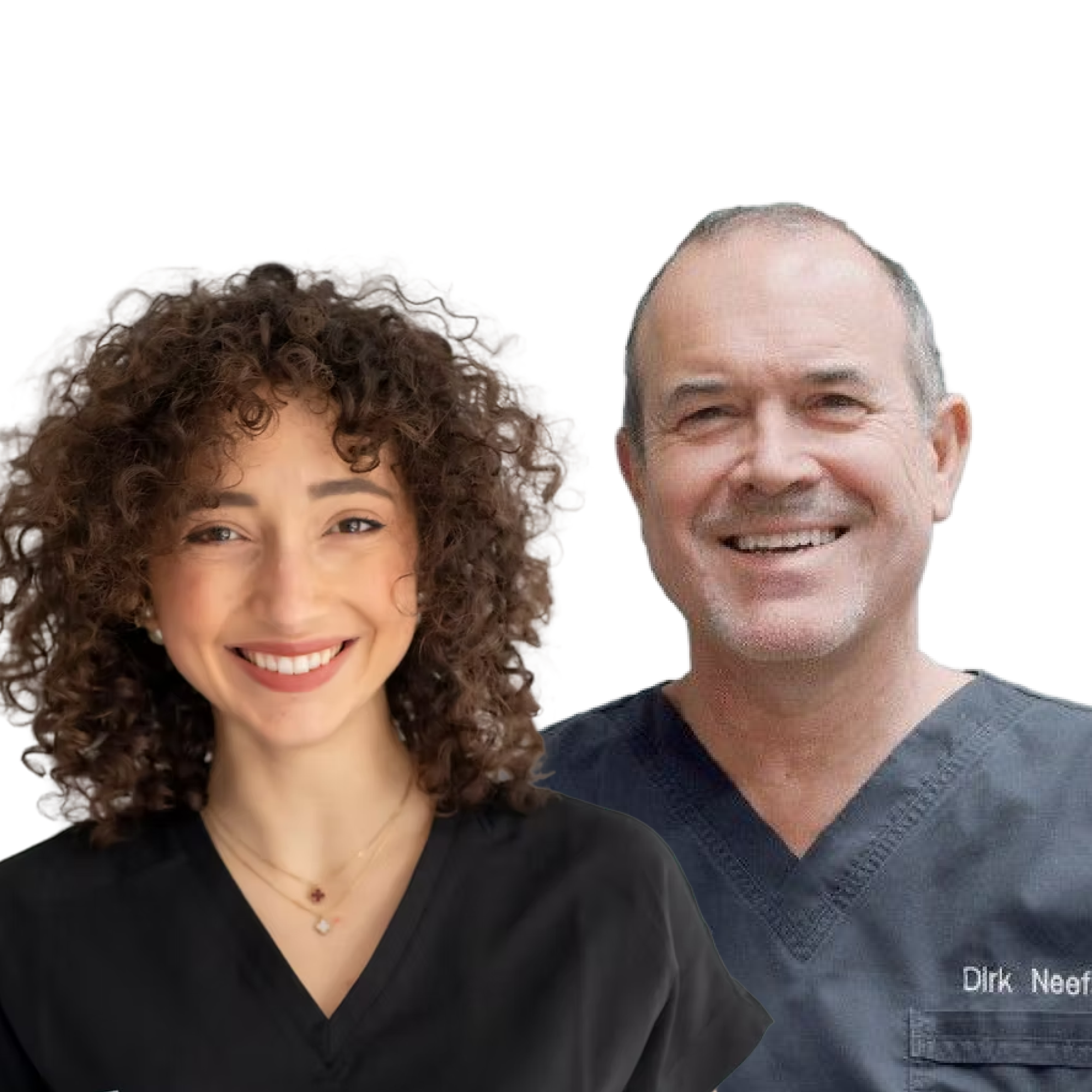
Dr. Victoria Sampson is a functional dentist and researcher based in central London. She obtained her Bachelor in Dental Surgery from Barts and the London and is now known for her work in developing salivary diagnostics, artificial intelligence, and microbiome testing. Her work has been acknowledged worldwide resulting in her becoming a scientific advisor, board member and clinical lead of multiple dental companies globally as well as a topical team member of the European Space Agency and NASA. Victoria has published numerous papers and was the first dentist in the world to link gum disease with worse COVID complications. Dr. Dirk Neefs is an accomplished dentist with over 30 years of experience, dedicated to advancing dental care and oral health. He earned his Bachelor of Dentistry from Vrije Universiteit Brussel in 1987 and a Master's degree in Surgical Dentistry from University of Liege in 1996. Since establishing his practice in Antwerp, he has focused on implantology, enhancing his expertise through international experiences in Spain. In 2019, he joined B-dent, and in 2023, he began collaborating with Vitadent in Kapellen. An active member of multiple professional organizations, including the ITI and Holomedecine Association, Dr. Neefs has shared his insights as a speaker at universities and events, including a TEDx talk in Antwerp. His innovations, such as the Tempocopy protocol and intraoral ice pack, exemplify his commitment to patient comfort and continuous learning in dentistry.
Done learning and want to get started?
Book a demo