
One Move Habits
Creating Lasting Change in Your Practice and Your Life
Transcript
Hello, everyone. Looking forward to having you this evening, thank you so much for joining us. We are gonna dive in tonight, and I have a question for you — what's one small change (I want you to think about this) that, if repeated consistently, could completely transform your practice or your life? One small change. And as you think about that during this webinar, we are going to have the guru here walk us through all kinds of ways to make small changes that are super impactful.
Most dentists and teams already know what to do — the real challenge is doing it consistently, especially when it comes to systems and habits, and the pressures we have every day that move us away from them. In this webinar, "One Move, Habits," Doctor Mendelson explores how meaningful transformation doesn't come from massive overhauls, but from small, intentional shifts repeated over time — and that's really exciting. He's gonna walk us through some great content tonight, especially the habit loop and habit stacking. We're gonna learn about basic routines, improving accountability, and building systems that actually stick. And if you walk away from this webinar with just one system that sticks, that will be a huge transformation in your practice.
Doctors and teams tonight are going to uncover real, practical ways to close workflow gaps, strengthen consistency — I think that's the key to success, since we do so many routine tasks in dentistry — and create lasting change, both personally and professionally. So, without further ado, let me introduce our wonderful speaker this evening, Doctor Martin Mendelson, a leadership coach, speaker, founder of Metamorphosis Coaching, known for helping dental teams build cultures of accountability, high performance, and huge success. Doctor Mendelson combines mindset science with practical leadership strategies you can immediately apply to your practice and your teams — creator of the TEAM framework (Thoughts, Emotions, Actions, Manifestation), former faculty member at Spear Education and Nova Southeastern University, and author of One Move Makes All the Difference.
I still have my bookmark, I'm not completely finished — I love it, and I'm hoping you're gonna talk about some of the classes you do as well, Doctor Mendelson — joining one of your classes was life-changing for me. So I'm really excited about this topic, really thankful to have you here, and I'll let you take it from here.
Awesome — well, thank you very much, Sheela, and thank you everybody for joining us this evening. The truth is, time is one of our most precious commodities, so it's not lost on me that people are calling in from all over to spend some time with us — and, of course, this will be available through Pearl later. I wanna thank not only Sheela, but Pearl itself — I have a deep connection to this company, which I'll talk about a little later. I also do wanna remind everybody, as you might imagine, I'm gonna be using some of Pearl's technology as examples for habit science — that should be obvious. But here's the thing: there's so much they have to offer that, whether you're a current user or not, I strongly encourage you to look into it, because they just came out with some amazing things, like perio charting and templated notes, and it's mind-blowing stuff. So whether you're a current user or not, I recommend you follow the demo links later to find out more.
So let's go ahead and get started with this evening's discussion. We're gonna be talking about creating lasting change — in essence, going on a journey. By the time you leave here this evening, you're literally gonna have a roadmap for how to accomplish and facilitate habit change within your practice and within your life. My promise to you is that this is gonna be all tips, tricks, and tools — all killer, no filler — to help you better understand habit change for your practice and your life.
But I need you to make a commitment to me: leave your "yeah buts" at the door. Look, you're all engaged in successful practices, and your success has been built up to this point by whatever it is you've been doing. Some of what we present tonight may be different from what you're doing, but that doesn't necessarily make it wrong. Research shows that when we're in a negatively primed space, thinking, "Yeah, that's not gonna work," or "Yeah, but I do it differently" — yeah but, yeah but, yeah but — we end up not being able to listen and learn the content of any speaker's information. So I invite you to leave your "yeah buts" at the door, and as a thank-you for doing that, I'm gonna give you several presents at the end — these slides and some handouts to help with the self-study we'll be talking about.
The truth is, we only have a limited amount of time this evening, and skills are skills, and skills take time to develop — whether those are skills of the hand, of the thought, or of the lips — we have to give those time credit, because we're all on our own journeys.
In order for you to better understand my journey, and why or how I even have the authority to be chatting with you here, we need to take a step back in time — twenty-three years ago this next month, to June of 2003, when I started practicing in private practice. This was my life — you're looking at a picture of the practice window, this is my nephew Steven looking out it. If you do the math, he's in his mid-30s today.
I never intended to have a life outside clinical dentistry, but the universe had different plans for me. Just shy of ten years into my clinical career, I started having issues with my hand, and within six months of those first symptoms, I was out of the practice of dentistry for good. I had to figure out what was next, and I had no idea where to go. I talk, in my in-person lectures, about a defining moment at the breakfast table — not being able to open a Sweet'N Low packet — that led to seventeen months of unemployment. Go try to find a job in your mid-30s — too young for this, too old for that, too inexperienced for this, too inexperienced for that.
I ended up with, basically, three to three-and-a-half positions that led to spending time here with you this evening. The first was as the liaison at a mid-to-large commercial dental laboratory, and I ended up making over sixteen thousand — yes, I counted — calls on cases: you had questions, we had questions. Little did I know, it was the beginning of my journey into communication.
Next, I joined Ivoclar Vivadent in North America — you know, the shade-guide people — and I don't know about you, but they didn't teach me in dental school how to lead a team of twenty-three sales and marketing people with budget oversight of over twenty million dollars. I wasn't taught that, I had to learn it real quick, and that's when I started learning leadership.
Then, in 2011, I joined Spear Education, and I'm very proud of my tenure there — I helped grow the study clubs to what they are today, the faculty club to what it is today. Along the way, I realized I was missing something, because what they were asking me to do, about halfway through my tenure, was to "coach" — in air quotes — doctors, study club leaders, faculty club members, and I really needed to better understand what that meant. So I started on this journey into executive coaching, team coaching, team facilitation, happiness studies — I'm currently engaged in a course with Wharton Executive Education to learn more about the neuroscience of leadership.
All of these experiences — decades of experience, certification, conversation — have led us here, to this evening, to spend time together. Because tonight, my role is as your coach. A coach is trained to help you go from A to B, whatever B is for you, through active listening and asking a number of empowering questions. So I kind of hope to build a bridge — the standing joke is that I've been trained to ask you questions twenty ways to Sunday, to get you out of your own way, to build that bridge.
So tonight, we're talking about building a bridge to better habits. When we think about habits, we need to come to an understanding — because if you're here, I've gotta assume you're interested in instituting a new one, changing one, maybe optimizing one. But what is a habit? Let's go to the dictionary: a habit is a routine or practice performed regularly, an automatic response to a specific situation. In other words, it's something done repeatedly for the purpose of performing the action itself — a habit is the activity, not a result. Getting in shape, losing a couple of pounds, reading more, spending more time with family — it's the habit that leads to those outcomes. Getting in shape isn't the action, is it — going to the gym is the action, eating less is the action. The habit leads to the result.
You're looking at an image of a gym — anybody who goes to one knows that on January 1st every year, the gym is packed, because everybody makes a New Year's resolution to be more fit, one of the top resolutions every year. But what percentage of people do you think abandon their resolutions? According to Forbes, it's 80%. But here's the kicker — by what month do they fail? By February.
So the question is why — we're gonna talk about that this evening. But what I wanna say is, if you wanna be great, you need great habits — you need the actions to lead to the results, which is a very different way of looking at it.
So I want you to think about two habits you'd like to change — one personal, one practice-related. Maybe your personal habit is drinking more water — starting to drink it more regularly, or optimizing your hydration. What about a practice habit — maybe holding daily huddles with your team, if you're not doing them, or changing them, or, as I'll talk about through Pearl, optimizing them. As part of your self-study, and the PDF I can send you at the end as one of my gifts, you'll be able to document: what are these habits, why did you select them, and what would it mean to you if you could engage in them regularly?
So this is the start of our journey — we've gotta put a peg in the sand to understand what we want to change first. But how are we gonna change? According to James Clear, who wrote Atomic Habits (a book I highly recommend), there are three layers of behavior change: the outcome, the process to get there, and the identity you feel based on those outcomes. Based on those layers, there are two types of habits — outcome-based habits, where you start with the outcome (getting in shape), then think of the process (going to the gym a couple times a week), then say to yourself, "I'm a person who is fit, who cares about my health" — that's an outside-in approach: outcome, process, identity. Identity-based habits are the reverse — "I am a person who cares about my health, therefore I'm going to go to the gym, which will result in becoming more fit" — an inside-out approach. What Mister Clear says is the research shows identity-based habits are what get you going — the ultimate form of intrinsic motivation is when a habit becomes part of your identity.
So which is it for you — "I am the type of person who wants X, Y, Z" (the outcome), or "I am the type of person who is X, Y, Z" (identifying as fit, whose process is the gym, whose outcome is losing a few pounds)? The ultimate question, then, is: is it the number on the scale, or the person getting on the scale? So many times, we keep focusing on the wrong thing.
Now, we've just been talking about your own internal thoughts and habits — just you. But when it comes to a dental practice, it's not just about you, is it — it's about everybody else on your team, and the diversity of the people on your team, in every sense, makes things magical. You've heard the phrase "there is no I in team" — but you know what is in "team"? Me. And all the "me"s within your organization, including you, bear responsibility for the thoughts going on between their ears, which ultimately guide what we'll later call a lagging indicator of success in practice. As Peter Drucker says, "Culture eats strategy for breakfast" — you can have all the strategy, all the processes, all the standard operating procedures in the world, but if you don't have the culture, the identity, of "this is the way we do things" — good luck with that. That's one of the reasons I have such joy working with teams of all sizes across North America, helping create an alliance, a culture, around who we are as individuals engaging in these processes to drive positive outcomes.
To do that, we need to take a quick step back, and I need to share some of my philosophies, based on a book called Man's Search for Meaning, by Doctor Viktor Frankl. Doctor Frankl was a neurologist, psychiatrist, and Holocaust survivor — he survived the horrors of Auschwitz for years, to come out the other side and become an internationally known thought leader. The quote attributed to him goes something like: "Between stimulus and response, there is a space. In this space lies our freedom to choose our response, and in our response lies our growth and our freedom."
What Doctor Frankl would tell you, a Holocaust survivor, is something very important for dental teams — because every single thing that happens within your four walls is, technically, neutral. Something happens, that's the stimulus — but between the stimulus and your (or your team's) response, there's a space, and in that space lies our freedom to choose our response. And in our response lies our growth and our freedom. My eyes have been opened in my Wharton course, learning about threshold theory, and understanding why teams act the way they do — versus you, as doctors, sitting there thinking, "Why would somebody not do that, isn't that obvious?" It's not, to them. And if we don't have what's called psychological safety — the ability to put up a hand and say, "Houston, we have a problem, following our standard operating procedure" — we're never gonna get where we want to go as a practice.
So, as a tip, trick, and tool, let me introduce my TEAM framework, at the core of my book, One Move Makes All the Difference. I want to define this acronym, then breathe life into it relative to you as a human being and a member of the dental community. TEAM stands for Thoughts (drive) Emotions (that create) Actions (that) Manifest (results). This is where "there is no I in team, but there is me" comes from.
So, pause for a moment — maybe take a breath — and think about your dearest friend that you don't live with. I'll share a picture of one of mine, and it's a bit ironic — here's one of my best friends, Doctor Kyle Stanley. If you know of Doctor Kyle Stanley, you'll know he's the clinical co-founder of Pearl. He showed me this technology in 2020, before AI was ubiquitous in today's vernacular, and I was blown away — it's such an honor to carry the torch for Pearl, in his honor, moving forward, because Kyle is more than just a friend, he's also a business partner. We actually run one of the only courses on mental health and dentistry in the world, and we're about to launch a nonprofit tomorrow called the Dental Mental Coalition, to support the mental wellness of dental professionals.
So, who is your Kyle? Today is Tuesday, the day we're meeting for this webinar — let's pretend you texted your Kyle last Tuesday, and you haven't heard back yet. Now, I asked you to think of your dearest friend you don't live with, so naturally, thoughts of care and concern come to mind — but let's set those aside for a moment. What thoughts might you have about your dearest friend Kyle's inability to text you back over the course of a week? When I do this live, I hear things like, "Well, he doesn't like me," "I said something," "he's mad at me," "he's too busy — I saw him go to dinner with the Joneses on Instagram, he had time for that but not to text me back." What kind of emotions would that drive? Anger, frustration, resentment. What kind of actions? Depends on the kind of person you are — maybe you send an angry or passive-aggressive text, or, if you're analytical (because none of us in dentistry are, right?), you count the exact number of days it took him to text back, and when he finally does, you count the exact days before you text back, to show him.
But I tricked you — how does that action manifest maintaining, or elevating, that friendship with your Kyle? Doesn't work so well, does it?
Now let's change the story. Given the thoughts you just had, now you find out something bad happened to your Kyle — something not good. Based on the thoughts you had, what are you thinking now? Having done this live over and over, the word "guilt" usually comes up. What emotions come out when you learn something bad happened? Love, care, compassion. What actions does that drive? Depends on the situation — maybe you go help take care of the kids, the pets, bring them dinner. How does that manifest, maintaining or elevating the friendship? That's a bit different, isn't it?
Here's what I want to tell you — this is universal, it works in any situation, and can also work in reverse. You come upon a situation that stresses you out — a team member isn't following your standard operating procedure, isn't following the habit we're gonna establish. What do you really want to manifest right now? You want that person to do the habit. What action brings you forward, what emotion supports that action, and what thought gives that emotion hope? This is the kind of work I do with teams all over North America, and it's transformative when we understand our thoughts always come first.
In the words of James Clear, your outcomes are a lagging measure of your habits — your net worth a lagging measure of your financial habits, your knowledge a lagging measure of your learning habits, your weight a lagging measure of your eating habits. What I'll really tell you, within the context of a dental practice, is: all outcomes are a lagging measure of your thoughts, and all habits are a lagging measure of your identity.
So, in the next layer of self-study, I want you to create an identity statement: "I am the kind of person who is ___." Ask yourself, how committed are you to making these changes, on a scale from one to ten? One meaning not at all, ten meaning "I'm in." And why did you give it that number — why is it so important to you?
So let's talk about habits themselves, and tell a story about habit science that has a dental origin — did you know that? When you get up in the morning, other than maybe using the restroom or checking your phone, what's the first thing you do? If you're like most people — not just because you're a dental professional — you're gonna brush your teeth. Why? There's a whole story connected to that, and I'm excited to share it, because there's a real connection between habits, habit science, and marketing, in dentistry.
Let me introduce you to this man — do you know who he is? You actually should, because he, in some ways, helps support our profession every day. His name is Claude C. Hopkins, and I came upon his story reading another book on habits, The Power of Habit, by Charles Duhigg.
Before I tell you what he did, let me share the state of dental health in the US in the early part of last century. Around World War I, young men age eighteen to thirty-five needed a minimum of twelve teeth to serve, according to the draft, yet twenty-four out of every thousand recruits were rejected for not having enough teeth. Can you imagine? In Britain, on the part of our allies, 70% of British recruits — and men at home of that same age — needed dental treatment. And let me tell you something else — US dental officers performed, get this, up to 385,000 extractions during World War I. When the US entered the war in April 1917, the US Army had only eighty-six dental officers, and that exploded to 4,600 by the end of the war.
Why do you think this was the case, that everybody had such terrible teeth? Because nobody brushed their teeth — it was just accepted that your teeth would fall out of your head, and nobody had the habit of brushing in the morning. Enter Mister Hopkins. Before Claude C. Hopkins, only 7% of Americans owned a tube of toothpaste. If you've ever gone to a drugstore, you know that just because you buy something in the pharmacy aisle doesn't mean you use it — so I wonder what percentage of Americans actually used toothpaste versus just had it in their medicine cabinet. A decade later, 65% of Americans had a tube of toothpaste in their medicine cabinet. By World War II, the US military downgraded their concerns about recruits' teeth, because so many soldiers were brushing every day. How did that happen? Mister Hopkins made it happen.
He got people to brush their teeth — we take this for granted today, but can you imagine, only 7% had toothpaste in their bathrooms, and there was no internet, no modern communications back then. So what did he do? I'll make a bold statement — if you understand what Mister Hopkins did, you can change any habit. There are some additional, modern, research-based nuances we'll talk about, but the concepts are the same.
He created a reward for brushing your teeth. "Does your tongue pass the tongue test? Would you like a clean mouth taste for hours?" — these are real marketing campaigns, magazine and newspaper ads, that within a decade caused Americans to go from 7% to 65% toothpaste utilization. He's quoted as saying, "I've made a million dollars for myself on Pepsodent because I learned the right human psychology" — and remember, this is World War I/World War II era, so a million dollars then is multiple millions today.
So what did he do? As Duhigg talks about in The Power of Habit, the psychology was grounded in two basic rules: number one, he found a simple, obvious cue; number two, he clearly identified the reward. Get those elements right, and it's like magic.
Hopkins had a conception of the habit loop, based on selling Pepsodent: the cue was getting up in the morning, the routine was brushing your teeth, and the reward was removing the film, so your teeth could pass the tongue test. Hear me out — the rewards are incredibly important, because rewards cause chemical changes in your brain, what Duhigg calls neurological cravings, and the anticipation of the reward is what pushes you forward when faced with a specific cue. The more modern version of the habit loop is: cue (you come upon a trigger), craving (you desire the reward), response (the action), and reward (you reap it).
I often use this example — I don't drink anymore, but, you get home from a difficult day, you wanna unwind, your cue is walking through the door, your craving is a glass of wine, your response is having one, and your reward is your buzz. It's a habit loop, but a linear progression — cue, craving, response, reward.
If you thought toothpaste was wild, let me introduce you to a second guest this evening — do you know who this is? No? Well, he invented this stuff — does that help? Let me tell you about a product you've definitely heard of. In 1996, almost thirty years ago, a little company called Procter & Gamble was looking to make this cool chemical that eliminated odors and made things odorless. Good idea — but they had a big problem with how they marketed it, because it just neutralized things, it didn't replace the smell with anything. Have you ever been to someone's house with, say, two dozen cats or a bunch of gerbils? No disrespect to cat owners, I'm a pet owner myself, I have a dog — but you can smell it, because it's not your house, while the people who live there are nose-blind to it.
So this company marketed the product by saying it "gets bad smells out of fabrics" — but the problem was, how do you even know you had a bad smell to begin with, and what was the reward, that it didn't smell anymore? That's kind of a neutral thing — is that really a reward? So they flipped their marketing to "cleans life's smells." I bet you've figured out the product by now — it's Febreze.
The cue was wanting to get bad smells out, or "cleaning," and the reward was that things were clean. That still didn't help — sales were tanking, because people were buying it once and not buying it again, a big spike then — bam — back down. They hadn't created a reward that spoke to people in the initial launch.
So let's talk about reward within dentistry — what's the reason you come to the office every day? When I work with teams, I do a facilitated exercise called "the why." Have you asked your team, "Why are we here as a practice? Why are you here, in your role? And in your role, what do you do to put the why into action? What one word or phrase sums up your role?" This exercise reveals whether team members are operating from outcome-based habits or identity-based habits.
From less than two weeks ago, let me share examples. Outcome-based thinking: "I answer phones," "I schedule patients," "I sterilize rooms." Identity-based thinking: "I create trust," "I reduce patient anxiety," "I help people move toward health." This distinction matters, because people consistently act in alignment with the identity they believe they hold — this exercise exposes whether someone sees themselves as a task-doer or a meaningful contributor to the patient experience. When that identity shifts, behavior naturally begins to shift with it. In other words, the "why" exercise isn't just about uncovering what people do — it's uncovering who they believe they are inside the practice, which is very important for facilitating change.
So why are you here, doctors — to provide great dentistry? Well, until our patients say yes, there isn't any dentistry we're gonna be able to do. And when patients actually understand what you see, they're more engaged. With Pearl, and the visualization of radiographs — showing patients bone loss, incipient lesions, the things we see — we end up not only saving time, but building trust, and helping patients make better decisions sooner. When we get up there and talk dental-speak to patients who aren't dental professionals, and show them X-rays, that means nothing to them. What would it be like if we could create an educational, objective display, through Pearl, to help influence them to say yes to treatment we know is needed and warranted?
Because the data is very clear — when people see what we see, in a way they can understand, acceptance of endo goes up, acceptance of restorative goes up, acceptance of scaling and root planing goes up — restorative treatments, implants, crowns, the data doesn't lie. It clearly shows this technology helps build trust. When Kyle showed this to me in 2020, nobody was talking about AI — today, that's all anybody talks about, so use this to your advantage.
But I'll tell you — change doesn't happen overnight, and we need to be mindful of what we're looking to reward, particularly in a clinical setting. As you see, change does not happen overnight, particularly within the confines of a dental practice. James Clear's work discusses that the reason it's called Atomic Habits is small changes lead to big results — mathematically, if we improve anything by 1% per day, per year, we're 37% more effective by the time we're done with that year. Another way to put it: one will always be greater than zero — even small efforts yield huge results.
So, in the next layer of self-study, ask yourself, based on the personal and practice habit you selected: what's the cue (when are you gonna do it)? What's the craving (why do you wanna do it)? What's the response (what are you gonna do)? And what's the reward (how will you know you did a good job)?
Everybody knows, with dieting or fitness, nobody expects to go to the gym once and become fit, nobody expects to diet for a day and lose twenty pounds (even with GLP-1 drugs), nobody expects to save a hundred dollars once and become a millionaire — life doesn't work that way. Mister Clear says good habits make time your ally, bad habits make time your enemy. He has a concept called the "plateau of latent potential," describing change in any organization, including a dental practice. It's a graph of results versus time — the straight line is what people think should happen ("we made this change, things should happen"), the curved line is what actually happens — we make changes, talk about them, not much happens, not much happens, then — boom — we end up in a better place than we ever imagined, if we stuck with it. But most people get lost in the "valley of disappointment" — the reason 80% of people fail their New Year's resolutions by February is they get lost there, because they don't stick with it, don't understand the science of habit change. We need to focus on the systems and rewards, not the result, or we get caught in that valley, because the result may be in the future as a lagging indicator — it's the systems, the processes, the cues that make most of the difference.
So now let's go deeper, into the four laws of behavior change: first, make it obvious (when are we gonna engage with the cue); second, make it attractive (make it something people want, crave); third, make it easy (so the response isn't a mountain of effort); and fourth, make it satisfying (reward the response, because what's rewarded is repeated). Put another way: when are we gonna do it, why should we do it, how should we do it, and what difference would it make?
The example I'll use, with Pearl technology, is Practice Intelligence — the first AI-powered clinical performance platform. It combines data from practice management systems, imaging systems, and AI-powered X-ray analysis from the past eighteen months to deliver clear, actionable insights — enhancing your schedule by identifying clinical needs, supporting everyone from management to hygiene to docs, and generating daily printouts with unscheduled treatment, predicted undiagnosed treatment, patients due for radiographs, patients due for periodontal probing, patients overdue for hygiene visits. This is your data, turned into daily opportunities.
But when we think about the laws of habit change, in the past, we'd get stuck on law three — make it easy, and it wasn't. Industry standard was people spending thirty minutes to two hours a day, about an hour on average per day, five hours a week, twenty hours a month, on this kind of review. Nobody wants to do that. What would it be like if, instead, we got a printout every day to bring into our huddle — unscheduled treatment, undiagnosed treatment, who's due for X-rays, who's due for perio probing? The "predicted" column is predicted by AI based on imaging, with nothing noted by any team member in the treatment plan — you could even consider these your "watches." This lets you look at your schedule at a glance, and hover over any patient to see who needs X-rays, perio charting, a cleaning, what the treatment opportunities are. If you get a sudden cancellation, you can look within seconds and know who's in hygiene, what they need, what's next, even their remaining insurance reimbursement, if applicable.
Let's use this to talk about behavior change. First law, make it obvious — this is about habit integration versus habit change. When we think about instituting change in a dental practice, please don't assume you need to throw everything out and weave in a whole new series of behaviors. If you take away anything from today, remember this: it's not about change, it's about integration. You're already treatment planning patients, already seeing patients, already preparing for the day — whether you're doing a huddle or not, you're still looking at the schedule, aren't you?
It's a concept James Clear calls "habit stacking" — if you're looking to institute change, it needs to be part of an existing system. Where are we gonna stack an additional behavior into an existing process, so that when we come upon a specific cue, we have a craving for it, and we do it? Whether you're conducting huddles today or not, you're starting your day somehow — so why not stack this behavior into the practice's morning routine, to reap the benefits we've discussed?
When we talk about making it obvious, from a cue perspective — when will we huddle? Some practices do it at the end of the day, because of split schedules. When would we prep for the huddle — what's the cue to prep the information, is it getting ready for the end of the day on the front office's part, or as we're leaving, reviewing the schedule for the next day? It'll be slightly different for each practice, and that's okay — it applies to both the prep and the huddle itself. Here's a formula: "I will do X behavior at Y time in Z location." You can use this for anything.
Second law, make it attractive — this is about why we're doing this, and it's all about case acceptance. I love case acceptance, because that's the only way we're gonna be able to provide dental care to people, human beings — without case acceptance, how do we serve our patients, meet our daily practice goals? Given today's reality, how could we even use AI as a practice builder? You've seen the statistics — how cool is it that your office is using AI, like, "Is it like ChatGPT? Kinda — but for dental X-rays."
Third law, make it easy — the daily printout for the huddle is important here. Not only do you see who has what needs, what AI has predicted based on imaging that's not in the chart or treatment plan, but also the remaining insurance reimbursement available, right next to the time slots, updated in real time. How can it be any easier? There's a whole science behind making things easier. In the book The Happiness Advantage, one of my favorite books of all time, Shawn Achor talks about the "twenty-second rule" — lowering the barrier to change by just twenty seconds was all it took to help him form a new habit. He wanted to start running every morning, so he'd sleep in his gym clothes (not his shoes) — the alarm would go off, he'd slip his feet into his shoes, and out the door he went.
I'll use an example of my own — I love to read, but not in hour-long chunks, I read in ten-to-fifteen-minute chunks every single day. Do you know where my book is? Right next to my coffee maker. What's the cue, when I make the coffee? What's the craving, wanting to finish the chapter? What's the routine, read for ten to fifteen minutes? What's the reward — for me, the knowledge, or, if it's fiction, a fun story.
Fourth law, making it satisfying — because what's rewarded is repeated, and this requires a little thought. Back to Febreze — what was being marketed had the wrong reward. It wasn't about odor elimination, it turned out to be about making things smell clean, because that was the indicator of a job well done — in people's minds, "clean" was synonymous with scent. They figured this out by observing a woman in Scottsdale, Arizona (I live in Phoenix) who used Febreze at the end of cleaning her teenage son's room, as a signal that she was done and the room smelled clean. They tweaked their marketing, added a greater concentration of scent, and a multi-billion-dollar product was born.
But how is this satisfying for you? This data shows it can increase case acceptance, but what about for the patient? Here's what's wild — 64% of patients say they don't understand their X-ray during a consultation. Why would they? Should we really expect them to? Because they don't understand, they end up switching dentists, confused after a diagnosis. Yet 55% say trust in the diagnosis and dentist is the most important factor for treatment acceptance, and 40% say they distrust dentists. Why would we not use a tool, ubiquitous in today's verbiage — AI is everywhere — to encourage people to accept treatment we know they need, that would benefit them?
So how are we going to make it satisfying? What is satisfying to you and your practice about meeting patient needs — what are you rewarding, how are you rewarding it, how are you celebrating it?
Bringing this together: make it obvious (what's the cue), make it attractive (what's the craving), make it easy (what's the response, and how do we make it easy to respond), make it satisfying (what's the reward). As part of your self-study, take time to think through the cue, craving, response, and reward.
So, to summarize what we learned today: all outcomes are a lagging measure of your thoughts. People during World War I, in particular, had really bad teeth. The science of habits has a dental origin. There's a habit loop with a cue, craving, response, and reward. There are four laws of habit change, and it will take time. It's about habit integration, not habit addition. Small changes matter, and all habits are a lagging measure of your identity.
I want to share a study by Doctor Amy Wrzesniewski, and finish with my favorite story of all time. If I asked what you do for a living, what would you tell me? I actually know this answer, because I've surveyed over a thousand dental professionals — when asked what they did, they gave me a title: dentist, hygienist, assistant. If you met me in an airport and asked what I do, you know what I'd tell you? I help people get out of their own way, on stages, with their teams, and one-on-one.
Doctor Wrzesniewski was interested in how people viewed their profession, so she went into a hospital and interviewed neurosurgeons and janitors, asking the same questions, bucketing their responses into three categories: job ("I'm just here for a paycheck, TGIF"), career ("I'm here for positional or financial advancement"), and calling ("I'm here for the betterment of humankind"). This study has been validated by other researchers with the same results — despite a larger number of neurosurgeons falling into the "calling" category, there was a relatively even split, roughly a third each, between janitors and neurosurgeons in how they viewed their work. So, let's get real — that means you had janitors mopping up blood, bodily fluids, and vomit who were primarily there for a calling, and neurosurgeons excising tumors and removing cancers who, for some of them, were primarily in it for the financial compensation. How do you view what you do for a living?
In 2018, I decided to go on an Alaskan cruise, because I was turning fifty in 2019 and wanted to hit all fifty states by then — the only two left were Alaska and Maine, don't ask me why. On this day, we got on the ship, went through security, went to our stateroom on Deck 10, and got a little hungry around noon, so we walked up two flights of stairs. As we rounded the top flight, we started to hear a lot of laughter and boisterous talking, and as we rounded the corner, we saw a group of passengers with a woman in the center, holding a spray bottle full of clear liquid, spraying hand sanitizer into people's hands. Except this is how she was doing it: "Hi! How are you? Lunchy, lunchy, washy washy! My name is Miley, rhymes with smiley." What is this woman on, I thought. "Hi — oh, you're so cute, oh, you're so handsome." So, social construct and all, I had to go through the gauntlet to get to the crab legs — I extended my hands, she looked me square in the eye and said, "Thank you for being here, sir — lunchy, lunchy, washy washy," squirt. I'm embarrassed to tell you, I rubbed my hands together and told my spouse, "Well, that was weird."
She was there the first day, the second day — this was her job. So, out of curiosity, not judgment — how would you like to stand on your feet for eight hours a day spraying hand sanitizer into people's hands? Around the second or third day, I started to notice little boys and girls running up the stairs singing, "Lunchy, lunchy, washy washy." I noticed two women and a man, with tears in their eyes, thanking her for the perspective she gave them just by doing what she did, how she did it. On day five, right around the corner from the buffet entrance, Doctor Wrzesniewski's research came to mind for the third time, and I thought, there's a poster child right here.
So I went and talked to her — I said, "Miss — Miley?" I said, "My name is Martin, this is what I do, I talk a bit about job, career, calling. If I met you on land, like at a restaurant, what would you tell me you did for a living?" She picked up her name badge, waved it at me, and said, "I'm a waitress — but I make people happy, I make people smile." She wasn't done — she said, "Sir, my colleagues, my coworkers, ask me, 'What do you take, what do you do, how do you work out, why are you so happy?'" She leaned in, looked into my soul, and said, "I don't do anything — it's all up here."
It is all up here, isn't it — because our thoughts lead to emotions, that drive actions, that manifest results. And, as Mister Clear told us, the ultimate form of intrinsic motivation is when a habit becomes part of your identity.
There's a lot more with Pearl I didn't have time to cover — voice-entered perio charting that just launched, templated chart notes that almost write themselves. I strongly recommend you sit for a demo to see what AI technology can do for you today, and I encourage you to connect with me — here's my QR code, we'll put the link in the chat. Fill out the contact form, and, by the end of the week, you'll have your handouts and PDFs to guide you on your journey, wherever it leads. With that, I'll stop my share and turn it back over to Sheela for questions.
Sheela thanks Doctor Mendelson, and a Q&A follows: he walks through the "alliance" exercise he runs with teams to define how they want to show up daily and hold each other accountable, and distinguishes toxic positivity from true optimism as a strategic tool, noting that these mental and communication skills, like clinical skills, improve with repetition. Sheela closes by offering the audience a QR code to try Pearl and its voice-charting tools, notes that many medical colleagues are already using similar AI tools, and encourages the group to buy his book, One Move Makes All the Difference, and to consider his team training programs. The webinar closes with thanks and a reminder to check hellopearl.com for future webinars.
Meet Your Host
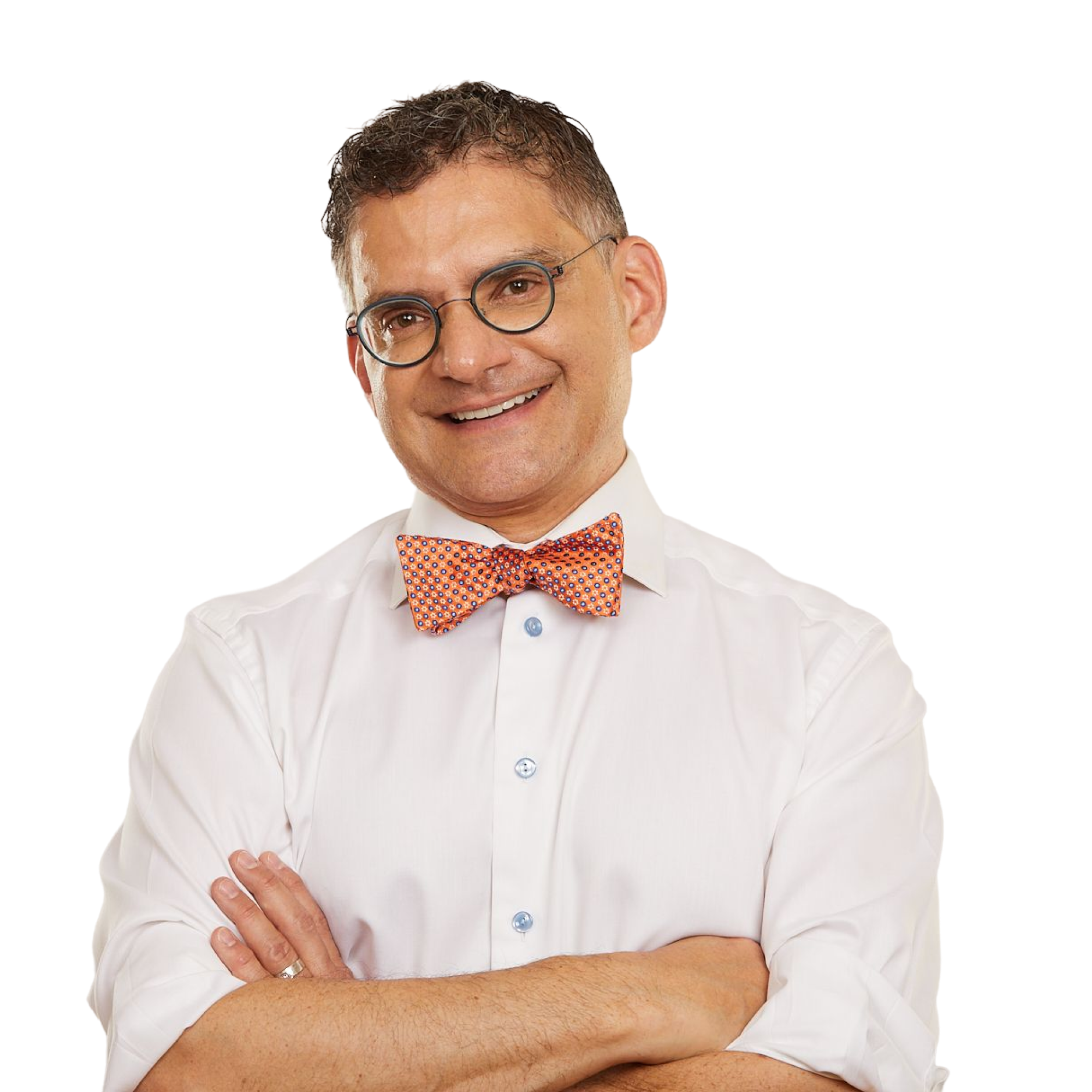
Dr. Martin R. Mendelson is a leadership speaker, coach, and founder of Metamorphosis Coaching, helping dentists and organizations build cultures of accountability and high performance. After a medical disability ended his clinical career, he channeled that adversity into a mission helping leaders harness mindset science to drive lasting change. He is the creator of the TEAM framework (Thoughts, Emotions, Actions, Manifestation), integrating leadership psychology and behavior science to help dentists lead more effectively and implement change with consistency. He has served as Adjunct Clinical Faculty at Nova Southeastern University and Resident Faculty at Spear Education for over a decade, and is the author of One Move Makes All the Difference.
Done learning and want to get started?
Book a demo