

Live From the Chair
The Patient Journey, Enhanced by AI
Transcript
Let's go ahead and get started then. So AI, everyone.
I'm Sophie Lovett. I'm from Pearl AI, and I'll be your host today. I am going to be joined by our cohost, David Rutherford. So David's from Henry Schein one, and we're absolutely delighted to welcome you to this session today. So it's titled live from the chair, the patient journey enhanced by AI.
So to book a meeting after this with with myself at Pearl or with anyone at Pearl or Henry Schein, you can scan the barcode that's that's here on my screen. We'll give that to you at the end as well.
Our presenter today is doctor Visham Patel from Bush Dental, and doctor Visham has been using Pearl in his clinic since he was in his twenties.
And we're especially excited about today's format, because it's gonna be a bit different from usual.
So what we'll do is we'll begin with a short presentation from doctor Vishan. And after, we're gonna take you inside a real patient visit within his clinic. And it was actually myself who had the pleasure of joining him there last week. It was pretty hot day.
And doctor AI walked me through how Pearl fits seamlessly into his workflow, and that was live from the chair.
So we hope this gives you a really clear and practical view of how Pearl supports clinicians in everyday practice, and there will be time for questions at the end. So feel free to submit those, throughout the session. There there's a q and a box, you should be able to see.
And so with that, I'm going to hand over to you, doctor Bisham.
Thank you.
AI. Alright. So hi, everyone, and welcome to this webinar, about elevating your patient experience with Pearl dot ai.
We'll be going over a patient checkup, like Sophie said, and I'll also be showing you how we can incorporate AI into this.
You'll not only know how AI can be, used with the team in the practice, but also how it helps the patients.
We'll also be showing you some of the tools Pearl uses and to increase patient uptake.
I hope you're all excited to see how Pearl can change your practice and the effect it could have on your patient's experience.
So here we go. Hello? So my name is doctor Bishan. I am a dentist working in a mainly private seven surgery practice in West London, the Bush Dental Clinic. Our practice provides a vast range of practices, so patients never need to leave, and all their services are seen under one roof.
Our love of constantly investing in the latest technology gives us the ability to offer the very best to our patients.
As soon as I saw Pearl for the first time, I was instantly drawn to it. Being able to turn an X-ray from black and white into color with a flick of a button is honestly amazing, and every time I do it, I'm amazed.
I found now being able to show a patient an X-ray and not having to explain all the different gradients of gray, a huge time saver whilst also improving my patient communication.
It's game changing to be able to use AI to help explain X rays to a patient now. So next up, we have a patient coming in to see us for a checkup. We'll be taking X rays, and I'll be showing you my general workflow, and how I incorporate AI into this.
Hi, Sophie. So we've got your X rays back. What we can see is we can see right hand side of the mouth in the traditional black and white. So what I've actually got now in the practice, we've got this new software which can turn the black and white X-ray into color.
So it allows you to better understand rather than pretending to understand. Alright? So I'm just gonna click down here, and here we go. So this is an annotated version of your X-ray now.
So what we can see is this software allows us to show you exactly what is going on in the mouth.
The first thing I wanna show you are these little green squares. Now these green squares indicate calculus, which is essentially plaque, which is hardened over a period of time. These then stick onto your teeth and kind of act like hooks. So whenever you eat, etcetera, they get hooked onto this bacteria, and then it just keeps building.
Yeah? So things like AI, that can then cause your gums to become more inflamed, you get bleeding, etcetera, really. And then over a period of time, you can actually get bone loss, which is something we do not want, basically. AI?
With this software, it color indicates them as well. So we've got green which is what you'd expect. And then in your situation, we've actually got some yellow which is something we wanna deal with before it things start to get even worse basically. Yeah?
What we can also do is if I click this little button here, we can see all your tooth parts.
Wow.
Yeah. So this breaks your tooth up into the three parts. So we've got your white enamel, we've got the green dentine, and we've also got the purple nerves. Alright? So that's what makes up a tooth. Yeah. What we can also see is here, that's a previous filling that you've had done a long time ago, I think it was.
The other thing is can you see this this little area of pink?
Oh, yeah.
So this area of pink is just in the enamel, and what we'd call that is it's actually the start of decay. Alright?
Now with this software, it allows us essentially picks these areas up so we can prevent it from turning into a filling. Now if this pink touches the green, we'd need to do a filling. Okay. AI?
So in the meantime, things like seeing hygienists, fluoride, tepee brushing can hopefully prevent that from getting worse essentially. Okay? Alright. Now as you can see in this image, there's another pink area here.
Yeah. Yeah. So this area looks a lot bigger. AI? So it's broken through the enamel and is now into the dentine.
And because the dentine's a lot softer, the bacteria just it loves it because it keeps eating away outside the tooth. Alright? Now with this software again, we can see the software again, we can see the exact percentages. So we can see forty nine percent in the enamel and fifty one percent into the dentine.
AI? So it's a pretty big filling, and we wanna kinda get that solved before it starts giving you issues. AI, your your tooth is still alive, but so that just normal filling can solve that basically.
AI didn't even fill it.
Yeah. So that's what I mean, the system is is amazing.
Because normally some patients as well, they'll say I haven't felt anything. So they don't come see the dentist.
With this at least you can see for yourself that there is something going on basically.
Okay. AI.
Do you have any questions at all?
Yeah, so AI I need to go and get that that treated, but what about those smaller pink areas? Is there anything AI all?
Is there anything I can do sort of quicker than Yeah.
So essentially prevention is key in dentistry now. So things like seeing hygienists, AI, fluoride mouthwash, tepee brushing, they're all great ways to get this better.
There's also this new, system called CureDont Okay.
Which I can talk to you a little bit later and write you up kind of a little treatment plan with everything in so then at least you know, what's going on, basically.
Wow. Okay. I've never seen it like this. And, AI didn't even see those smaller areas on the X-ray you showed me earlier. So I just think I understand a bit more what's going on now. So thank you very much.
I should AI should have come here earlier.
No problem.
AI, Sophie. So I've got your Okay. Well, I hope you all enjoyed that video. It was very embarrassing seeing myself again in that video explaining everything.
But here we go. So as a reminder, if you have any questions, please just feel free to drop them down in the chat box below, and we can answer everything at the end.
So to before we move on, I'd like to take a moment to show you an X-ray, within Pearl up close so you can get a feel for how intuitive and visually engaging the interface is. As you can see in this image, the layout is designed with clarity in AI.
Bright colors, color coded overlays highlight areas of concern, whether it's caries, bone loss, or calculus.
A visual key on the right hand side, so this bit here, helps you and also your patient instantly understand what each color represents.
There's also a toolbox with a variety of functions that lets you interact with the image.
Now one of the best things, with PUL is that you, as the clinician, remain in full control over display over, what you display, during a patient consultation.
You can toggle different functions on and off using simple switches in the sidebar.
This is especially helpful if you want to avoid overwhelming a patient or focus on a specific area. For example, if you're just talking about caries, you can turn everything off, bone loss, calculus, and keep the discussion focused and clear.
Now Pearl also respects your clinical expertise.
If you disagree with any finding or feel, something isn't highlighted, and it's not clinically relevant, you can easily edit the image. Just literally click on this little pencil button with the arrow, and you can manually deselect or remove any markers or areas identified.
So, for example, if you didn't believe this was decay, simply click it, and it will disappear.
Now these visual tools not only support your diagnostic workflow, but they're also incredibly effective for patient communication.
So to get the most out of AI, I feel it's really important to involve the entire team in its use.
As you saw earlier, dentists can use AI to help explain X rays to patients more clearly. Power offers a second opinion that validates your clinical judgment.
Hygienists can use it to highlight calculus deposits and track changes in bone level over time using the measurement tool. Even receptionists can benefit from Pearl's features as I'll explain later on.
By training your entire team, integrating Pearl AI into your workflow, and leveraging its diagnostic and visual capabilities, you can really enhance your accuracy. You can, increase treatment, treatment acceptance, and you can also deliver a more consistent and trusted patient experience.
So what happens if you've gone through all the steps, you've spoken to the patient about the clinical findings, you've shown them all the color, you've answered all the patient's questions, and they still say no?
Well, in our practice, when this occurs, we don't let the conversation end just there. So, normally, after around a month, our reception team will use AI to send the patient a copy of their annotated X rays accompanied by a a simple visual key. So as you can see in this image, that's exactly what we'd show and send to patients.
This document, serves several important purposes. So first of all, the patients can review their X rays at home at their own pace.
Everything is color coded to help them diagnose and better understand what was seen on the X rays at their checkup.
It also makes it easier for them to consider the urgency of treatment, more seriously. And I've even had patients explain their x rays to family members and ask for their advice.
This follow-up document becomes a key thing for that patient record, showing the diagnosis and treatment recommendations we chose in the appointment. If the patient later comes back in pain or has an infection, which needs root treatment or an extraction, essentially, you've covered it, and you've given all the information to the patient. You've identified everything early. You've explained everything clearly, and patient education was provided.
Now this is key in those cases where, patients are asymptomatic or there isn't a gaping hole in their mouth.
It also shows due diligence in identifying and communicating risk, before complications have arisen.
I feel it's a great tool to have and utilize in the practice, and and we've had a lot more uptake from those patients who normally wait until, they get symptoms.
So how does AI help patients?
With CAL, the process is incredibly straightforward. With one click, black and white to color. In this instance, patients can clearly see the different layers of the two as we explained in the video.
Even previous restorative work is highlighted, which makes it a lot easier for patients to understand their dental history.
By explaining these color coded elements and what they represent, patients move beyond kind of simply looking at an X-ray and guessing where everything is or pretend to know where everything is, and they truly begin to kind of understand it.
No more guessing what they're seeing. Instead, they gain a deeper awareness of their dental health.
For example, in the video earlier, I pointed out the enamel lesions, and I found patients really appreciate that you've taken the time to explain that these little areas don't need a filling yet.
Emphasizing preventative measures like OHI, fluoride, advanced treatments like curidont, can help them avoid further intervention.
Now as we move to the larger pink areas on the X-ray, patients typically also begin to recognize that they might have caries or that's a bigger problem. This is where AI really shines. Patients can see for themselves that pink has penetrated past the white enamel and now is into the green dentine.
This visual cue helps them understand that a filling is needed to stop the decay from getting worse, getting deeper.
Now back to the clear distinction between the enamel lesions, the dentine lesions, patients instantly grasp, the significance of the treatment and the next steps.
The annotations make things and they make the conditions easier for patients to understand. And patients, I feel, are more likely to accept treatment when they can see the problem firsthand.
This also then, builds up trust, not only in you, but your diagnostic process.
So this is another tool in the Pearl armory. So this is called the compare tool.
This is a prime example of how we can show the strength of Pearl and how it can enhance a patient's understanding.
So I saw this patient back in twenty twenty four where we AI caries on the upper left five measially and also the upper left six.
The patient chose not to proceed as he wasn't feeling anything, and there wasn't a big hole that he could see.
You can see he's also previously had, amalgam fillings in this area.
Now we can use the compare tool in Pearl to see two X rays side by side in color. This can show a patient that their condition may be worsening or on the flip side hasn't progressed.
Now with decay, pearl also gives a percentage number indicating how far it has traveled into the dentine and into the enamel. We can use this to show a patient whether a lesion is growing over time. This is a huge advantage, to educate a patient who feels they don't have a problem. For example, in this situation, this is exactly what we did.
In May twenty twenty four, we can see it was fifteen percent into the denti. And then in twenty twenty five, we can see it's risen to twenty six percent.
Now just by seeing those numbers, a patient normally they it literally just clicks, and they finally understand what you've been talking about.
In my experience, I've seen a lot more uptake in these types of patients, who prefer normally just to leave decay.
It also gives a patient a huge realization that things are worsening, and they could need further treatments or further fillings if things aren't addressed.
In this situation, we actually replaced all the amalgams, and he wanted the fillings done as well. So that was the work that we did. And he was really happy. And he was this was actually his testimonial.
So he said, I'm so glad I was finally able, to realize what had been occurring and go ahead with treatment. Being able to see the color X rays and percentages really helped me understand how the decay was worsening.
So we managed to get that uptake of treatment.
Okay.
So Pearl has really revolutionized the way I approach, my diagnosis and also my patient communication as a clinician. It's completely transformed how I carry out my assessments before, before kind of after using Pearl.
Before, I used to do this little drawing as you can see, and try to verbally explain what patients should be looking for in their X rays. Now, those visual explanations are built in with color, with annotations, and everything is clear and intuitive.
This is saving me valuable time, which I can further educate patients or simply build back better rapport or just chat about football.
As powerful as Pearl is, it's important to remember that it should always be used as a supporting tool alongside your own clinical expertise, but it can significantly enhance it.
I'll admit, I was pretty skeptical about AI and how it would fit into my workflow. But looking back, adopting Perl has been a no brainer. The return on investment has been cleared, not just in case acceptance, but also an increased turnover for all our clinicians at practice.
Beyond the clinical benefits, AI has elevated the patient experience. Patients are generally impressed, by the color coded X rays, and it makes conversations about treatment far easier, and more engaging. Also, patients love how we keep investing in the latest things. So this is another thing that patients are blown away by. Now in short, PO gives you the best of both worlds, advanced automation and also full clinical control. You're supported, not replaced, and it's a tool that empowers you, to diagnose with confidence, communicate with clarity, and tailor each consultation to your individual patient.
So thank you for your attention. I hope you've enjoyed everything and the presentation. I can now open the floor to questions.
That's wonderful. I think we have a QR code there as well on the next page, Dewey.
I'll just I'll stop sharing, and then they can just see your screen maybe.
I think so. Yeah.
Okay. So we have a had a couple of questions in the chat.
There is also a q and a, box as well. I'm not sure if you can see that.
So somebody's asked what percentage of errors and, what percentage of error in predicting these X rays through AI? And what is the so in terms of that, in terms of the accuracy, etcetera, it can vary, depending on the quality of the X rays.
We are looking to get better all the time, but I think, Vashan, you can probably attest to this that there are errors. And but would you ever go back to using a paper atlas over a satnav?
No. Exactly. I mean, AI the only times I've found in kind of real practice situations is if you've if you've taken an X-ray and the teeth overlapping or, you've tilted the X-ray slightly, and it's you're not taking the X-ray properly. If you get your grade one X-ray and you give it to Pearl, it is it it does work from unders. I'm I'm always out to try and get it and see if I can do better than it. But, honestly, most of the time, it's it's completely fine. And I I don't know how I would even go back to not using Pearl now, basically.
Oh, really?
Yeah. AI. Yeah. It's good. Because you you look at the black and white, and then you turn Pearl on, and it it shows you everything as well. And it also backs you up. So if you do think something's there, you can always use it as a backup, really.
Very good.
I'm AI on that note, Mishan, what would you what would you say your patients would do if you did go back to black and white? What would happen to them?
Has someone cut your funding?
Probably.
No. All patients, they love it because they can actually see. They don't need to pretend all the grays are there, etcetera. They can see everything clearly.
That's the best thing. When they see that pink interdenty after you've explained everything else, they're they're just like, oh, does that mean I need a filling?
Oh, that looks quite close to the nerve. And you just need to agree, and that's that's it, basically. You don't need to spend hours telling a patient, can you see this gray? Can you see that?
Yeah.
So you It almost almost gamifies it a little bit, doesn't it, as patients want to be involved nowadays?
And if you can gamify AI scenario where patients are nervous, sixty percent of the UK population are AI, but then it's If you can make them understand your education, but then gamify a little bit with the percentages, again, the small lesions that potentially haven't turned into in-depth, you can really draw them in and build that trust. And, well, once you've got patients' trust, treatment conversion, hourly rates, revenue, What's the next step?
A hundred. Yeah. A hundred percent.
You save time on needing to build that trust. You you essentially get it instantly because you don't need to you you're showing them a second opinion, essentially.
So they they trust you, but they're also trusting the computer. And they say, okay, well, computer says this. Yeah. Let's let's do it really.
Nice. And we have a couple more questions as well coming in. Feel free to pull them in.
We've got one here, so in the chat. So thank you so much is what AI saying.
So they're asking about editing the X-ray if you didn't agree with the diagnosis, and you showed us about how to do that, how to remove.
They also ask about what if it misses something.
Again, I hope you don't mind if I field this and pass it over to you.
Depends on the imaging system that you're using or the system that you're using per within.
So within Dental Vision AI, for example, you can remove, findings quite easily.
And within Exact, Examine Pro, you actually have the option to be able to draw, either free hand draw or, a box you can add on.
So you've got the option to add in as well there. If anybody kinda needs any extra training or anything like that, please let us know. But again, you know, the explanation with the tooth parts, it's there, to really help that that enhanced communication so you can point to different areas. If you feel that it's missed something, again, good to put on the two parts and point out where you feel that, say, for example, an area of decay is on the tooth. So it doesn't atomize it. But, yeah, of course, it can miss things as well. You do have the option to draw those in on exact.
Mhmm.
And then we have another one here. So probably one probably one for AI, doctor Fishon. How do you find Pearl, with diagnosing recurrent caries?
Yeah. It's it's exactly the same, essentially.
It's it works.
When you've got decay, it will show you underneath the filling, a dark little area and which will highlight it, and it'll pick it up as well.
So it will also do that.
Yeah.
That's that's what I would say, really. So, yeah, it does pick that up as well.
And I have another one here, about we mentioned Curadon.
And, is that is that something that you're using as well for those watch areas or going to use?
At the moment, no.
AI have spoken to CuracDont and, they Of Vivadas.
Sorry.
Yes. So they are actually coming yeah. They are coming into the practice to give us a demo of everything. And, yeah, I look forward to seeing how it works.
AI I was at a talk, the other day as well, and they were explaining it. And it actually the percentages of how it works is pretty fascinating. So now you don't need to just walk. You can actually treat these areas as well.
Okay. And that's a new up and coming thing to do.
Because, yeah, before, we were just doing well, we used to give a lot fluoride mouthwash, fluoride toothpaste, etcetera, to our patients.
As I think I said in my previous webinar, with Pearl, that goes through the roof essentially.
So being able to do Well, your percentage is over a thousand percent increase in fluoride mouthwash since using Pearl. It was something Patients always say, what am I supposed to do with those enamel lesions?
And then you say, AI, you do x y zed. So, yeah, we're definitely looking into using, CureDont to help with that as well.
Yeah. That's that's something that's, yeah, really useful to to add to those, you know, watch areas and guess that prevent those preventative measures and early interventions are are super helpful as well.
Any more questions from anyone? Anything else anyone would like to add?
Don't be shy.
Oh.
Oh, here we go.
Oh, did you change the amalgam restorations because of recurrent decay or recurrent caries? Because AI breakdown, you showed us, I don't recall seeing current, recurrent caries, but it did look a bit radiolucent on the amalgam restoration, especially on the upper left. There is a very, very, that that that that is something who's got an item detail right there.
No. So the patient so the the areas of decay we saw, I don't think they're absolutely I think there may have been a lining or something underneath the, the amalgam, but the patient simply just wanted it all redone. He wanted all the amalgam to be done. So we just did quadrant dentistry, replaced everything, all the decay.
It it may have been leaking under a mouth because he'd had it for quite a few years.
So that that may have been it, basically.
Somebody once said to me that because with with Pearl, it shows how large the area of decay is or or is in some cases that it, you know, and kind of laying that overlaying that on the anatomy of the tooth, they can see where the filling would be and therefore AI of what it would look like. So it helps, the patients decide what they want to do with that there as well.
I had a question as well about the integration with Dentally and Dentally Vision.
David, can you field that one?
Yeah. Of course, I can. So, I mean, obviously, Vision's been showing you Examined Pro and how Pearlie AI integrates with that. With Dental Vision, we take it one step further, though, as Dental is our cloud based system.
We've got Dental Vision, which is also our cloud based X-ray software. So vision so Pearlie AI immediately links into that. So regardless of where you are in the country, you can be looking at notes from home. You've got access to your x rays.
You've got access to Pearl AI. So you can do really complex treatment plans. You can get home, see the kids, pop in the bed, attend a webinar like this, and then finish your notes. Do whatever you need to do there.
So it really truly gives you that remote based system. It also severely reduces your hardware requirements on-site as well. So we've talked a little bit about return investments AI getting rid of expensive servers, hardware, and everything else. Vishal will have a conversation later about that transfer to Denki, by the way.
It's a different conversation for another day. But it's definitely that next step in dentistry, how to make your team more mobile, remote, and really drive that usage forward.
It's pretty stunning as AI, I must admit.
Whilst we've got you all here, AI got some some information I'd like to share with you. I'm probably sharing a bit prematurely, but we've been recently, we've recently been doing some work with, lovely dog shop in Scotland who has, decided to time how much time she's, saved per visit.
And per visit is worked out nine minutes per visit since she's been using Pearl.
She's already a great communicator like you, Doctor. Visham.
But this has really enhanced that it's taken out that ambiguity or, you know, the, the patients having to question what they're being told because it's almost bringing them along with them. You know, it's, it's allowing patients to really understand their oral health needs.
So, she said it's also made patients a lot stickier as well. They're coming back more, they're returning, which is really nice as well.
You know, pay people have got a lot more choice these days, and choice isn't always the best thing. It's quite nice to to stay somewhere and and be loyal and, yeah. We're we're hearing that yeah. Similar to what you said, doctor Vishen, AI have about not wanting to go back to gray and black and white, it's the same for patients as well now. They're choosing to to go for for practices that are using pearl and seeing those gorgeous colors.
AI think that's a really important point there, Sophie, as well. I mean, the amount that it costs to generate a new patient coming in and the amount that you guys spend on marketing budgets, if you can actually retain your patient retention by keeping them loyal, by building that trust, you then can upsell because they're dental stable quicker with things like Curadont. You've got dental stable patients, which are then AI for cosmetic work, whitening work, regular plans, and hygiene visits. There's a whole host of possibilities that this delves down into.
I mean, them time statistics AI minutes per patient as well is crazy. Can you imagine that if you then coupled that with DENTLY's soon to be released AI clinical notes, which saves two thirds of your exam time as well? So you've immediately cut down in nine minutes and then say number five minutes, that's nearly fifteen minutes. That's nearly half an existing patient return exam. That's craziness. How many more patients can we see to boost the health of the UK with that, capability?
Fantastic.
Yeah.
I see some very good points.
Nice. New frontier of British dentistry. Yeah. Well, I mean, we're all big fans.
And Bush Dental is a fantastic clinic as well. It's absolutely gorgeous.
And it's nice and cool in the summer. So definitely worth a visit to Bush Dental as well in Shepherd's Bush. Like I said, I was lucky enough to go last week, and, live from the patient chair.
AI was good to have you.
Right.
Unless there's any other questions, I think that wraps us up. As I said, put my QR code here. Feel free to contact any of us. You've got David Rutherford from Henry Schein one. You've got AI, Sophie Lovett, and the wonderful doctor. Thank you so much.
Thank you so much for Henry Schein for, co hosting with us today, and, we'll see you all on the next one.
Alright.
Thank you.
Yeah. We might have a late late question on this, actually.
Oh.
Oh, there's some some thank yous and yeah. Cool. Thank you so much. Take care, everyone.
Meet Your Host
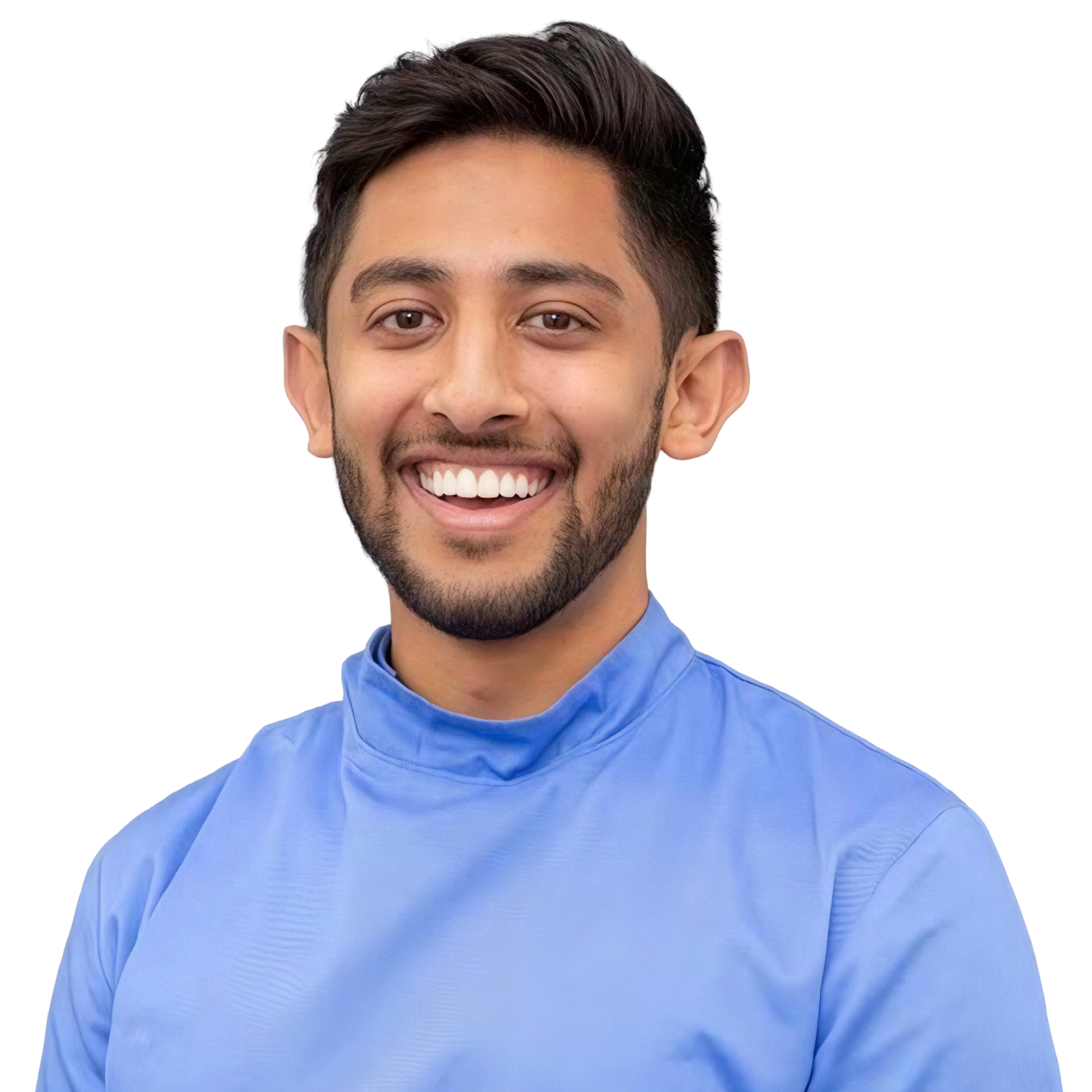
Dr Vishan Patel was born in London and graduated from the University of Bristol. Vishan is a charming, enthusiastic, friendly and caring professional focuses on making his patients feel relaxed and calm when under his care. His pain free approach to dentistry gives his patients an overwhelming sense of confidence in his abilities. Vishan prides himself in Cosmetic and Restorative dentistry. He has completed over 100 Invisalign cases and multiple full mouth makeovers while at the Bush Dental Clinic. Vishan loves to use the latest materials and gadgets in order to offer the very best treatment for his patients.
Done learning and want to get started?
Book a demo