
From Diagnosis to Discussion
Using AI to Enhance the Patient Experience
Transcript
Hello, everyone, and happy Friday. We made it another week. We are so excited to have you on our webinar today. You are gonna learn so many takeaway nuggets on this webinar.
So I wanna go over a few housekeeping. So my name is Sheela Roth. I am head of clinical education at Pearl, and I'm gonna walk you through a few quick steps, and then we're gonna dive right in. First of all, we would love this to be interactive.
In a lot of webinars, you're sitting there and you're listening and checking your phone. We're gonna give you such great information. We would love for you to put some questions in the chat as well as you get a chance to play a game today and try out all of the AI on your own phone. So you wanna stay tuned because we will announce a winner at the end.
Let me jump in and share with you a few incredible things about this webinar today. We are so excited to have everybody as AI is such a hot topic, and there's a lot of myths that are going around about AI. Right? Is it gonna take my job?
What's happening in dentistry? Should I adopt it? We are in a phase of mass adoption. So we're talking about something that is really changing the way dental teams work, artificial intelligence, and how do we actually incorporate it in the workflow?
We don't wanna add any more time. Right? Today is about helping the clinician review images faster, and also all of us that are educating patients have the patients be able to see what we see. We're thrilled to have our friends and partners from Oryx with us today.
Oryx has been a fantastic partner with Pearl. We're gonna share some magic about how we work together in just a little bit. And I'm excited to welcome Katie Nelson, our senior account executive at Oryx. Katie, thank you so much for being here and for helping us bring this conversation to dental professionals.
So happy to be here with you guys. We love our friends at Pearl so much and love seeing our doctors find success as well.
Excellent. And we have our lovely Kimberly Kuishin, who is our director of partner growth at Pearl, who is all things partners, and I'm honored to have you here today, Kimberly.
Excited to be here. Thanks, Sheela.
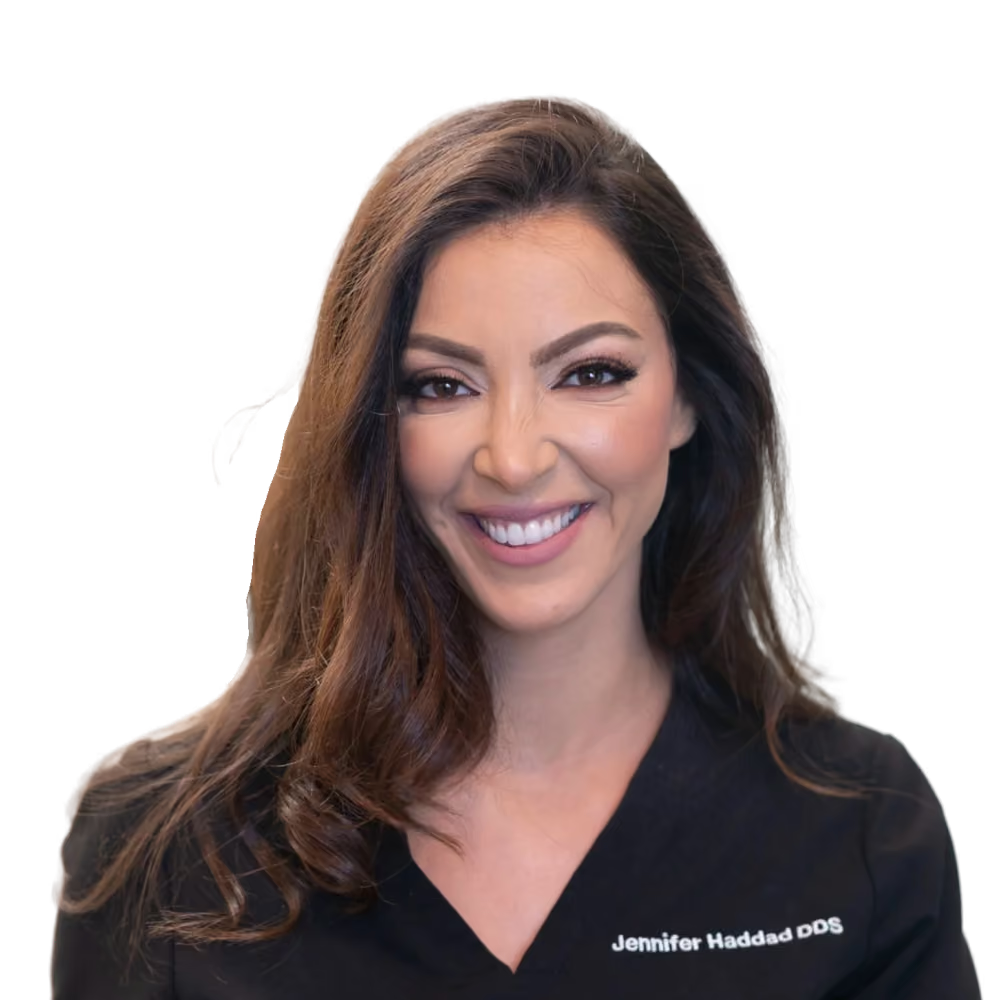
Now I'm especially excited to welcome Doctor Jennifer Haddad. Jennifer is a biomimetic and restorative dentist practicing in Beverly Hills and West Hollywood, and she brings an incredible combination of both excellent clinical experience, science, and the artistry in restorative dentistry. She's also speaking on behalf of different companies that she feels very valuable about the information that they're going to be able to share with you and how these things make her day easier.
She also serves on the board of the LA Dental Symposium.
So, Doctor Haddad, I'm gonna turn it over to you in just a moment. But when you think about AI in a restorative place, one of the questions I'd like to ask you is, where do you see it having the biggest impact, not just in diagnosis, but the way you deliver care and communicate with patients?
I will tell you the communication has been a huge game changer. And what I mean by that is whenever I am able to incorporate AI into my daily practice. Right? And for example, one of them is Pearl.
That's been huge. For a patient to finally understand what it is that we are seeing allows them to accept treatment, and that's really what it is. Whenever there's a visual attached to anything that we're doing, right, whether it is trying to indicate a cavity, an infection, even cosmetics. Right?
When you're able to give them a visual of some sort, that communication barrier between the patient and the dentist becomes bridged because now we both have a clear understanding of really what it is that we, as clinicians, are trying to explain to our patients and what we're recommending. So that's been huge.
I love that. And shocking statement is sixty five percent of people are visual learners. Right? We've been showing them black and white and trying to explain things for so many years, and now we have the ability to speak in patient language. So we're excited to learn from you today. Take us inside your workflow and show us what AI really looks like in a modern restorative practice.
Sheela, thank you for having me, you guys. I am so thrilled to be here with you today, and I really wanna thank you all for taking the time to attend today's webinar.
I'm excited to talk about how AI can help us enhance the patient experience, and we're going to explore how we can use AI not just as a technology, but as a tool to support us and to support better communication and a more meaningful patient interaction.
Before I begin, I would like to disclose that I do not have any relevant financial relationships with commercial interests, and with that I would like to say that I am so grateful for the opportunity to be here today and to share this information with you and to share what it is that's helped my practice so we can help each other. A quick introduction so you all get to know me a little bit better. My name is Doctor Jennifer Haddad and I graduated from the USC School of Dentistry in 2013.
During my time there I was one of the fortunate students who directly studied biomimetic dentistry and trained under Doctor Pascal Magne, who is the father of biomimetic dentistry, and this practice philosophy is something that I carry onto my private practice for about thirteen years now. I'm currently a host and an educator for The Society, which is a virtual dental community, and was a faculty resident for Magne Education, located minutes down the street from my current dental practice.
My private practice is currently located in the heart of Beverly Hills in West Hollywood in a modern state of the art dental facility with my colleague Doctor Victor Kagitorian. And prior to my practice here I did spend time in many different dental settings within the LA region like PDS and other fast paced dental environments. I did pick up several pearls from each of my experiences. And with the various settings I was in, I took what I liked from each and I created my own niche. And now I have the luxury of working with really some of the best technologies, specialists, and even the best lab.
I want you all to take a second and imagine being one of fifty two dentists in this medical building. Yep, you heard it.
Fifty two dentists in one building in the heart of Beverly Hills. When people hear this, they're shocked and I always get people asking me, well, how is my practice surviving with such competition?
But I'm gonna tell you really what separates me from the rest. Number one, it's my niche and passion in biomimetic dentistry. Number two, it's been incorporating the latest technologies and treatments in dentistry for my patients.
And three is just my love for being minimally invasive, which my patients pick up on.
I've really have some of the best mentors throughout my career, and my journey in practice has led me to becoming a part of the Magne Education team where we all inspire and educate others in biomimetic dentistry under one roof.
Now let's get started. My goal for you today is really twofold.
First I want to walk you through practical AI tools and features that you can begin implementing in your dental workflow right away to enhance the way you care for and communicate with your patients.
Second, I want to show you how modern dentistry is evolving. It's not just in terms of the clinical technology, but really how we can transform the overall patient experience, improve the communication, create more meaningful interactions with people that we serve with tools like AI.
Okay. Why AI? AI is a huge topic. A lot of dentists and even many other professions are "getting replaced" by AI.
However, I wouldn't worry about that with dentistry. I'm gonna tell you why.
What I find interesting is that technologies aren't necessarily just about making the dentist's job faster.
They can change the patient's experience and that is huge because when we spend less time looking at the computer, for example, and documenting, which everyone loves in dentistry, but we have more opportunity to look at our patients, communicate with them, really spend time with them, and they are the main purpose of what it is that we do. Rather than having a separate AI tool that requires another login or another screen, there are softwares like Oryx that bring AI into the clinical experience from documentation to charting to perio exams, diagnostic imaging. Really, the goal is to reduce some of the administrative burden while we focus more on the patient.
So why is AI becoming so relevant? Well, there are three major reasons. Okay? First, our teams are time starved. Honestly, we're always looking for more time to do more things and we're trying to balance that clinical care with the charting, the documentation, the insurance narratives, and there's so many administrative responsibilities that compete for our attention.
Every minute we spend time documenting is a minute we're not spending time having a meaningful conversation or even seeing a patient.
Number two is patients have a different expectation today. They've grown up with digital, visual, and on demand technology. They are now accustomed to really seeing information presented clearly and visually, and they increasingly expect that same level of clarity and engagement when they come into a health care setting. They don't just want us to tell them what we see.
They want to understand it and visualize it. Okay? Third, we're dealing with increasing diagnostic complexity. Dental images can contain radiographic and clinical findings that may be difficult to identify consistently amongst either doctors, staff members, or people in your practice or amongst different practices.
So when you have AI, it provides an additional consistent set of eyes that can help bring attention to finding those details that deserve a closer look. Okay? So when we put those things together, at the end of the day, AI becomes less about the technology, and it's more about giving tools that can support both clinical care and better patient experience.
Now before we talk about how AI can help, let's recognize a common challenge in dentistry today. There's a disconnected practice. We often have multiple systems for practice management, imaging, charting, perio, communication, insurance. And then when those systems don't communicate, guess what?
Our information becomes siloed, and our teams spend valuable time moving one information to another. This can lead to a lot of after hours charting and inconsistent documentation, again, taking time from what matters most, which is our patients. This is where integrated technology and AI really makes a difference. It's connecting the workflow.
So how do we move from a disconnected practice to a connected digital workflow? Well, guess what? AI works best when it acts as a connective tissue between systems we already use rather than becoming just a stand alone tool.
And that has been the beauty of what it is that I have incorporated into my practice, and it can help connect all the clinical findings, the imaging, the documentation, the treatment planning, the communication to reduce that repetitive work and allow for a more seamless flow. And guess what? The goal is simple. You have time management, and you're focusing on the patient.
And with all this, I'd like to say that this really creates a trust equation. Okay? The patient can see the finding, understand what it means, feels included in the decision making process. And when they can visualize it and they know what we're talking about, guess what?
It makes it so much easier for them to understand their diagnosis and why we're recommending it. They're no longer just being told what they need, but they see it, they understand it, they participate in the conversation, and I think that's where technology can really enhance the patient experience, not by just making the decision for the patient, but giving them that information and then giving them confidence. Guess what? That leads to a higher acceptance rate.
And I'm gonna go ahead and I'm gonna transition into a real life patient case with you here. This is a great example of how visual technology can build trust, improve patient understanding, and help patients feel more confident in making an informed decision about their treatment. So let's take a look at my patient, Gianna. Okay?
Can you guys guess what she's coming in for?
Here's a little background for you. She is nineteen years old.
She hasn't been to the dentist in over two years and she says to me that she wants straighter and brighter teeth for her birthday and she has sensitivity on the upper left and her medical history is not significant.
So let's take a look and gather our records. Okay? We start with photographs. What are you guys all seeing so far?
Let's take a closer look with the digital scan now. This is part of my daily workflow with every patient because it is one of the most powerful tools we have not only for diagnosis but also for patient education.
A digital scan gives us a 3D image of exactly what it is we're seeing clinically, so instead of just explaining the findings again, we can show patients their own teeth in 3D, and a lot of patients are always so impressed by this, making it so much easier for them to understand their oral health and the treatment we're recommending. Another major advantage is it eliminates the need for messy impression materials. It creates a more comfortable experience for the patient as well so the result is really a faster and more efficient process.
Now with certain scanners you can use another technology called near infrared imaging, which is a radiation free tool that uses light to detect interproximal caries in real time and guess what, it reaches a ninety six percent accuracy compared to bitewing X-rays. So here we are leveraging technology to be more minimally invasive, but also more productive and proactive.
Of course, we take our necessary photographs. And with AI technology, you can see that it's been a huge, tremendous game changer in my practice since the patients are able to understand early cavities versus ones that need to be treated. Obviously, some examples are Pearl and Overjet, and here I am using Pearl in my Oryx software.
And by the way, how great is it when you can have a case acceptance so high with this technology?
And one thing that I found out, and it's a shocking fact actually, is that AI dental radiograph adoption is still likely under fifteen percent of all US dental practices overall.
And really when you have AI technology, it really serves as a second set of eyes for clinicians, providing real time, objective, and color coded visualizations that improve the diagnostic accuracy and patient trust and education.
Believe it or not, AI is more sensitive to mineral changes and it detects it faster than our naked eye. For a lesion to be visible on an X-ray, mineral loss has to be beyond forty to sixty percent, and that's when the caries process is happening, and so that's why it's so helpful to incorporate this technology.
You can see all these interproximal caries lesions on the right and left. You can see why she's had sensitivity on the upper left now. And, really, you're starting to gather that whole picture of this patient who's come in, and she really had come in essentially for cosmetic purposes, but she has way more important underlying dental problems here that we need to address as her dentist. Now what would your treatment plan be for her? What would you do with a tooth like thirteen? Would you root canal, treat, and crown this tooth? Would you restore it with an onlay? Or would you do a simple composite?
Really, with all this information, I begin to enter detailed notes in my software, and this software is an all in one cloud based dental practice management platform designed to bring clinical care, patient communication, and practice management to one system. In this case, I am using Oryx, and it really features a lot of the following.
You have AI transcription and summarization, AI exam charting, AI dental imaging, AI voice perio charting, and AI clinical documentation. I'm gonna be going through these prompts shortly with you, and I'm gonna show you how helpful these features have been.
So first things first is the clinical examination. What's nice is that AI will help you chart, and it guides the dentist through the examination and assists with chart findings.
And what's so nice about this is that AI transcribes and summarizes and listens to the patient visits as we are talking into the software, and it generates a structured clinical summary, which helps reduce documentation time. Here, what I'm doing is I am actually — you're not listening, you can't hear it because I'm talking over it. But what I'm doing is I'm talking to the AI, so I'm recording what it is my recommended treatments are, what my findings are. And then what happens here is that it produces a nice consistent summary of the procedures planned. It also records what it is that I said, and it's helpful in creating progress notes if we need to. There's so many features in this software that I can go through, and I'm just trying to be as consistent as possible to show you what's possible with a software like this.
Again, once you record the audio, the AI can also go ahead and chart the exam conditions, and it also can enter the treatment procedures. If there's anything you need to modify or change, it's so easy to do it because the list shows up, and it's so nice that it makes your clinical system workflow so much more efficient so that you can actually have, again, more time to sit with the patient, to do what it is that you need to do instead of having the front office, the back office, enter all of this for you.
One of the things I really like about this technology is the workflow is really seamless. The AI is not something that requires us to really stop what we're doing, which has been amazing. You don't have to open up another program. You don't have to move between multiple screens.
It's incorporated directly into the workflow so we can use it while we're already examining the patient and review their images.
Another feature that I think is really interesting is the AI voice perio charting. Traditionally, when we are doing a perio chart, we're either relying on another team member to record the measurements, or we're trying to probe, remembering the numbers, and then entering them into the computer at the same time. How many of you guys have experienced that? Now with the voice powered perio charting, I can simply call out the measurements as I'm probing, and this is happening in real time, and the AI captures those measurements, places them directly into the perio chart in real time, and that means I don't have to stop what I'm doing.
And guess what? In many cases, I don't even need a second person dictating into the chart. So from a practice perspective, this is a huge impact on efficiency because it allows either a hygienist or a dentist to remain focused on the patient instead of constantly shifting attention between the patient and the computer. It can free up another team member to focus on other responsibilities rather than simply calling out or entering names.
And we all know how much there is to do on a daily basis during a patient visit, and we can utilize that team member more efficiently. But guess what? The biggest benefit here is the patient's experience. When we're not looking down at a keyboard, turning away from the patient every few seconds, we really can manage better engagement with them.
We can talk to them about what we're seeing. We can explain their perio measurements and help them understand their numbers.
AI is becoming such an increasingly valuable diagnostic in imaging specifically, in helping identify potential pathologies and findings on the radiographs, it really serves as a second opinion, and it brings more consistency amongst team members and other doctors.
And when we think about dentistry specifically, radiographic evaluation is a cornerstone of clinical care. You guys all know this. This is an area where AI can provide an additional layer of support. It helps us analyze images, again more consistently, while keeping the clinician at the center of the diagnostic process.
It's a tool. It adds to us. It does not replace us. Radiographic evaluation is a cornerstone of clinical care in dentistry, and Oryx began integrating Pearl's AI powered imaging into its platform in 2023.
It's continued to evolve as AI has become more integrated in the dental workflow. Ultimately, for me, the biggest advantage has been communication, and it's been a game changer in my practice. It helps us identify findings, organize information, communicate what we're seeing without adding another layer of work. And, again, we don't have to spend so much time clicking, typing, documenting.
We focus on the patient.
Now what I love about this feature is that, again, it's embedded in Oryx. It's AI powered imaging. It integrates diagnostic AI from Pearl or, for example, Overjet, to analyze dental imaging and flag potential findings. For example, like caries, bone loss, periapical radiolucencies, and calculus, and you can see how it highlights each of them and color codes them. Right? So it highlights each of these different problems or infections or things to look out for. So I'm gonna show you a couple of examples here.
Look at how much easier it is to communicate to a patient with what you see. So we've always been accustomed to showing them the radiograph on the left side. And now, before AI, you would have to really point to those dark areas on the radiographs, tell them where those areas of cavities are developing. And then you would have to try to pinpoint the areas of calculus and I would always tell them, look, it's like sticking out like a pimple, and I'm hoping that they see it, and guess what, most patients, even though we don't know it, they'll just nod to agree with us.
Now there is no guessing involved, and that has been such a beautiful improvement in our daily workflow, at least in mine, I will tell you. They can visualize what we are seeing. They're not guessing. They're just not nodding anymore. So let's take a closer look.
If a patient has calculus, look at how nicely it identifies it. It boxes the area of calculus. I don't have to sit and point and try to see if they see what I see with calculus.
One of my favorite features with Pearl is highlighting the different layers of the tooth and helping educate our patients again through visualization.
When the patients understand, the acceptance rate goes up.
Okay. So we're gonna do something fun. I'm gonna stop talking for a little bit. We're gonna play a little fun game together, and it's gonna test our radiologic skills.
Okay? Everyone likes to play a game, at least I do. What's going to happen is you are going to take a look at the X-ray. There's gonna be three different radiographs.
Okay? You are going to add the findings that you see on those three separate radiographs, and we're gonna compare what it is that you see to what AI picks up. Once you're done, you'll submit your results, and I will announce a winner at the end.
So let's go ahead and let's get ready to play and win. Go ahead and take out your phone. You can scan that QR code. Okay?
And for the highest score, the winner will receive a fifty dollar gift card of your choice from Pearl in a week. However, you must enter an email address where you can receive this prize if you win.
I'm gonna give you a few minutes to play, so go ahead and get started and really focus on trying to have fun spotting all the radiologic findings.
And, again, we will be disclosing the winner at the end of this presentation, which is really exciting.
It takes about ninety seconds to load, everyone, so give it some time. If you're noticing it's taking a little time, again, it takes ninety seconds. And as you go through, you're going to be basically working with the prompts on the bottom. Right? You're going to be dragging that to the top if you see caries, if you see a periapical radiolucency or a margin. That's, again, areas you want to go ahead and match it up to.
And, yes, if you guys are just watching the webinar on your phone, there is a link that they can send you guys, and you guys can play this as well.
So as you guys play this, I am gonna go ahead and continue with my presentation.
And, again, we will announce the winner at the end, which is gonna be very exciting.
You guys will get a gift card of your choice, and it'll be emailed to you, okay, in a week.
So let's get back to Gianna's case.
We have addressed the caries lesions that are in dentin, we're gonna be completing a restoration on the existing root canal on tooth number nineteen, now what would you guys do in a case like this with the rest of these incipient lesions that are highlighted above? And there's really no wrong answer here. How many of you would tell the patient to watch and wait?
How many of you guys would feel guilty to drill into these teeth? And then when we watch and wait, how many of you guys will see that the cavity is growing, and how many of you guys would drill and treat these lesions? Again, there's no wrong answer here because as a provider, we're always fighting between overtreatment and undertreatment of our patients.
And the reality is, with all this information, again, most would wanna prep in this case. But let me ask you one thing. If this was your daughter or your niece at such a young age, would you want to be as conservative as possible? So in this case, I go through the sequence as listed above.
But what's nice is with all of this clinical and radiographic information that we've collected, I'm able to generate and print a personalized risk assessment report for the patient through my software with Oryx. This gives us a visual tool to review together, it helps the patient see their findings, understand their individual risk factors, and have a more informed conversation about their treatment and preventative care.
So ultimately, it helps turn complex clinical information —
[Minor technical difficulties.]
Are you guys able to hear me?
Yes.
You're back, Doctor Haddad.
Okay. Perfect. I just wanted to double check.
So now with all this information, she's ready for her treatment, which she understands and accepts. Again, she came in for a more cosmetic purpose, and now I'm throwing all of this at her. But with my AI tools, with everything that I have incorporated into my software, she was able to understand, and she accepted, which is beautiful.
So in her case, I have the confidence of using composite as a final restorative material for many of these teeth and being minimally invasive to avoid a root canal.
And in restoring all of these lesions, what I'm doing is I'm using a rubber dam to complete IDS, which is immediate dentin sealing, and to achieve a high bond strength by preventing contamination.
Of course, during my bonding protocol, this rubber dam helps to reduce contamination to really get a superior adhesive outcome.
These steps are so underestimated, and the reason I like the rubber dam is because in cases like this, how can you successfully execute all of these steps without the rubber dam? There's such a higher chance of getting contamination without it, because it's not just one or two steps, but several steps to get a superior outcome.
Once I've addressed the patient's chief complaint, now she will go through a hygiene protocol. And in this case, guided biofilm therapy is a preventative dental cleaning protocol that uses airflow technology, and what I love about this technology in my practice is it utilizes warm water and fine powders to remove biofilm, which makes it more comfortable for the patient.
Airflow technology is minimally invasive. It provides comfort, it's efficient in biofilm removal. What I love is it's super effective around ortho brackets, on implant surfaces, on restorations like veneers, which you can't really do with hand scaling, and it has a superior interproximal reach to remove biofilm. It supports tongue and palate decontamination, which is amazing. You can remove that biofilm from the tongue and the palate, and that's been so amazing for patients to experience, and it can be used on exposed dentin and primary teeth.
Okay. Ladies and gentlemen, you get an exclusive look into my oral hygiene protocol.
What guided biofilm therapy uses is, number one, you can see to the left, a disclosing agent. It's a dye to highlight bacterial biofilms. And then number two, the airflow device, which uses air, warm water, and fine powder, which is typically erythritol or glycine, to remove plaque and stains supra and subgingivally.
Okay, guys. Look at the results on my patient, Gianna.
Do you guys really think that traditional hand scaling and polishing alone can get you that dramatic of a result as the airflow did? Look at how the before has yellower teeth, and then right after we remove that plaque, she has brighter teeth instantly. The use of fine powders removes the stains effectively, which aids in the cosmetic aspect of our treatment, and then what's nice is it prepares the surface before any restorative bonding and/or whitening procedures.
So after hygiene and restorative treatment has been completed, she is ready for the orthodontic phase. The caries are controlled and she's in Invisalign to now address what she originally came in for.
Now that she's going through her Invisalign treatment, she is excited to achieve what she originally came in for, which is straighter, brighter teeth, and she's been so compliant.
And the reality is, with all that was presented to her, most patients would sit there and they would want to just get what it is that they came in for. With an appropriate way of communicating to the patient, you are now able to help them understand what's going on, why it's important, and again bridge that gap of understanding treatments, the importance of treatments, and why we have to address things accordingly before we address what they want specifically.
And guess what? She's celebrating her birthday on Monday, so I know she wanted straighter and brighter teeth for her birthday. But because, again, she was informed and educated about the phases, the process, she was okay with taking care of all that was important to her.
And now, in celebrating her birthday, she has a nice healthy smile that she's working on.
And, really, as we conclude, I wanna leave you with one key message.
AI is not replacing the role of a dentist. It can strengthen it. And when patients can see what we see and they understand their diagnosis, they participate in the conversation.
We are creating greater communication, education, trust, confidence in treatment decisions. When patients see what clinicians see, guess what? It leads to a nice percentage increase in case acceptance when a dental AI company like Pearl is used chairside. And when you have an organized software like Oryx that allows you to prompt through all of the important aspects of a dental examination, clinical findings, perio charting, that is just such a game changer for your workflow alone, and it helps to bring consistency throughout all members of your practice.
So, really, I urge you to start exploring one AI tool that you can incorporate into your practice, at least one, because it is going to help you tremendously. It's gonna help your patients tremendously, and you're going to see what an improvement there has been in that communication.
Because number one, it's gonna help you communicate more clearly, it's gonna educate your patients more effectively, and then ultimately just enhance their overall experience.
And I have had such a pleasure just sharing with my patients what it is that I see. I'll never forget when, before I became a dentist, I was told by my dentist, hey, you have a cavity that's starting to form. I would take a look at those radiographs. Back then, they weren't even digital.
And I was trying to stare at those radiographs, and I would not even understand or see. I've always remembered that moment and that experience in my own lifetime, and that's something I apply to my patients. I think about my patients. When Pearl AI came out, I was so thrilled because now I was able to show them what it is that I am looking at, and I know they can see it because it's color coded.
How beautiful is that? How beautiful is it that we are able to really just bridge that gap and not have people guessing? And there are so many patients that are shy to tell you that, hey, I'm unable to see this. They're just gonna nod.
They're going to say, okay. And you know what it's like when we're sitting and we are trying to explain with our dental terminology what it is that they need.
They're not understanding what they see on a treatment plan.
And with a software like Oryx, like I said, that report is able to just break it down so much easier.
What a privilege it is to be practicing in this day and age in dentistry with all that we have at the tips of our fingers. It's been such a pleasure to share with you a case like Gianna's, and I am loving the experiences that I'm having with my patients. And I'm hoping that you guys are able to also have that same experience with just upping the technology and really incorporating something that is going to just make your life and your patient's life easier.
I'd really like to thank you all for your unwavering attention.
I hope you've learned a lot today. I am here to really share everything that I absolutely love with my day to day practice of dentistry, and I am so looking forward to always seeing what is coming in the near future because it's just making our lives easier and our patient experiences so much more streamlined. So it's been such a pleasure, and now I wanna open it up to any questions you may have.
I wanna share with you guys my socials, my email if you'd like to connect with me.
And now I wanna take some time for questions.
Excellent. So I'm gonna share my screen in just a minute after everybody has grabbed Doctor Haddad's information, so that we can give you a QR code to be able to find some time to meet with your team and have a demo of Pearl and Oryx.
Let me put that up, and then we're going to do two more things before we let you go. One, we're gonna announce the winner, and then we will also give you the CE credit.
So I need to share my screen, I think.
Let's see here.
Okay.
Excellent. So how we would like to invite you is, scan this QR code on the left to see how you can work with Pearl. All of our features, our radiological side, our morning huddles and chart audits that are done for you, as well as our voice tool as well. What I love most is as you're moving into thinking about moving to Oryx, or if you're currently using Oryx, Pearl is directly inside of your imaging system.
So I really wanna start off with questions. I know Kimberly has some. But a lot of the times, Doctor Haddad, you went through this incredible presentation that feels amazing. And then also as somebody implementing it, I'm thinking, oh my gosh.
Does that take six weeks? How long does that take? How do I get my team trained? And I bring that up because that's one of the biggest things that we hear — is this hard to adopt?
We've all put, like, scanners and things in where we had to change our entire workflow. Can you walk us through how this has saved time and improved your workflow a little bit, about adoption and training, that kind of stuff?
Well, I really wanna say that the biggest aspect of what I loved about incorporating this type of software is the support that comes behind it. The support teams from Pearl, from Oryx, has been amazing, and that's what really got us going, to be honest, because it is a lot of information. When we incorporate any type of technology, we all know it's such a learning curve. You have to be patient. That's the reality of anything you're trying to incorporate that's new, especially technology.
And the thing is, what's nice is that they were holding our hands throughout the whole process. It took a couple of weeks. You know? And what we did well — what's nice is that we kind of implemented things step by step, because there's so much, it's like information overload, so you don't wanna be so overwhelmed to the point where you don't wanna use it.
And that's what happens with a lot of technologies, whether it's a printer, a milling machine, a CEREC, softwares, right — you become bombarded and you're like, oh my god, so many cool features, but I don't know how I'm gonna make this happen within the week. And then you start seeing yourself kind of using more time up before it becomes more efficient. But the reality is that with Oryx, there's so many prompts, and it makes it so simple for you. But once you start to, like, again, practice — and we would practice on each other as staff members, right, so that we were able to really become very experienced when a patient comes in.
Any family or friends that came in, those were also people that we were able to practice and utilize it with. Again, with Oryx and Pearl, their support team was so helpful. We did set aside some time so that we had meetings with them. We watched those webinars, the training videos.
So those were all things that you have to take time to incorporate so that you can utilize it and be so efficient with what it is that it offers you. Because once you grasp this technology into your hands, you guys, it's like a point of no return. You're just like, how did I not have this before?
Yes.
I recall looking at X-rays for many years. And then when we started using Pearl, it was very strange to not have it when I went back into the office and was talking to different practices, and it took me a lot longer to look at the images. One thing I just wanted to say about our partnership with Oryx too is working with the Oryx team was so helpful because both Pearl and Oryx are really aligned on what the clinician needs. We're talking about, like, where are we placing buttons? How do you turn the AI off fast? Right? We understand the needs of the clinicians, and it was really fun for us to be able to work with the team that's putting the clinician at the forefront of their technology.
So I wanna make sure everybody knows that you take an image with your regular sensors — excuse me, I'm fighting a cold today — you can, in seconds, have the AI appear directly inside of Oryx on the images, and you click a button and the AI is off. So as far as a learning curve, you can maximize it with all of those trainings and webinars, but we understand you want the AI on, take a look, AI off, and some doctors do it the opposite way. But it is in real time directly inside of Oryx, and Pearl also sits as a stand alone product. So, Kimberly, I think we have some questions.
Yeah. There were lots of questions about that exact thing, about where do we order the software. And I'm not sure with that question if they're speaking about Oryx or Pearl. So let's start with Katie — maybe you wanna answer, like, how they would get started if they're looking at the QR code, but you can answer that one.
Yeah. Absolutely. That QR code is going to allow you to book a demo directly with us.
And during that demo, we can talk to you about all of the great clinical features that Doctor Haddad had shown and then also show you how easy it is to just turn Pearl on right inside. I would like to echo exactly what you ladies were saying. I think the biggest feedback that we hear is that Pearl's amazing, and sometimes we see customers who used it in different platforms, and their biggest hiccup was that their team wasn't utilizing it because it was an extra step. And within Oryx, it's part of their workflow, and that is really what everybody's loving. So the adoption rate is so much higher.
But, yes, we would love to show you everything. So just click on that QR code for us.
Yeah. And I'm gonna say that's perfect, Katie. And then the other side of that is also — there's been a couple questions about, like, how much it is to add to Oryx. Again, click the QR code. If you have Oryx and you're looking to add Pearl, as well as some of the other features Doctor Haddad had, definitely contact us. If you are not an Oryx user but still curious about all the stuff that Pearl has, then that's why you use the Pearl demo one.
Okay. Go ahead.
I was gonna say, should we announce a winner and then answer a few more questions?
I love it. Alright. Are you ready?
I'm ready.
Okay.
The winner is — drum roll, please —
Shaheen, you are the big winner. So congratulations. Congratulations.
We're really excited. Yay. She started the chat ready to go. You'll receive an email — put in your information, and you'll receive an email with the instructions on how to receive your prize.
Excellent. Okay.
Congratulations.
Yes. That's fun. And you can see too, as you move through it, where you think it's a cavity or maybe you don't. And I think that's important to address too — AI is not perfect. It's not gonna come in and be a hundred percent, and, you know, Doctor Haddad can just go to Hawaii for two weeks and come back with all the fillings ready to go on her schedule. Right? Wouldn't that be nice?
It's so nice.
But using this as the diagnostic aid is the entire goal. Let me jump into the next slide here so that you guys can have your CE credit, which we're really thankful that Oryx was able to do for us.
And by the way, Sheela, Kirk — there's someone in the audience.
He's going live with Oryx on Monday. Congratulations, Kirk. It is gonna be amazing. There's so much that you're gonna just learn, and you're gonna see how, just, the patient's experience is huge.
Right? So when you're actually going through the prompts of the exam, they're gonna look at you like, who is this? Like, wow, I've never had an exam like this.
So keep that in mind. I want you guys to utilize — like, you have to train your staff members to utilize those prompts, because it's gonna go through details of the TMJ. It's gonna go through, you know, intraoral, the mucosa, perio — it just goes into so much detail, and you'll start to determine how and what you're gonna use and what you're not gonna use, just so you can make your patient experience efficient and gear it to your practice. So congratulations.
Excellent. Perfect.
And Kirk had that follow-up question of who is the best contact for aiding my office in utilizing Pearl. Katie, this is a question for you.
Absolutely. I am going to send a message to your onboarding manager and your customer success manager so they can make sure that you are an expert on day one, Kirk.
Perfect. That's the benefit to having Katie right here. It's the perfect answer. There's a question from an IT solutions team member here, Yuri, asking about any issues with compatibility or reliability on Mac compared to Windows, specifically when using Pearl or a USB based sensor.
Yeah.
Doctor Haddad, have you seen anything in your practice?
Are we talking to Sheela?
I mean — you guys, I'm on a Mac. I have the modern dental practice.
Right? So with a modern dental practice, what do we have as computers, everyone?
We have Macs. Right? And the biggest problem that we had for the longest time before we adopted Oryx was trying to find something that was compatible with a Mac. But the beauty is that Oryx is compatible with Windows PC and with Mac, and that's why we have it, and it's been amazing.
And the fact that we can utilize Pearl within it is amazing.
What Sheela had mentioned before — again, what's nice is that it's your tool. It's like your assistant, in a sense, right? So no one's ever going to replace us as clinicians, our training. We went to school for so long.
We trained naturally without AI. So what's nice is you take that X-ray, I take a look at the X-ray without the AI first. I analyze it myself, and then guess what?
I click AI. It confirms things. It shows up things I didn't notice, and then I'm able to, again, educate my patients. But, yes, there isn't any problem with compatibility, at least from my experience.
Wonderful. Thank you. And I think we alluded to this earlier, but it's a great question. How long did it take for you and your team to adapt to the system, both Oryx and Pearl?
So because Pearl's embedded in Oryx, Pearl was actually really straightforward. That was probably immediate, within the week. Oryx took a little bit more time because there was a lot to learn. There was a lot to incorporate.
And I would say it took about four to six weeks to really get a nice grasp on it. So in the beginning, we're trying to navigate through everything. We're clicking. We're trying to figure out, okay, well, how do we add this or that? But, really, it makes it so clear, and you just have to take a little time. Just like anything, right, you gotta read the manual, instructions. You gotta go through — see, okay, well, how do we do this? How does it provide? And what does it provide? And like I said, the support teams with Oryx were just there, holding our hands, so it's been really nice.
So about four to six weeks, I would say.
Excellent. Alright. Well, I think — so we can let you guys get back to your day.
We would love to, Doctor Haddad, maybe have you finish with a final thought. And, again, feel free to reach out to us. Everybody will receive this recording who has registered. So you can rewatch this.
You can reach out to Doctor Haddad, myself, Kimberly, Katie, and I think the best thing is to try a demo. Set it up, bring your team, and talk to your team about how this would really incorporate and allow you to focus on your patients more. So I'll let you finish, Doctor Haddad. And, again, just wanted to thank Oryx and Doctor Haddad for all of your time and everything you're sharing with us today.
It's very valuable.
Thank you, Sheela. You guys, thank you, Pearl, and thank you, Oryx. Honestly, it's been such a game changer for me to have both of these incorporated into my practice. And, truly, it was such an organic meeting of really sharing my gratitude with them and being like, I love this.
And, you know, just sharing this with you guys, I wanna be able to help our dental community, just making it more streamlined, making it more efficient so that our job is easier instead of harder. We already have so much to do. So, this is just going to help streamline communication, you know, with staff members. And what's nice is that you guys can also delegate, right, different tasks to your staff members. You're not necessarily the one who has to take it all on.
And, again, that's what Oryx and Pearl — their teams and their support systems have been so helpful, because if I needed a staff member to kind of learn something, they were able to do that on their time. And I am so excited for you guys to incorporate this technology into your day to day. So thank you guys for having me. I'm here for you if you have any questions at all. Happy Friday, everyone. Enjoy the rest of the day.
Thank you, guys. Thank you, Doctor Haddad. Have a great weekend, everyone.
Thank you.
Meet Your Host
Dr. Jennifer Haddad is a biomimetic and restorative dentist practicing in Beverly Hills and West Hollywood, known for preserving natural tooth structure through evidence-based, esthetically driven care. She serves as Resident Faculty at Magne Education and previously taught alongside Dr. Pascal Magne at USC Ostrow, her alma mater. She's a Key Opinion Leader for GC America, vVARDIS, SprintRay, Pearl AI, and DMG America; PR Director for the LA Dental Symposium board; and a clinical evaluator for Dental Advisor. Dr. Haddad also hosts The Society with Bright Smile Digital, advancing restorative dentistry through mentorship, industry collaboration, and thought leadership.
Done learning and want to get started?
Book a demo


From Diagnosis to Discussion: Using AI to Enhance the Patient Experience is approved for 1 CE hour (AGD Subject Code 550). Attendees will receive their CE certificate via email within two weeks of the webinar.
This activity has been planned and implemented in accordance with the standards of the Academy of General Dentistry Program Approval for Continuing Education (PACE) through the joint program provider approval of CE Approved and Oryx. CE Approved is approved for awarding FAGD/MAGD credit.