Bone graft dental code: What you need to know
Bone grafting in dentistry is not captured under one single CDT code. Instead, it falls under a group of codes that vary based on the type of graft, the reason it is being placed, and the area being treated. That is why bone graft coding can feel more complex than other surgical procedures. The appropriate code depends on whether the graft is used for socket preservation after extraction, ridge augmentation before implant placement, periodontal defect repair, or sinus augmentation.
This matters because bone grafting is one of the higher-value areas of dental coding and one of the easiest places to create claim problems if the procedure is not described correctly. The code needs to match the clinical purpose of the graft, not just the fact that graft material was placed. In most practices, the key question is not “Was a bone graft done?” but “What type of graft was done, where, and why?”
The main bone graft dental codes
The following codes cover the primary bone graft procedures used in general and specialty dental practice. They are not interchangeable. Each one applies to a specific clinical situation.
D7953 - Bone replacement graft for ridge preservation
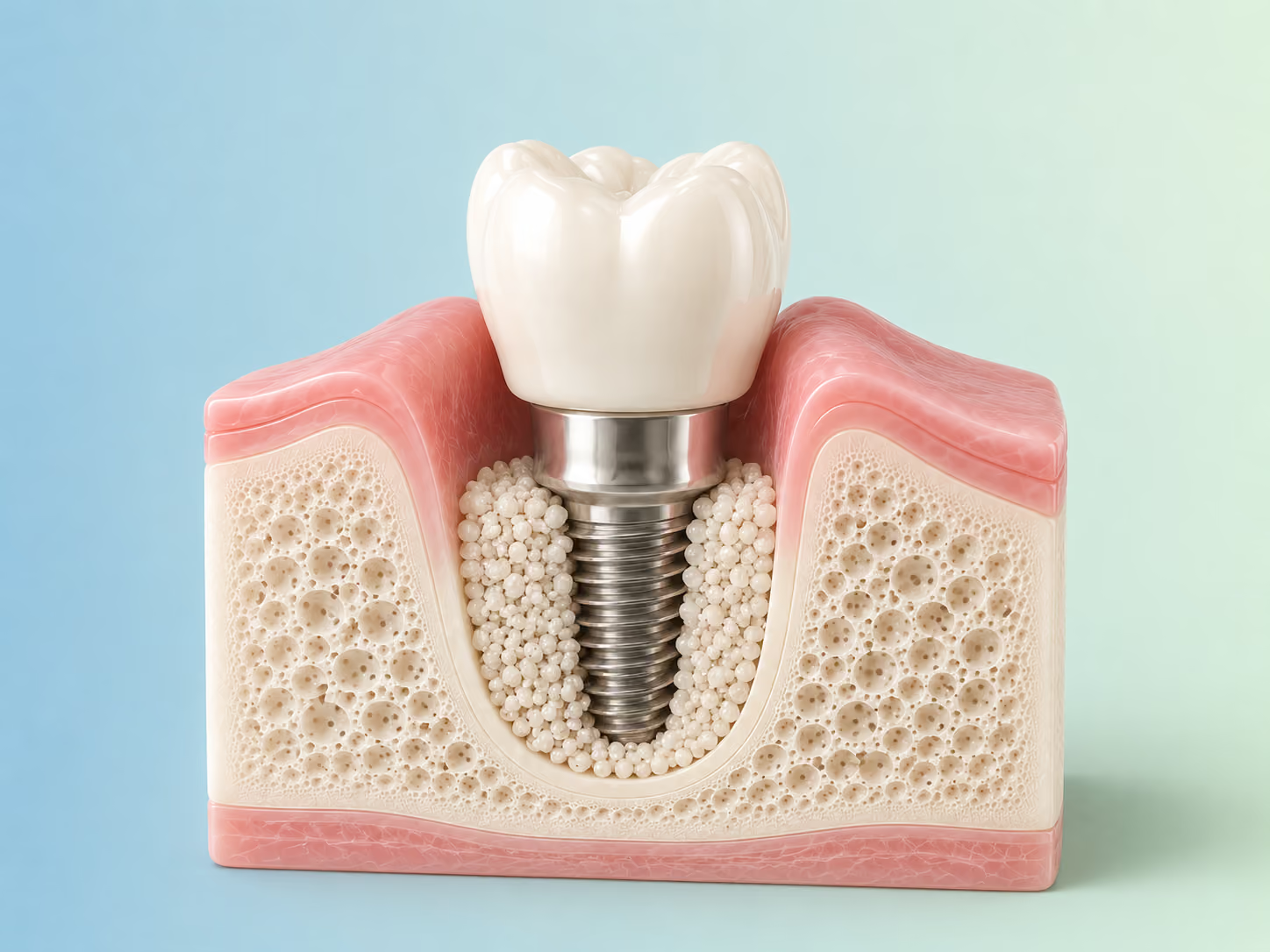
D7953 is one of the most commonly used bone graft codes in general practice. It applies when graft material is placed into an extraction socket to preserve ridge volume after tooth removal.
This code is typically used when the goal is to maintain the site for future implant placement or prosthetic support. It is billed separately from the extraction itself. If a membrane is placed over the grafted socket, that membrane is coded separately rather than included in D7953.
D7950 - Osseous, osteoperiosteal, or cartilage graft of the mandible or facial bones
D7950 is used for more extensive grafting procedures involving the mandible or facial bones. These are usually augmentation procedures performed when there is significant ridge deficiency and a simple socket graft would not be enough.
This code may apply in cases involving block grafts, onlay grafting, or other larger grafting procedures intended to rebuild the site before implant placement. In general, D7950 reflects a more complex grafting situation than routine ridge preservation.
D4263 - Bone replacement graft, first site in quadrant
D4263 is used when bone replacement grafting is performed during periodontal surgery to repair an osseous defect caused by periodontal disease.
That distinction is important. This is not an implant-site graft or a socket preservation code. It is a periodontal graft code tied to a periodontal defect. It is billed for the first site in the quadrant treated during that appointment.
D4264 - Bone replacement graft, each additional site in quadrant
D4264 is used in combination with D4263 when there is more than one grafted periodontal site in the same quadrant during the same surgical visit.
Once the first site is reported with D4263, each additional site in that quadrant is reported with D4264. Good documentation is especially important here because the record should clearly show each distinct periodontal defect being treated.
D7951 - Sinus augmentation with bone or bone substitutes
D7951 is the code typically used for a lateral window sinus lift. This procedure is performed when the posterior maxilla lacks sufficient vertical bone height for implant placement, and the sinus floor needs to be augmented with graft material.
This is a distinct surgical procedure and should not be confused with socket preservation or ridge augmentation. It reflects a more complex grafting procedure performed in a very specific anatomic area.
D7952 - Sinus augmentation via a vertical approach
D7952 is used for a vertical or transcrestal sinus augmentation approach. Unlike D7951, which reflects a lateral window technique, D7952 is used when the sinus is augmented through a vertical access approach at the implant osteotomy site.
The distinction here is based on surgical technique, not just treatment goal. Both codes relate to sinus augmentation, but they are not interchangeable.
Benefits of using the correct bone graft code in your dental practice
Using the correct bone graft code does more than support billing. It also improves documentation, treatment clarity, and claim accuracy.
Accurate procedure classification
Bone graft procedures vary widely in purpose and complexity. Correct coding helps the record show whether the graft was placed for socket preservation, ridge development, periodontal defect repair, or sinus augmentation.
That matters for future treatment planning, long-term recordkeeping, and insurance review. A chart note that simply says “bone graft placed” is not enough. The code and documentation should reflect the type of graft performed and the reasons for it.
Streamlined insurance claims
Bone graft claims are often reviewed closely, so code accuracy matters. When the procedure is coded according to the actual clinical indication, the submission is easier to understand and easier to support.
The right code also helps place the procedure in the correct benefit category, whether that is surgical, periodontal, or implant-related. Many plans still require pre-treatment estimates or additional supporting documentation for grafting procedures, so clear code selection makes the process smoother.
Appropriate unbundling of associated procedures
Bone grafting is often performed alongside other procedures, and those services are not always included in the graft code itself.
For example, extraction, membrane placement, implant body placement, or other surgical procedures may need to be reported separately when performed at the same visit. This is one of the most important parts of bone graft coding. If everything is collapsed into one code, the practice may undercode the case and create claim issues at the same time.
Enhanced revenue and practice efficiency
Proper use of bone graft codes helps the practice bill accurately for the surgical time, graft material, and clinical skill involved. It also improves internal consistency.
When the team understands which graft code applies in which situation, implant and periodontal surgical cases are easier to chart, submit, and follow up on. That reduces rework and improves revenue accuracy across more complex surgical appointments.
FAQs
What is the most common dental code for bone grafting?
In general practice, D7953 is often the most commonly used bone graft code because it applies to ridge preservation after extraction. That said, the “most common” code depends on the type of treatment the practice provides.
Does dental insurance cover bone grafting?
Sometimes, but coverage varies widely by plan and by the reason the graft is being placed. Some plans may offer benefits for certain periodontal or surgical grafting procedures, while others may exclude implant-related grafting entirely.
What is the difference between D7953 and D4263?
D7953 is typically used for ridge preservation after extraction. D4263 is used for bone replacement grafting as part of periodontal surgery to treat an osseous defect. The difference lies in the graft's clinical purpose.
Is a membrane billed separately from the bone graft?
Often, yes. In many cases, membrane placement is reported separately from the graft itself rather than included in the graft code.
What bone graft code is used for a sinus lift?
That depends on the surgical approach. D7951 is generally used for a lateral window sinus augmentation, while D7952 is used for a vertical or transcrestal sinus augmentation.