
AI dental diagnosis explained: Benefits, accuracy & use cases

8
minute read
•
June 10, 2026
Key Takeaways
- High accuracy rates: AI dental diagnosis achieves 95%+ accuracy in clinical validation studies, detecting caries and bone loss.
- Enhances, not replaces, dentists: AI supports decision-making while you maintain diagnostic authority.
- FDA cleared and clinically validated: Leading platforms undergo regulatory review for safety and effectiveness.
- Improves case acceptance: Visual findings help patients understand conditions and accept treatment.
- Reduces missed diagnoses: AI helps identify pathology that may otherwise be overlooked.
Artificial intelligence is changing how dentists interpret radiographs. Modern computer vision systems can analyze dental X-rays with accuracy rates above 95%, identifying subtle patterns in enamel, dentin, and bone that are difficult to detect consistently with the human eye alone. Instead of relying only on subjective interpretation, you now have objective visual and quantitative support during diagnosis.
AI dental diagnosis tools, including FDA-cleared platforms such as Pearl’s technology, highlight cavities, bone loss, calculus, and other pathologies directly on images. This improves patient understanding, reduces missed findings, and supports clinical confidence. You still make the diagnosis. The software simply provides a reliable second opinion that strengthens your clinical judgment rather than replacing it.
What is AI dental diagnosis?
Before discussing benefits, it helps to clarify what AI dental diagnosis actually means in practice.
AI dental diagnosis is software that analyzes dental radiographs using deep learning models trained on very large datasets of annotated images. The system evaluates bitewing, periapical, and panoramic X-rays to identify and mark potential pathology directly on the image.
Instead of producing an autonomous diagnosis, the platform provides visual overlays, measurements, and suggested findings for you to review. You confirm, modify, or reject those suggestions, keeping full clinical control while benefiting from consistent image analysis.
Typical conditions the software helps identify include:
- Caries
- Bone loss
- Calculus
- Periapical radiolucencies
- Impacted teeth
- Defective restorations
The key difference is that findings become measurable and repeatable rather than purely subjective interpretations.
How AI dental diagnosis works
To understand why the technology improves consistency, it helps to look at what happens after an image is captured.
Deep learning and neural networks
Dental AI systems rely on convolutional neural networks, a type of deep learning model designed for image recognition. These networks are trained on hundreds of thousands to millions of labeled dental radiographs, so they learn to recognize patterns associated with disease.
In practical terms, the system learns the same radiographic indicators you were trained to identify, including enamel radiolucency, dentin penetration, crestal bone height, and calculus density patterns. The difference is consistency. The model applies identical criteria to every image without fatigue or variability.
The underlying technology is similar to medical imaging analysis but is specialized for dental anatomy and pathology.
Image analysis process
Once a radiograph is captured, analysis happens automatically and takes only seconds.
- The X-ray uploads from the imaging system
- The AI scans the image pixel by pixel
- Potential pathology is detected and categorized
- Measurements such as bone level or lesion depth are calculated
- Annotated findings appear on the image with confidence indicators
You then review the annotated radiograph and incorporate confirmed findings into diagnosis and treatment planning. The workflow stays familiar, but interpretation becomes structured and repeatable.
Integration with practice management systems
For AI to be clinically useful, it must fit into the appointment rather than interrupt it.
Modern AI dental diagnosis software integrates directly with imaging platforms, so analysis occurs automatically when X-rays are taken. Results appear inside the patient chart during the same visit, allowing real-time patient discussion.
Most systems support widely used platforms such as Dentrix, Eaglesoft, and Open Dental. Because analysis runs in the background, chairside workflow remains uninterrupted.
The benefits of AI dental diagnosis
Once integrated, the advantages become evident in everyday patient care rather than in isolated cases.
Improved diagnostic accuracy
AI acts as a consistent second set of eyes. It does not fatigue, rush, or vary between providers, helping standardize diagnostic quality across patients and appointments.
You may notice earlier identification of interproximal caries, clearer monitoring of subtle progression over time, and fewer overlooked findings. Rather than replacing clinical judgment, it reinforces it by making interpretation more consistent.
Enhanced patient communication
Patients rarely resist treatment because they distrust dentistry. More often, they simply cannot see what you see.
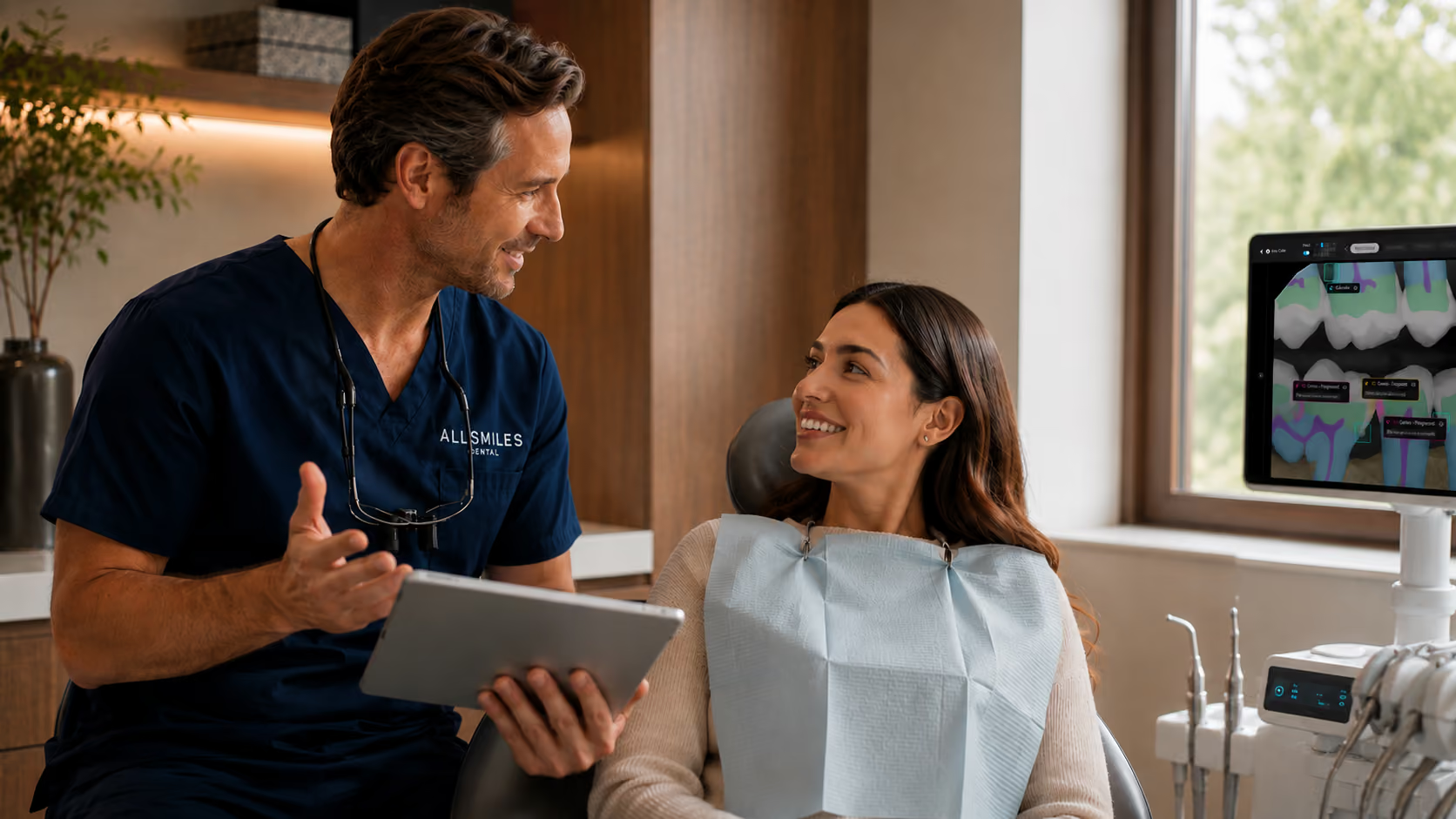
When pathology is visually highlighted, radiographs become easier to understand. Showing measurable bone loss or lesion depth turns explanation into demonstration. This improves transparency and builds trust because the diagnosis is visible, not abstract.
Increased treatment acceptance
When patients clearly understand a condition, decision-making becomes easier. A visually supported diagnosis reduces hesitation and shortens the time between recommendation and treatment.
Practices commonly observe:
- Fewer delayed decisions
- Greater acceptance of comprehensive care
- Earlier intervention and better outcomes
The impact is clinical as well as financial. Earlier treatment typically means simpler procedures and improved long-term oral health.
Time efficiency and productivity
AI pre-screens radiographs before your review, allowing you to spend less time searching for findings and more time discussing care.
Interpretation becomes faster and documentation more structured. The time saved shifts toward patient education and treatment planning, where your expertise provides the greatest value.
Risk management and liability reduction
Missed pathology is one of the most common contributors to dental malpractice claims. AI does not remove clinical responsibility, but it strengthens documentation and reduces the chance of overlooked findings.
Because suspected pathology is visually marked and stored with the radiograph, the record demonstrates what was evaluated at the time of diagnosis. A documented second opinion supports clinical reasoning if disease progression becomes apparent later.
Over time, this also standardizes evaluation across providers. The same radiographic features are analyzed consistently rather than varying by fatigue, time pressure, or experience level.
Consistency across providers
In multi-provider practices, diagnostic variability is unavoidable. Early lesions and borderline bone levels are especially subjective.
AI introduces a shared baseline before human interpretation. Every image is evaluated using identical criteria, which helps:
- Support newer associates
- Maintain consistent treatment planning
- Improve documentation uniformity
- Strengthen quality assurance
Instead of replacing judgment, the technology aligns interpretation across the team.
AI dental diagnosis accuracy and clinical validation
To understand where AI fits clinically, it helps to look at published evidence and regulatory review rather than marketing claims.
Clinical study results
FDA-cleared systems such as Pearl’s Second Opinion demonstrated diagnostic accuracy above 95% for caries detection during validation testing submitted for clearance.
Peer-reviewed research also shows that dentists assisted by AI detect more pathology than those working alone, particularly interproximal lesions.
Large-scale diagnostic accuracy analyses across studies similarly found that AI systems achieve sensitivity and specificity comparable to those of experienced clinicians.
FDA clearance and regulatory approval
Dental AI diagnostic software in the United States is regulated as a medical device. To obtain FDA 510(k) clearance, developers must demonstrate safety and effectiveness relative to existing clinical standards.
The review process includes:
- Clinical performance testing
- Risk analysis
- Quality control requirements
- Ongoing post-market monitoring
Clearance means the software can be used as diagnostic decision support, not autonomous diagnosis. The dentist remains responsible for final interpretation.
Comparison to human performance
Studies consistently show the strongest diagnostic performance occurs when clinicians and AI work together.
Controlled evaluations found AI-assisted dentists detected significantly more caries than unaided dentists, especially early interproximal lesions. Additional research also reports improved detection sensitivity in aided readers compared to unaided readers.
The combined approach works because pattern recognition and clinical reasoning complement each other rather than compete.
Limitations and edge cases
AI performance still depends on image quality and the extent of training coverage. Rare conditions, unusual anatomy, or imaging artifacts may affect detection.
For this reason, AI provides suggestions and confidence indicators rather than conclusions. The dentist reviews every finding before diagnosis, and ongoing model updates continue to improve edge case performance.
Where AI is most useful in daily practice
The value of AI becomes clear during routine examinations rather than unusual cases.
Cavity detection and classification
AI is particularly effective at identifying early interproximal lesions and distinguishing enamel from dentin involvement. This helps prioritize treatment urgency and monitor progression between visits.
Because the same criteria are applied every time, lesion monitoring becomes more objective across recall appointments.
Periodontal bone loss assessment
Quantitative bone measurements change how periodontal disease is communicated. Instead of estimating severity, you can demonstrate measurable change over time.
That improves patient understanding and supports documentation for insurance and treatment monitoring.
Calculus and tartar detection
Marked calculus deposits make hygiene recommendations easier to explain. Patients can visually see accumulation rather than relying on verbal description, improving acceptance of periodontal care.
Periapical pathology identification
Radiolucencies associated with endodontic pathology can be consistently highlighted and monitored. Follow-up imaging becomes easier to interpret because the same measurement baseline is used at each visit.
Treatment planning support
When all findings are summarized on annotated radiographs, treatment sequencing becomes clearer. Urgent needs can be prioritized while elective care is planned more predictably.
How to implement AI into your practice
Adoption works best when framed as a workflow improvement rather than a technology replacement.
Choosing the right AI solution
Focus on clinical validation rather than feature lists. Evaluate FDA clearance status, peer-reviewed evidence, and integration compatibility with your imaging software. A real demonstration using your own radiographs is usually the most informative evaluation.
Staff training and change management
Successful implementation depends on team confidence. Train dentists, hygienists, and front office staff together so communication remains consistent.
Position AI as support for decision-making rather than oversight. Adoption improves when the team understands its clinical purpose.
Patient communication strategy
Introduce AI as an advanced diagnostic aid that helps you be thorough and transparent. Emphasize that you make the diagnosis while the software visualizes findings.
Patients generally respond positively when the technology improves clarity rather than automation.
Measuring ROI and success metrics
Track both clinical and operational outcomes after implementation:
- Case acceptance rates
- Diagnostic consistency
- Appointment efficiency
- Treatment value per patient
- Patient satisfaction
Most improvements appear gradually as the technology becomes part of routine exams.
Final thoughts
AI dental diagnosis represents a significant advancement in clinical care. Computer vision can now detect caries, bone loss, and pathology with accuracy exceeding 95% while keeping the dentist in control of final decisions.
By acting as a visual second opinion, AI improves diagnostic consistency, strengthens patient communication, increases treatment acceptance, and reduces missed findings. FDA-cleared platforms like Pearl’s Second Opinion demonstrate how technology can enhance clinical expertise rather than replace it.
FAQs
How accurate is AI dental diagnosis?
Clinical validation studies show accuracy above 95% and improved detection when dentists use AI support.
Is AI dental diagnosis FDA-approved?
AI diagnostic systems receive FDA 510(k) clearance as clinical decision support devices after safety and effectiveness testing.
Does AI replace the dentist’s judgment?
No. The dentist always makes the final diagnosis. AI provides detection support only.
How much does an AI dental diagnosis cost?
Costs vary by provider and practice size, typically evaluated based on ROI rather than per-scan pricing.
What pathologies can AI detect?
Common detections include caries, bone loss, calculus, and periapical lesions as specified in FDA device indications.
About the author
Dr. Mike Barniv brings a wealth of dental experience from over two decades in full-time private practice to his role as Vice President of Clinical Affairs at Pearl, a company leading global dental AI innovation. Before joining Pearl, Dr. Barniv served as VP at Delta Dental of Idaho, where he oversaw claims, utilization management and the strategic implementation of AI technologies. In academia, Dr. Barniv served as an assistant professor at the University of the Pacific School of Dentistry in San Francisco, CA, where he was also the director of their AEGD residency clinic. In his current position, Dr. Barniv leverages his comprehensive dental knowledge and experience in both clinical and administrative realms to enhance Pearl's commercial, clinical, and institutional endeavors. His unique perspective, combining hands-on dental practice with expertise in dental education and insurance sector innovations, positions him perfectly to advance progress toward comprehensive integration of AI across the dental category.

