Key Takeaways:
- Pearl has launched Second Opinion 3D, making its FDA-cleared 3D imaging AI available to general dentists in the US and Canada.
- The commercial release of the FDA cleared technology adds two workflow features built specifically for general dentists: an embedded specialist radiology-report request, and automatic conversion of CBCT findings into insurance claim-ready documentation.
- Built for chairside use rather than specialist image review, Second Opinion 3D is designed to help general dentists interpret CBCT scans and walk patients through what the AI finds in real time.
Pearl today launched Second Opinion 3D, putting its FDA-cleared 3D imaging AI into general dentists' hands as a commercial product for the first time. General practices are adopting CBCT faster than the software built to support them: most viewers on the market were designed for specialist image review, not for a general dentist working through a normal patient appointment. Second Opinion 3D is Pearl's answer: a CBCT tool built around how general practices actually work, and integrated into the same Second Opinion interface providers already use for 2D imaging.
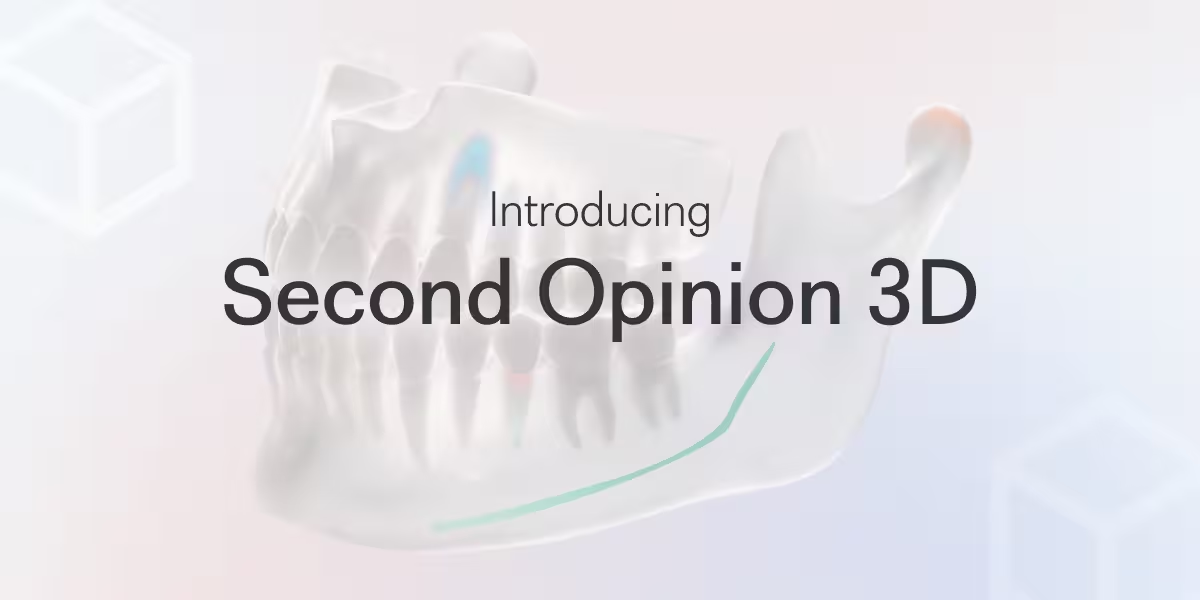
The launch builds on the FDA 510(k) clearance Pearl received last year, when it became the first dental AI company cleared by the FDA for both 2D and 3D radiologic image analysis. That clearance covered the underlying AI, which automatically identifies structures such as the mandible, maxillary complex, nasal space, airway, inferior alveolar nerve canal, and individual teeth in CBCT scans. Today's launch turns that clearance into a product: alongside general availability, Second Opinion 3D now lets providers request a report from a licensed oral and maxillofacial radiologist without leaving the interface, and automatically converts 3D findings into insurance claim-ready documentation, two steps that previously required separate portals and manual staff work.
“General dentists have invested in CBCT for years, but reading these scans well has traditionally required specialist-level training most practices don’t have. Second Opinion 3D helps every dentist do more with CBCT. That matters beyond the tooth being treated: CBCT is one of the more exciting imaging modalities we have because of what it can reveal about a patient's health beyond their mouth. By making CBCT more accessible and useful for dentists, we’re advancing a technology that has a role to play in bridging the gap between dental medicine and systemic health."
— Ophir Tanz, CEO and Founder, Pearl
"What I really wanted was something that would scan every slice, flag anything worth a second look, and take me straight to it. That's exactly what it does. It's caught things I would've missed just focusing on the one area I came in to check. And when I'm sitting with a patient, I can isolate exactly what I'm looking at and show them, instead of trying to explain a blob on a screen. That changes how confident patients feel about the treatment plan we land on."
— Dr. Todd Yerondopoulos, Enamel Creations, Pleasanton, CA
What does this mean for general dentists?
CBCT has moved from a specialist tool into everyday use in general practice, but the software built to support it hasn't kept pace, and the workflow around it hasn't either. Getting a specialist's opinion on a scan typically means exporting files and going through a separate referral process, and turning a 3D finding into something a payor will accept for a claim is manual work that falls to practice staff. Both add friction to a workflow that's already asking general dentists to interpret imaging outside their usual training.
Second Opinion 3D is Pearl's answer to that gap, now available as a full product rather than just a cleared technology. The AI automatically segments key anatomy and color-codes each for easy visualization, allowing users to remove or highlight specific anatomical structures. It presents anatomical structures in an interactive viewer with 3D rendering, zoom and rotation, opacity controls, length measurement. Second Opinion 3D also supports radiology-report requests and claim-ready documentation, and the ability to easily turn CBCT scans into claim-ready 2D images features mean providers no longer have to leave the software or hand work off to staff to get a second opinion or bill for what they found.
How does this compare to existing CBCT viewers?
Most CBCT software was designed for technical image review, engineered for radiologists and specialists first, with general dentists and practice workflow as an afterthought. Second Opinion 3D is built the other way around. Where a traditional workflow requires downloading a scan and uploading it to a separate radiology portal, Second Opinion 3D keeps that request inside the same software. Where turning a 3D finding into claim documentation has meant manual rework by staff, Second Opinion 3D generates it automatically. And where most viewers assume the person reading the scan is a specialist, Second Opinion 3D is also built for the general dentist and the chairside conversation.
What happens next?
Second Opinion 3D also includes AI-powered pathology detection, covering findings such as TMD, carotid artery calcifications, impactions, periapical radiolucency, and sinus radiopacities. These capabilities are currently available in Canada and pending regulatory approval in additional markets.
For multi-location practices and DSOs, Second Opinion 3D can standardize how CBCT is reviewed, documented, and communicated across locations and providers.