What is the Arestin dental code?
4
minute read
•
August 13, 2026
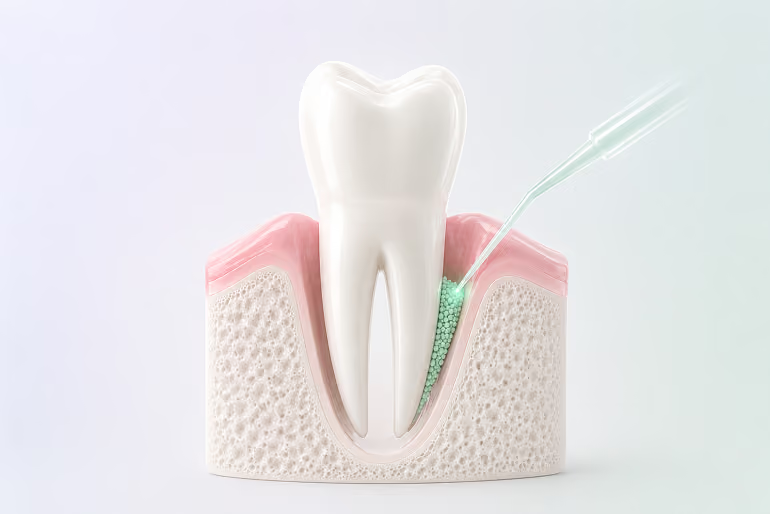
Arestin is the brand name for minocycline hydrochloride microspheres, a locally delivered antimicrobial placed directly into periodontal pockets as an adjunct to periodontal treatment. The dental code used to bill for Arestin placement is D4381, which refers to a locally delivered antimicrobial agent used to treat periodontal disease.
In practice, D4381 is used whenever a qualifying antimicrobial product is placed into the periodontal pocket of a specific tooth. Arestin is the product most commonly associated with this code in everyday dental practice. One of the most important things to understand is that D4381 is billed per tooth, not per pocket or per quadrant. If Arestin is placed around multiple teeth during the same visit, the code is reported separately for each tooth treated.
When is D4381 used?
D4381 is used when a locally delivered antimicrobial is placed into a periodontal pocket as part of active periodontal care or as an adjunct to periodontal maintenance.
That may happen at the same visit as scaling and root planing, during a periodontal maintenance appointment when there is residual pocketing and signs of continued disease activity, or at a later re-treatment visit for persistent sites. The key point is that the code is reported at the time the antimicrobial is placed, not at some later follow-up appointment.
How is D4381 billed, per tooth or per site?
D4381 is billed per tooth.
That means if Arestin is placed into more than one pocket on the same tooth, you still bill one D4381 for that tooth, not one code per pocket. If Arestin is placed on multiple teeth during the same appointment, then each treated tooth gets its own D4381 entry.
This is where documentation matters. The chart should clearly identify each tooth number where the product was placed. That helps support the claim and reduces the risk of rejection because the treatment was not documented specifically enough.
Does insurance cover D4381?
Sometimes, but coverage varies widely from plan to plan. D4381 is one of the more commonly disputed periodontal codes, so it is important not to assume coverage.
Some plans cover it under periodontal benefits if certain clinical criteria are met, such as minimum pocket depth thresholds or signs of active disease. Other plans treat it as a non-covered service, apply frequency limits, or require stronger documentation before considering payment.
Because of that, a pre-treatment estimate or preauthorization is often a smart step when the patient has dental insurance. Clear notes about pocket depths, active inflammation, bleeding, and the reason for recommending adjunctive antimicrobial therapy can help both the insurance claim and the patient’s understanding of the treatment and any out-of-pocket costs.
Benefits of using the D4381 code correctly in your dental practice
Using D4381 correctly helps the practice document periodontal treatment more clearly, submit cleaner claims, and bill properly for adjunctive therapy that might otherwise be overlooked.
Accurate procedure classification
D4381 makes it clear that a locally delivered antimicrobial was placed as a separate periodontal service, rather than being absorbed into scaling and root planing or maintenance.
That helps the chart reflect the teeth treated, the product used, and the reason it was placed. It also strengthens the long-term periodontal record by showing which sites require additional intervention.
Streamlined insurance claims
When D4381 is billed with the correct tooth numbers and supporting clinical details, claims are easier to understand and defend.
That matters because many plans review this code closely. The more clearly the record shows the treated teeth, the pocketing, and the rationale for placement, the stronger the submission will be.
Appropriate patient communication and consent
D4381 also supports better patient communication. Because Arestin is an adjunctive treatment and may not always be covered, it is important to explain what it is, why it is being recommended, and what the patient may owe.
Using the code correctly helps the team present the treatment more clearly and avoid confusion around whether it is part of the cleaning or a separate periodontal service.
Enhanced revenue and practice efficiency
Proper use of D4381 helps the practice capture appropriate reimbursement for the product cost and the clinical time required to place it.
It also improves efficiency because the team has a clearer process for documenting and billing per tooth when multiple teeth are treated at the same appointment. That reduces missed charges and keeps periodontal coding more consistent.
FAQs
What dental code is used for Arestin?
The dental code used for Arestin placement is D4381.
Is D4381 billed per tooth or per quadrant?
D4381 is billed per tooth, not per quadrant.
Does insurance cover Arestin placement?
Sometimes, but it depends on the patient’s plan. Some plans provide benefits for D4381, while others do not or apply strict clinical requirements.
Can D4381 be billed at the same appointment as scaling and root planing?
Yes. D4381 is commonly billed at the same appointment when Arestin is placed as an adjunct to scaling and root planing.
What documentation is needed to support a D4381 claim?
The record should identify the specific teeth treated, along with pocket depths, signs of active disease, and the clinical reason for antimicrobial placement.