
Dentistry is entering its measurement era

7
minute read
•
June 30, 2026
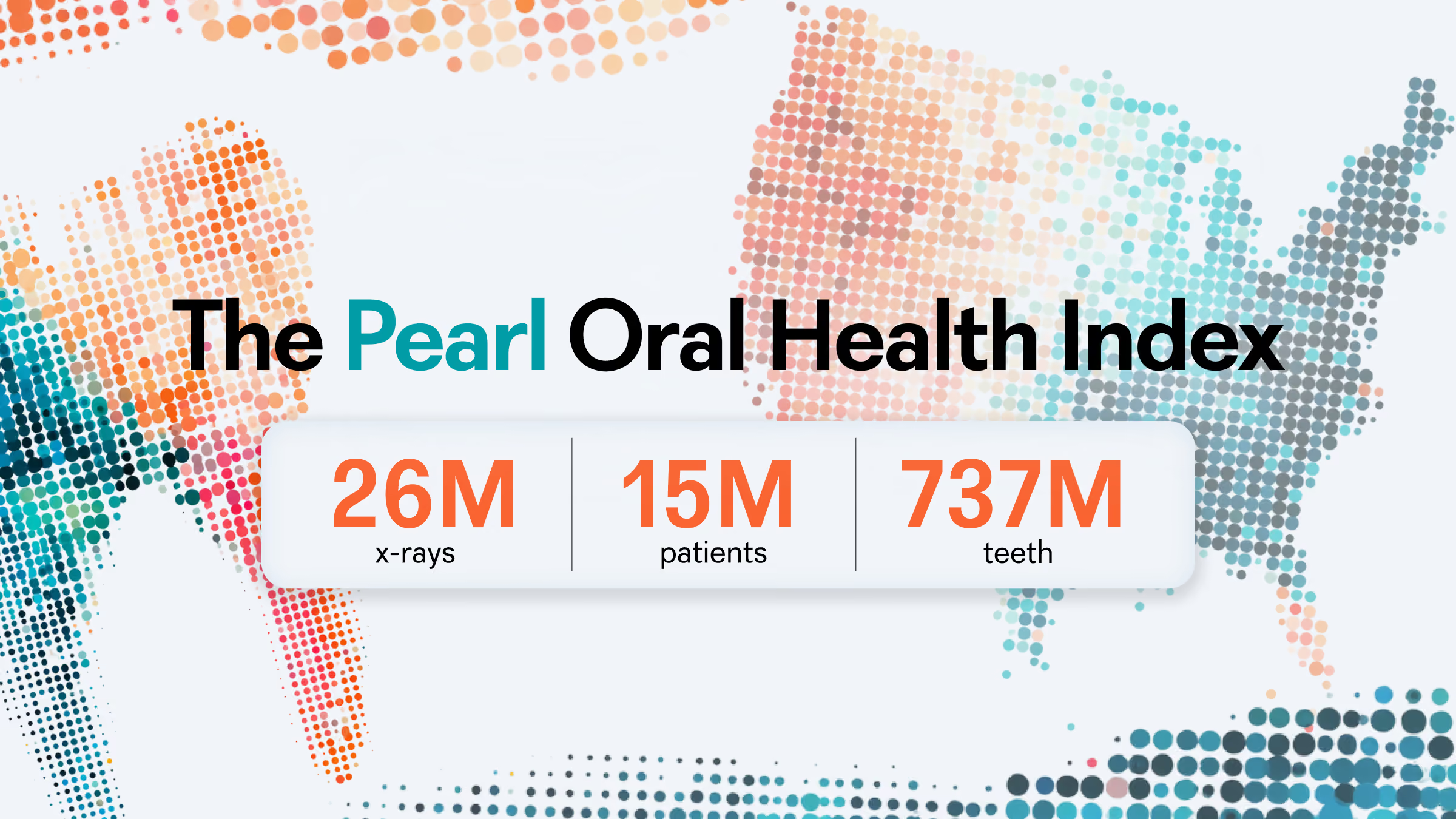
Yesterday, Pearl released the Oral Health Index, the first radiographic census of the American mouth. Our AI analyzed 26 million dental x-rays across 15 million patients in all 50 states and the United Kingdom, and produced a picture of oral health in America that looks dramatically different from what official public data show.
The most compelling is this: The true rate of untreated tooth decay in the U.S. is at least 4.5 times higher than federal survey data suggests.
The CDC’s NHANES, the government’s gold-standard oral health survey, estimates that 21% of adults have untreated tooth decay. The NHANES was developed in 1971 and relies on manual exam using a mirror, explorer, and compressed air. It doesn't include x-ray imaging, and it surveys only 30,000 participants.
Our study, which analyzes millions of anonymized x-rays from more than 22,000 participating dental practices, represents a best-case scenario. It includes only people who made it to the dentist. For those without access to care, oral health outcomes are likely to be worse, suggesting the diagnostic gap could be even wider than our findings indicate.
But the deeper story isn't the difference between federal estimates and radiographic reality. The deeper story is what becomes possible once you can measure at this scale.
One finding in particular should matter to every clinician reading this.
Across hundreds of zip codes where Pearl compared two or more dental offices — each seeing at least 100 adult patients — the typical difference in untreated decay detection rate between neighboring practices is 9.2 percentage points. In the most variable zip codes, the spread reaches 17.8 percentage points. In the single most extreme case we observed, two practices in the same zip code showed a 45-point gap.
Across 282 offices, each seeing 200 or more adult patients, the top-diagnosing 10% of practices find four times as many affected teeth per patient as the bottom 10%.
This is not a comfortable finding, but it is an honest one, and it matters precisely because we've never had data like this before.
Pearl’s OHI shows what is possible as dentistry enters its measurement era. With AI systems now able to analyze data at scale, individual clinical insights become actionable intelligence.
A practice can see how its diagnostic patterns compare to those of its peers in similar settings. A health system can identify which patient populations are slipping through without adequate care. A payer can move beyond counting procedures and start assessing whether care is actually effective. A public health official can identify dental deserts not by counting practice addresses but by examining actual outcomes, such as tooth-loss rates and untreated decay burdens, that reflect the effects of access barriers in clinical practice.
Our data, for instance, shows that in the most underserved zip codes — those with no resident dentists — patients lose 40% more teeth. The treatment trajectory is fundamentally different: extraction rather than restoration. That statistic isn’t shaped by geography, but by access barriers whose effects are now visible because we finally have the data.
Dentistry is not broken. It is informationally constrained. The dental industry evolved outside the interoperability requirements that pushed medicine toward integrated records. Practice management systems were developed without the regulatory drivers that compelled FHIR compatibility. The reimbursement system was built on procedure codes rather than diagnostic codes, which means the most clinically meaningful variable, what was actually wrong with the patient, has never been systematically captured at scale.
These are conditions that shaped how we see dentistry, and changing them requires collective action across dentists, health systems, payers, technology companies, and regulators. The ADA is already pressing for imaging interoperability standards. Federal agencies are beginning to require prior authorization workflows that depend on the kind of data infrastructure dentistry is still building. The direction is clear.
This is not a failure of the profession. It's a structural condition that no individual dentist, insurer, or health system created and that none of them could have solved alone. The tools to see dentistry as a system simply did not exist. They do now.
Pearl’s Oral Health Index is a proof of concept for what becomes possible when clinical data is aggregated at the scale modern AI makes achievable: a vision of dentistry as a cohesive system that elevates care for millions of patients, rather than just one at a time.
With these kinds of insights, dentistry will finally be able to see itself clearly. Dentists will be able to benchmark their diagnoses against peers. Networks and payors will see if care is consistent and effective. Researchers will be able to build analytical datasets based on systemically captured variables. And patients will move through a system shaped by policies built on complete information, with a truer understanding of whether the care they receive is exceptional, average, or far below average.
Let’s all have the courage to look.
About the author
Ophir Tanz is an award-winning entrepreneur and technologist. He is the founder and CEO of Pearl, an AI company focused on solving fundamental problems in the dental industry. Previously, Ophir founded and led GumGum to several hundred million dollars in global revenue by applying computer vision machine learning to drive and measure value for the digital media and sports sponsorship industries. Ophir earned a bachelor’s and master’s degree at Carnegie Mellon University. An established member of the Los Angeles startup community, Ophir actively advises and invests in startups and, in 2017, was named one of Goldman Sachs’ 100 Most Intriguing Entrepreneurs.