Front desk to final restoration: The hidden tech driving same-day dentistry
4
minute read
•
May 5, 2025
Key Takeaways
- “Same-day” dentistry covers a wide range of services, from emergency care to same-day crowns and implants.
- Getting the best ROI from your same-day dentistry services relies on supporting every step of the process, including scheduling, insurance verification, and case acceptance, not just delivery of care.
- Scheduling software that makes organizing the day’s workflow simple and efficient is a key part of successful same-day dentistry.
- Same-day dentistry equipment isn’t all about CAD/CAM: consider other needs, such as chairs, monitors, apex orators, and curing lights, when planning to expand or streamline your services.
Done right, same-day dentistry benefits everyone. Patients appreciate the convenience and access to care. Clinicians work more efficiently. And the practice enjoys a bump in production—along with a reputation for responsiveness and innovation.
Spinning up a same-day practice requires owners to invest in new technologies. Unfortunately, most start at the finish line, purchasing expensive CAD/CAM and fabrication machines without investing in other technologies that accelerate the return on those investments.
We spoke to Jill Nesbitt, founder of Optimize Dental Consulting, to understand which mix of technologies—from the hidden to the humble to the high-end—contribute to efficient, effective, and profitable same-day dentistry.
First, assess your systems
“Technology is a strategy,” said Nesbitt, and like any good strategy, its success depends on clear goals and a thoughtful plan of execution. Before you invest in new tools or workflows for same-day dentistry, take a step back and evaluate where you are now.
“It starts with an assessment,” Nesbitt said. “Not just what software are you using, but are you using it to its full capability? Do the pieces integrate? And if you’re not sure, there are services available to help you find out.”
This means identifying the tech already in place, assessing how well it’s being used, looking for gaps and redundancies, and “understanding where your team is frustrated and where time is wasted.”
Scheduling software success
The key to same-day dentistry success is excellent practice management and efficient scheduling in your same-day dentistry tech stack, Nesbitt said. “It doesn't matter how great your technology is if you can't implement it well,” she noted. “Experienced dental managers know that when we look at a patient schedule at the beginning of the day, there will be some patients who do not show up–this could open up anywhere from 5% to 30% of our day. So how do we set up a system to avoid that wasted downtime?”
The morning huddle is where a practice manager calls the day’s plays, from routine hygiene patients to restorations to—yes—same-day dentistry opportunities. The right practice management and scheduling tools can highlight these opportunities, giving the front office team a chance to highlight them for clinicians in the morning huddle.
Practices should consider investing in these systems, including AI-powered software that highlights undetected and untreated treatment needs for scheduled patients, like Pearl’s Practice Intelligence. Barring that, a structured schedule template with logical labels, columns, and time blocks is a good starting point.
Providing each provider with a customized, annotated schedule will ensure no clinician overlooks a same-day opportunity among scheduled patients. Of course, emergency visits are also same-day dentistry, Nesbitt said.
“Often, I see practices that haven’t blocked time in the daily schedule to accommodate patient emergencies,” she said. “Maybe all you can do is take some x-rays and prescribe some pain medication, but often, in a multidoctor practice, you likely can find a provider who can do an extraction or start restorative care.”
Clinical tech: The connective tissue
Once the schedule is structured for agility, the next layer of a same-day tech stack is the clinical foundation. These are the tools that make it physically possible to pivot from diagnosis to treatment within a single visit.
Start with the obvious: are there enough chairs to move patients efficiently between hygiene and restorative care? A same-day workflow breaks down quickly if the patient is ready but the operatory isn’t. Room availability becomes more than a logistics issue—it’s a barrier to care.
Then look at your imaging capabilities. In addition to digital x-rays, panoramic scanners and CBCT improve diagnostic accuracy and accelerate decision-making. When a patient has to wait for imaging or be rescheduled for a scan, the same-day opportunity disappears. Worse, the urgency to accept treatment can fade.
Specialized tools like apex locators, curing lights, and endo motors also play a quiet but crucial role. They may not be used every day, but when a patient with a painful tooth shows up at 11 a.m. and the right tool isn’t ready, your team’s hands are tied.
Equally important is the technology that bridges clinical insight with patient understanding. Same-day dentistry hinges on patient buy-in, and the tools that support real-time, visual communication can make the difference between a patient saying “yes” today or putting off care indefinitely.
Something as simple as a patient-facing monitor lets clinicians guide the conversation with x-rays and intraoral images. Add AI-powered software, like Pearl’s Second Opinion, that highlights signs of disease—bone loss, periapical pathology, interproximal decay—and the patient doesn’t just hear a recommendation, they see the need. The result? Greater trust, better treatment acceptance, and more meaningful use of your same-day capacity.
But, is it covered?
Of course, one last hurdle always needs to be cleared before treatment can commence: the question of payment. As Nesbitt explained, explanations of insurance coverage and payment options directly affect access to services, particularly same-day services.
“It's one thing to offer, ‘Do you want a night guard?’” she said. “The patient's going to turn around right away and say, ‘Is it covered by my insurance?’ If you don't know, you're not going to have the opportunity to do same-day dentistry. So that goes back to how well is your practice management software set up, this time from an insurance and billing perspective?”
Real-time insurance verification software pulls patients’ insurance details straight from insurance company databases and database exchanges so practices can find these details in seconds. And, some—like Pearl’s Precheck—sit within chairside computers so clinicians too can find coverage details and answer questions immediately, instead of waiting for the front desk to finish up a 20-minute phone call to the insurance company.
Nesbitt is also a believer in using digital solutions for patient financing applications and payment, such as texting patients links to online portals, although she cautions that practices must know and follow state laws surrounding such technology.
However, she points out that the time and effort saved by paperless processes not only facilitate immediate access to treatment, but translate to real benefits for team members. “No more stacks of forms to scan,” she observed. “No more sticky notes of things to do.”
The big-ticket items
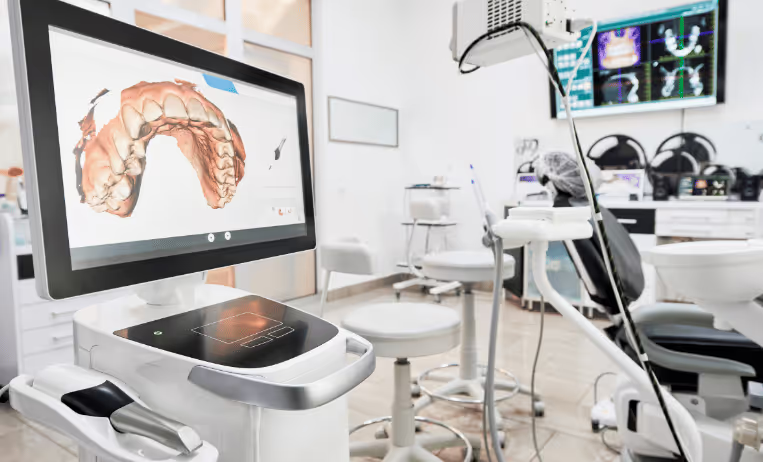
At the top of the same-day tech stack are the bright, shiny CAD/CAM indirect restoration tools such as intraoral scanners, chairside mills, 3D printers, and design software.
With price tags that can range up into the tens of thousands for a high-end scanner or over $100,000 for a top-of-the-line mill, these machines require careful planning before purchase: Where will they be located? What patient demographic will you serve—or hope to serve—with them? What training do they require, and how many restorations do you need to produce per month to break even?
Practices interested in offering same-day CAD/CAM services on a smaller scale should consider 3D printers. Today’s printers can produce everything from nightguards to permanent crowns within just a couple hours, and they cost less than $15,000.
For those with plans to provide same-day endodontic or implant services, a mill may be on your wish list. As with any major purchase, consulting your CAD/CAM representative is a great place to start exploring these options.
If you don’t already have an intraoral scanner, you’ll need one to start producing items in-house. But they can also be used to provide data to traditional labs, and they make patients much happier—no more impression goop.
Turning gaps into opportunities
Same-day dentistry tech can be as complex as you want or need it to be. Ultimately, however, successful same-day services are founded on the same principles as any other kind of dentistry: smooth scheduling, excellent diagnostics, insurance verification, and patient acceptance.
As Nesbitt puts it, “You can start by looking at the current state of your practice. What technology is available, and then where are the gaps?”
Careful planning takes time, and the investment is significant, but chances are if you build it, they will come: 71% of patients told Accenture that access to care is the number one reason they choose a healthcare provider.

About the author
Sheela Roth is a veteran dental practice management expert, thought leader and public speaker. As Head of Clinical Education for the dental AI company Pearl, Ms. Roth is responsible for developing and delivering strategic training programs that educate dental offices, staff and partners on AI and its successful application in dentistry. Previously, Ms. Roth founded and led the practice management consultancy Absolute Dental Business Solutions. She earned her BS and RDH from Loma Linda University..